Sponsored

Any suggested mods to reduce wandering and “constant correction” on stock ’25 Rubicon?

GuzziMoto

Well-Known Member
Joined
Jan 28, 2026
Threads
0
Messages
115
Reaction score
127
Location
Skinny part of MD
Vehicle(s)
2023 Jeep Gladiator EcoDiesel
If your threshold for TPMS hasn't been adjusted, I would expect the warning to persist until all four tires have been inflated to the stock tire pressure or above it.
The TPMS system works as what we in my business call a deadband switch. There are two values, the value that the switch turns on at, what I call the threshold pressure, in this case by memory I think it is 5 or 6 psi below the target pressure, and the target pressure. The warning stays off until one or more pressures drop below the threshold pressure. Once the warning is triggered, the pressure has to go above (even fractionally) above the target pressure to reset the warning, to turn the switch off. So if the target pressure is 37 psi, and the threshold pressure is 32 psi, the warning stays off until the pressure drops below 32 psi. Once it does that, the pressure must be raised not above the threshold pressure of 32 but above the target pressure of 37 to reset the warning.
I the pressure drops down to near, but not below the threshold pressure of 32 and then goes back up, never turning the warning on, it does not need to go above the target pressure of 37.

When you use a tool like Jscan or a Tazer or Procal to adjust the TPMS, it typically adjusts both the target pressure and the threshold pressure as a set, maintaining the 5 or 6 psi gap between them. There might be a way to adjust the two values independently, but the options I have seen adjust them as a set. For example, if I adjust the system to 28 psi for the target pressure the threshold, the point at which the warning will turn on, will be 5 or 6 psi below that.
Sponsored
 
OP
OP
gonemad

gonemad

Well-Known Member
Joined
Jul 24, 2024
Threads
15
Messages
426
Reaction score
735
Location
fringes of RTP
Vehicle(s)
’25 JT Rubicon, '24 FLHP Road King police
Occupation
retired headhunter
If your threshold for TPMS hasn't been adjusted, I would expect the warning to persist until all four tires have been inflated to the stock tire pressure or above it.
The TPMS system works as what we in my business call a deadband switch. There are two values, the value that the switch turns on at, what I call the threshold pressure, in this case by memory I think it is 5 or 6 psi below the target pressure, and the target pressure. The warning stays off until one or more pressures drop below the threshold pressure. Once the warning is triggered, the pressure has to go above (even fractionally) above the target pressure to reset the warning, to turn the switch off. So if the target pressure is 37 psi, and the threshold pressure is 32 psi, the warning stays off until the pressure drops below 32 psi. Once it does that, the pressure must be raised not above the threshold pressure of 32 but above the target pressure of 37 to reset the warning.
I the pressure drops down to near, but not below the threshold pressure of 32 and then goes back up, never turning the warning on, it does not need to go above the target pressure of 37.

When you use a tool like Jscan or a Tazer or Procal to adjust the TPMS, it typically adjusts both the target pressure and the threshold pressure as a set, maintaining the 5 or 6 psi gap between them. There might be a way to adjust the two values independently, but the options I have seen adjust them as a set. For example, if I adjust the system to 28 psi for the target pressure the threshold, the point at which the warning will turn on, will be 5 or 6 psi below that.
I downloaded the owner’s manual from the Jeep app. They include a very abbreviated one in the glove box but it doesn’t cover TPMS, but they do discuss essentially what you just described, in the full manual, although you did a better job. I blew them all up past 37 (on the door jam plate, and what the info screen said was required), which reset the warning, and then aired them down a smidge. All good now. When I get past this wildly fluctuating North Carolina March weather, I’ll air them down a smidge more.
 
Last edited:

JT1

Well-Known Member
Joined
Nov 13, 2020
Threads
7
Messages
747
Reaction score
723
Location
Oklahoma
Vehicle(s)
2021 Gladiator Willys
I installed the Bilstein steering stabilizer. The short report is it seems to have no noticeable impact on drive-ability on pavement. Maybe if the front end had a lot of miles on it, and/or wear/tear, maybe it would have, but not on this ’25 JT Rubicon with 7,000 miles.

It is a stout gas charge in that thing, but it didn’t seem to push the steering left (or right) as far as I could tell.

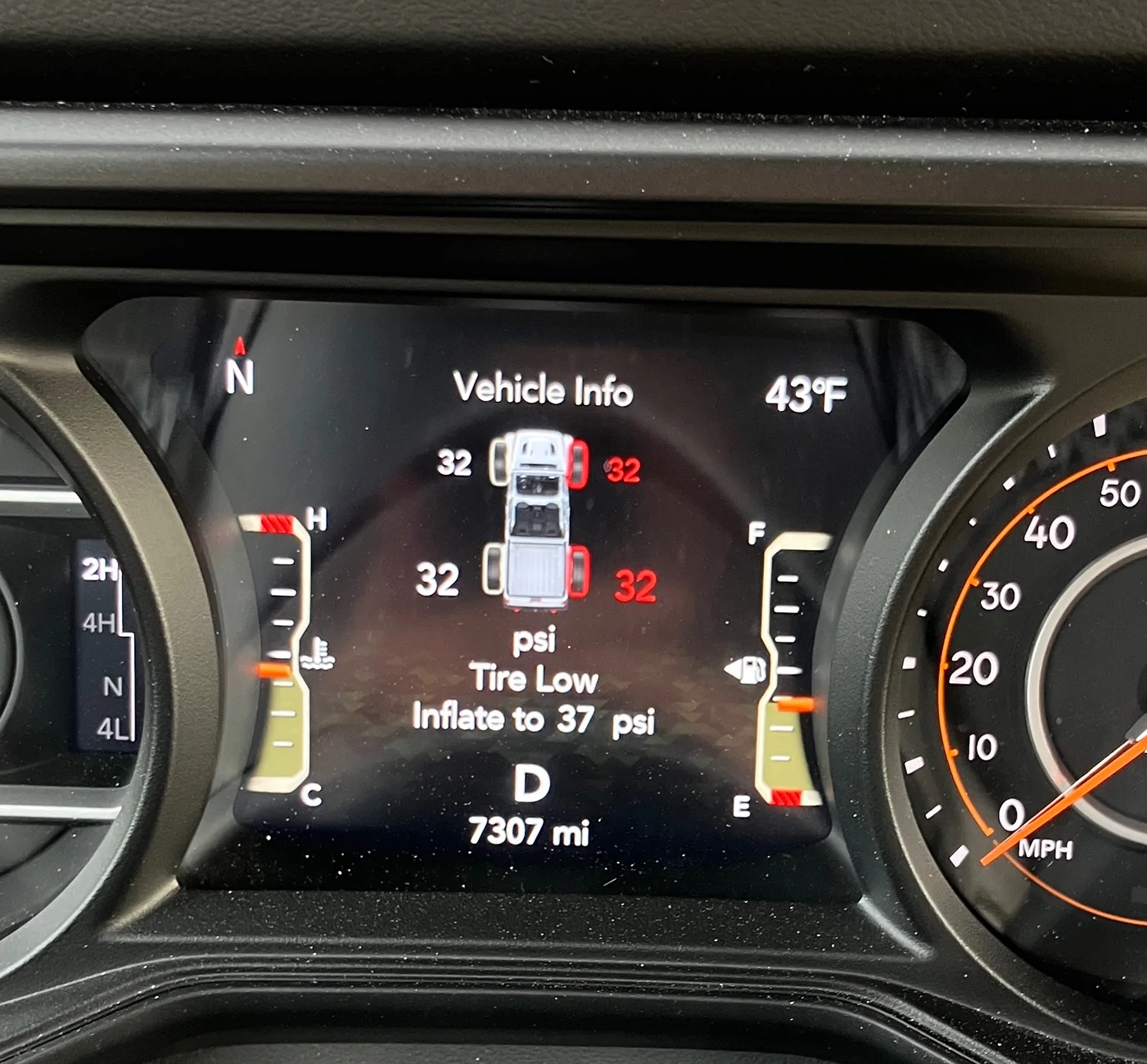
It was 85 degrees yesterday when I adjusted my tire pressures down further than I already had, to around 33lbs “cold”. It was 42 degrees this morning so they were all at 29lbs and I got the TPMS warning. Interestingly it only lit up the tires on the right side of the info screen. Maybe that’s normal? They were at the same pressure as the tires on the left.

I ignored it all knowing the day will warm them up, as will rolling friction in the 30 mile round trip I needed to make to the dump, and I wanted to see how the TPMS warning would behave.

I got up to 32lbs all around just driving and the warning remained. I’ll keep an eye on it today to see at what pressures the warning turns off.

IMG_5533.webp
The lights will go off when you go above 36psi.

That never settled/constant adjustment with the steering is probably a sign of low caster. The Mopar part numbers you referenced are exactly a 1/4" longer than the stock ones, and they look factory and have factory attachment points for brake lines and wheel speed sensors.
 
OP
OP
gonemad

gonemad

Well-Known Member
Joined
Jul 24, 2024
Threads
15
Messages
426
Reaction score
735
Location
fringes of RTP
Vehicle(s)
’25 JT Rubicon, '24 FLHP Road King police
Occupation
retired headhunter
The lights will go off when you go above 36psi.

That never settled/constant adjustment with the steering is probably a sign of low caster. The Mopar part numbers you referenced are exactly a 1/4" longer than the stock ones, and they look factory and have factory attachment points for brake lines and wheel speed sensors.
Thanks for the confirmation on the LCA part #.
Just ordered.
 
  • Like
Reactions: JT1
OP
OP
gonemad

gonemad

Well-Known Member
Joined
Jul 24, 2024
Threads
15
Messages
426
Reaction score
735
Location
fringes of RTP
Vehicle(s)
’25 JT Rubicon, '24 FLHP Road King police
Occupation
retired headhunter
I just installed, or rather, had a retired wrench in my neighborhood install, the longer (1/4”) Mopar lower control arms on the JT. Assuming that the alignment was in spec when they were installed, is there any compelling reason to change anything? The Jeep drives straight, but I haven’t had enough drive time to really assess the impact on improving the previous "constant correction” characteristic that solid front axles tend to have on the road. I’m planning a 450 mile round trip later this week.

Just as background, free play in the steering wheel was no more than an inch, Bilstein steering damper has been added, Bilstein 5100 shocks, and the Jeep has 7000 miles on it. Running stock lift, wheels, and tires.
 

Sponsored

Zachanadandy

Well-Known Member
First Name
Zach
Joined
Oct 17, 2023
Threads
4
Messages
3,044
Reaction score
4,836
Location
Patterson, ca
Vehicle(s)
2023 gladiator Mojave
Occupation
Electrical foreman
I just installed, or rather, had a retired wrench in my neighborhood install, the longer (1/4”) Mopar lower control arms on the JT. Assuming that the alignment was in spec when they were installed, is there any compelling reason to change anything? The Jeep drives straight, but I haven’t had enough drive time to really assess the impact on improving the previous "constant correction” characteristic that solid front axles tend to have on the road. I’m planning a 450 mile round trip later this week.

Just as background, free play in the steering wheel was no more than an inch, Bilstein steering damper has been added, Bilstein 5100 shocks, and the Jeep has 7000 miles on it. Running stock lift, wheels, and tires.
Due to the wide variance in ride heights between all the JT and JL models and the fact that they all use the same control arms, the range that Jeep says is within spec is too large. I believe as low as 4⁰ of caster is still "within spec". Virtually everyone who's messed with their caster agrees that they drive better with 5.5-6⁰. Even though it was likely still within the factory spec, your longer LCAs added caster which will likely track better.
 

VA6489

Well-Known Member
First Name
Rob
Joined
Nov 2, 2017
Threads
9
Messages
309
Reaction score
370
Location
Dahlgren Va
Vehicle(s)
Mercedes E250 Bluetec
Build Thread
Link
Occupation
DoD
First, let me say I am not unhappy with the current handling, and fully understand the on-road handling characteristics of solid front axle vehicles. That said, if I’m not fiddling with my Jeep, or my bike, I get bored. Really bored.

This truck has 7,000 miles, and spends WAY more time on pavement than off. I did a search here, but it seems that most mods discussed are for lifted JT’s. I don’t plan a lift, but I do have a possible hemi swap planned in two years when close to the end of the 3/36 warranty. Rubitrux will need to make a few mods to handle the extra weight on the front end. Other than that, I’m just doing piecemeal improvements.

Running stock 285 70 17 Wild Peak AT3W's.

Suggestions? Would a better steering damper/stabilizer make any noticeable difference? Thanks in advance.

@gonemad
Some thoughts and ideas:

OEM stuff is built as cheap as possible to keep unit costs down.

Stuff I have found short of the mark:
- Ball Joints UHMMW wear material deforms after 5000+ miles, Upgrade to Dynatrac or similar aftermarket
- Rod Ends ( Tie rod Drag Link) same issue with internal wear material. Lots of upgraded options available
- Tie rod and track bar are tubular and as such tend to flex under load couple this to a worn out or wear out ball joint and rod ends things tend to get very loose. Suggest investigating 7075 aluminum tie rod/drag links in the aftermarket.
- Track bars (F&R) also tend to flex under load. Forged options are available in the aftermarket
- Frame side track bar mount flexes under load few options for braces in the aftermarket
- Steering box OEM tend to have a dead spot in the center. The dead spot wears with time. Few options are available PSC leads the list.
- Control arm bushings tend to be rather weak and allow for movement under load. upgrading the bushings or the control arms to a better joint helps.
- If you have the electronic sway bar the unit tends to build play in the connection reducing the effectiveness.
- Caster angle , a word, add more 6-7 degrees is an optimal setting and will help with straight line tracking
- Alignment 1/16-1/8 toe in.

Looking at all that is going on in the suspension OEM rigs tend wander due to play in all the various components. Add to that Big HP (read Hemi) and the suspension will wear you out.

I have gone thru this list on the past couple Jeeps I have had and the change is dramatic. The Gladiator is a heavy rig and the light weight components do flex quite a bit is Stock Form.

Good luck with your tinkering. Hope this helps.
 
OP
OP
gonemad

gonemad

Well-Known Member
Joined
Jul 24, 2024
Threads
15
Messages
426
Reaction score
735
Location
fringes of RTP
Vehicle(s)
’25 JT Rubicon, '24 FLHP Road King police
Occupation
retired headhunter
I just put the stock steering stabilizer back on. That gas charged Bilstein made for heavy steering during turns on pavement at typical on-road speeds.
 

JTGuy

Well-Known Member
First Name
Pascual
Joined
Jul 23, 2023
Threads
57
Messages
1,756
Reaction score
1,685
Location
San Dimas CA
Vehicle(s)
20022 Jeep Gladiator
Occupation
Manager
I have the Fox ATS with resevior. Love it.
 

VA6489

Well-Known Member
First Name
Rob
Joined
Nov 2, 2017
Threads
9
Messages
309
Reaction score
370
Location
Dahlgren Va
Vehicle(s)
Mercedes E250 Bluetec
Build Thread
Link
Occupation
DoD
@gonemad
Steering stabilizers I am not a big fan of if the rig wanders. they just mask a bigger problem.

Forgend Track bars and Up graded steering gear will yield you the biggest results.
 

Sponsored

Stinggrey 21 Rubi

Well-Known Member
First Name
Brian
Joined
Sep 29, 2022
Threads
6
Messages
60
Reaction score
71
Location
Usa
Vehicle(s)
21 JT, 1998 ram 12 valve
Occupation
Bum
Verify torque on on all threaded steering components that touch the crappy aluminum knuckles. Then recheck every other oil change
 

Gizmo

Well-Known Member
First Name
Gary
Joined
Jun 23, 2023
Threads
4
Messages
566
Reaction score
509
Location
West Creek NJ
Vehicle(s)
22 Hydro Blue Sport S MT.
Occupation
Retired Operating Engineer Local 825
Better aftermarket lower control arms ,1 for the adjustability, 2 for the better bushings. Soft OE bushings does nothing to help the amount of steering correction needed whether you notice it now or not its there. Next get rid of OE track bar same reason soft bushings. That two components that help in the steering dept. OE steering stabilizer is fine for those tires. I ran stock with 37 KO2’s. Little things all add up
Sponsored


Top