
Sponsored

Are we in denial about the factory oil viscosity and grade specifications?

Dougstdig

Well-Known Member
First Name
Doug
Joined
Sep 5, 2017
Threads
26
Messages
1,603
Reaction score
1,560
Location
FL
Vehicle(s)
‘21 JTRD - '08 Dodge Ram 2500 4x4
Explain CAFE plz.

I know of one long time friend in the heavy maintenance industry that run diesel grade oils in his gas engines because the additive packages are better. He swears by it and has run like this for years. He doesnt drive 3.6 and has been operating Toyota for over 400k km on his wheels.

In fact, he also flushes out the coolant immediately when purchasing new and installs CUMMINS diesel coolant because it’s also better. His gas engines run amazing
So you can understand me being uncomfortable running the MS12991 certified oil required in the 3.0L Diesel motor. Nowhere on the jug does it say anything about for Diesel Motors...yet here we are. Every time I get it changed it feels like I'm putting gasoline in it...LOL
Sponsored


DanW

Well-Known Member
First Name
Dan
Joined
Mar 2, 2017
Threads
45
Messages
1,884
Reaction score
2,472
Location
Brownsburg, Indiana
Vehicle(s)
21 JT Rubi, 18 JLU Rubi, 2008 JKU Rubi, 07 Vette
I wouldn't. You are clearly not an edge case for your particular engine's follower/arm issues either, and you keep up with your maintenance. The VVL issue is more curious though and more closely similar to the higher pressure flat-tappet cam failures. If a better formulated oil, even if a bit heavier, doesn't hurt operation, doesn't cost any more, and is more resistant to poor maintenance discipline, why not not talk openly about it and give folks an opportunity to make their own decisions? What if it would reduce the edge case failures further?

The warranty concern is mostly a red herring. Unless its 90w, the dealership tech has no idea and doesn't care what he drains from the crankcase. If you are worried, spill and fill it with 20w. Not a show stopper.


It proves the VVTL oil control systems operate without blatant malfunction on 40 weight, which is a good first step.


This is good to hear.
I am not worrying. I was being sarcastic. I should've typed in purple. That engine was compression checked at about 160k miles and it was as good as a new one. 20 weight oil has worked very well in it.
 
OP
OP

TheRealStreetcommander

Well-Known Member
Joined
Apr 13, 2023
Threads
4
Messages
211
Reaction score
383
Location
East Coast
Vehicle(s)
Gladiator
Occupation
None of your business.
I'll do that. Thanks.
Check the forum posts, basically all the tear downs of eaten cams had exhaust on intake in one of the banks.
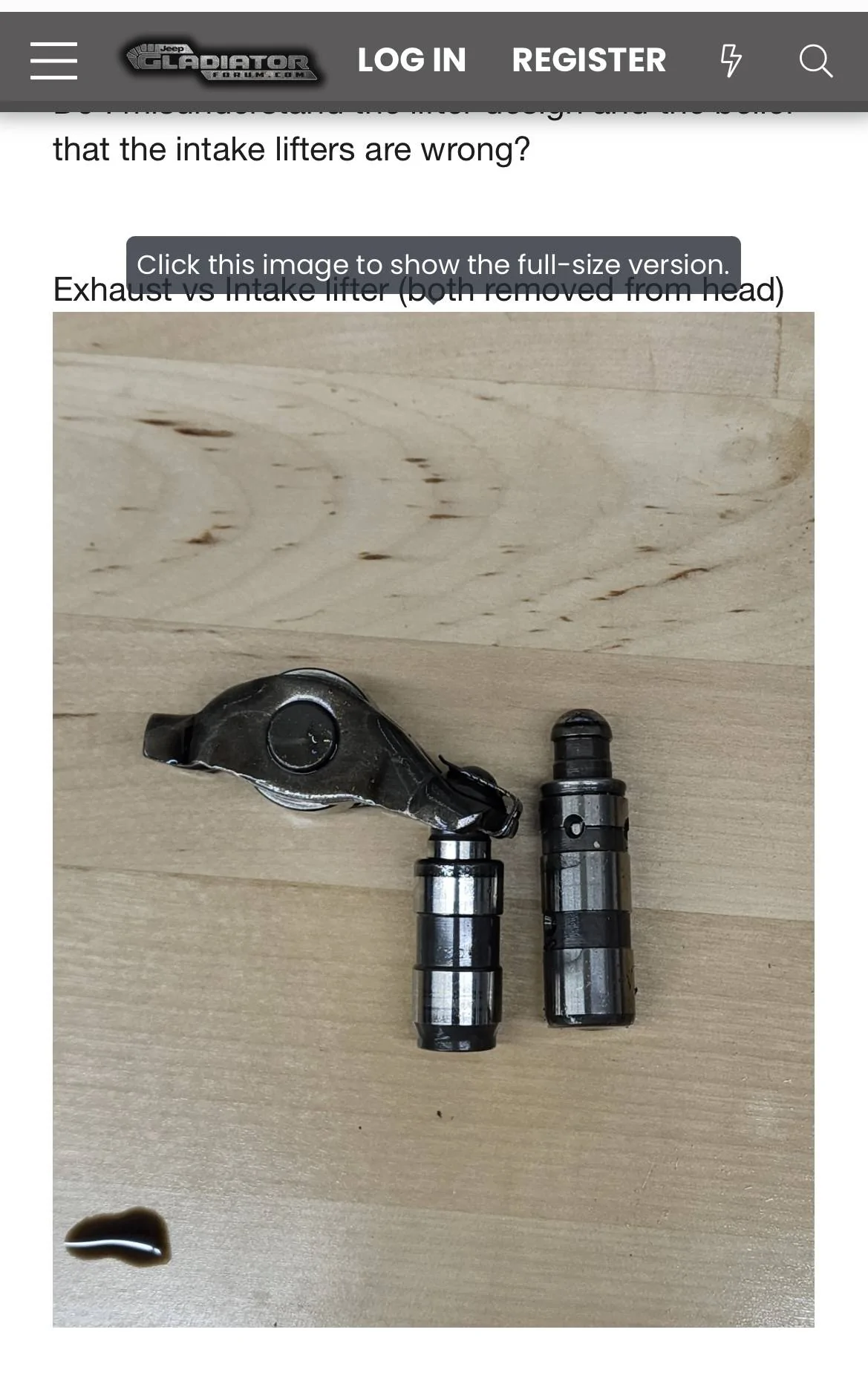
I found this in a different thread here. Courtesy of DC3. This idea that the I&E lifters can be mixed up really needs to be evaluated a bit deeper. This photo seems to indicate that it may not be possible to assemble the valvetrain with the lifters mixed up. The lifters are wildly different heights. This may have been intentional during design.

This topic really deserves it's own thread.
Jeep Gladiator Are we in denial about the factory oil viscosity and grade specifications? IMG_7374
 

bleda2002

Well-Known Member
Joined
May 11, 2021
Threads
24
Messages
2,759
Reaction score
4,500
Location
34655
Vehicle(s)
2021 JTR Firecracker Red
I found this in a different thread here. Courtesy of DC3. This idea that the I&E lifters can be mixed up really needs to be evaluated a bit deeper. This photo seems to indicate that it may not be possible to assemble the valvetrain with the lifters mixed up. The lifters are wildly different heights. This may have been intentional during design.

This topic really deserves it's own thread.
IMG_7374.webp
There are multiple threads proving that it was a line mistake, check Dave's thread on it for the most info.

It also seems isolated to 2020 model years and gladiators, there if pretty much none of this on the JL forums, at least not in any sufficient quantity to suggest there is any kind of design issue.

Here is the thread for it https://www.jeepgladiatorforum.com/...-the-bad-of-a-roots-supercharger.54832/page-4
 
Last edited:

Maximus Gladius

Well-Known Member
First Name
Kevin
Joined
Jan 30, 2021
Threads
75
Messages
2,919
Reaction score
3,731
Location
Calgary, AB, Canada
Vehicle(s)
2021 JTR, 2023 JTR
I'd like to share my simple science findings on viscosity based on hard data. My personal feelings and opinions aside, I have hard data from oil analyses reports (many of them done from my two 3.6L engines) that show viscosity drops pretty much as soon as an oil change is done. I've seen the viscosity drop to darn near 1 FULL POINT at 1500 kms (932 miles) and pretty much stay there for the oil change duration.

So 0/20 weight is spec'd so let's look at their viscosities. In my two engines on this 21 JTR, I've used 3 different 0/20 oils. (Viscosities attached)
- AMSOIL Sig Series 0/20 - 8.84 @100c
-Pennzoil Ultra 0/20 - 8.35 @100c
-Quaker State Full Syn 0/20 - 8.62 @100c

A little disclaimer here, I never did well in math and wouldn't dare be embarrassed to dare take Physics in High School so I invite the ones that have an easier comprehension of these to question what I've done and maybe consider my thought angle and what I've done.

FIRST ENGINE 0 - 32k kms. 2021 JTR
Engine's flaws - consumed coolant from day one until replaced @32k kms. It also misfired a couple times at 16k kms. NORM, who identifies as an FCA engineer didn't care my engine consumed coolant only signed off on replacing the camshaft.

That engine had AMSOIL sig series 0/20 except the first fill from the factory. Can only assume it was Pennzoil but can't prove it but let's assume it was. First oil change was done @1000k kms. Viscosity dropped from 8.35 to 7.6, shy of one full point.

I then changed out with AMSOIL Sig Series 0/20 and changed my oils 6 times in 32k kms.
FRESH VISCOSITY AMSOIL - 8.84
2nd - 8.88
3rd - 8.73
4th - 9.0
5th - 8.86
6th - 8.9. Explanation was given by the lab to say 'an internal coolant leak noticeable in the oil will thicken viscosity'.

*A lot of you know at this point I was entangled in a big fight with FCA and AMSOIL over my transmission that blew up at 32k kms so after getting my second engine and transmission replaced by my insurance company, I swore I'd never use AMSOIL again and chose to go with Quaker State 0/20 for the engine.*

SECOND ENGINE REPLACED @39K, I'm now at 59k kms
Flaws - NONE, runs super quiet.
First fill of engine (assuming it is Pennzoil ULTRA 0/20) was over filled to 12L of oil and ran for 1567k kms to BC and back, summiting a few mountains there and back and oil change was done when I got back to discover the over fill !! I blew a personal gasket and dealership took off all the intake stuff and cleaned out the oil mess.

I have done 7 oil changes in 20k kms with QS 0/20 to see if the analysis reports show any sign of internal damage. NONE SO FAR. Numbers look fantastic, maybe IRON is a little high for my liking @ 80ish in 7000k kms.

Viscosity drops in the first oil change from 8.35 (fresh Pennzoil) to 7.75 and this is where I then thought about "maybe keeping the viscosity equal or near to the original fresh bottle sample might be a good thing." So for the next 5 oil changes, I put in 4L 0/20 and 1L 5/30 and the viscosity actually only dropped from 8.62 to 8.14 to 8.23 !!

The 5th oil change I put in 3L 0/20 and 2L 5/30 and the viscosity went from 8.62 to 8.66 !! My theory worked. So I have a question now about how this engine is engineered (by actual engineers and not by those identifying as such) if the engineers develop the tolerances to be best handled by a viscosity of, say 8, and the viscosity is known to drop a full point and be "ok", can we not run a 5/30 (maybe experience a quieter engine to boot) and the viscosity be in the upper 8 or maybe low 9's ??
 

Sponsored

sharpsicle

Well-Known Member
Joined
Apr 29, 2021
Threads
22
Messages
2,776
Reaction score
6,272
Location
Tampa, FL / Milwaukee, WI
Vehicle(s)
2020 Gladiator Overland, 2002 VTX1800
I'd like to share my simple science findings on viscosity based on hard data. My personal feelings and opinions aside, I have hard data from oil analyses reports (many of them done from my two 3.6L engines) that show viscosity drops pretty much as soon as an oil change is done. I've seen the viscosity drop to darn near 1 FULL POINT at 1500 kms (932 miles) and pretty much stay there for the oil change duration.

So 0/20 weight is spec'd so let's look at their viscosities. In my two engines on this 21 JTR, I've used 3 different 0/20 oils. (Viscosities attached)
- AMSOIL Sig Series 0/20 - 8.84 @100c
-Pennzoil Ultra 0/20 - 8.35 @100c
-Quaker State Full Syn 0/20 - 8.62 @100c

A little disclaimer here, I never did well in math and wouldn't dare be embarrassed to dare take Physics in High School so I invite the ones that have an easier comprehension of these to question what I've done and maybe consider my thought angle and what I've done.

FIRST ENGINE 0 - 32k kms. 2021 JTR
Engine's flaws - consumed coolant from day one until replaced @32k kms. It also misfired a couple times at 16k kms. NORM, who identifies as an FCA engineer didn't care my engine consumed coolant only signed off on replacing the camshaft.

That engine had AMSOIL sig series 0/20 except the first fill from the factory. Can only assume it was Pennzoil but can't prove it but let's assume it was. First oil change was done @1000k kms. Viscosity dropped from 8.35 to 7.6, shy of one full point.

I then changed out with AMSOIL Sig Series 0/20 and changed my oils 6 times in 32k kms.
FRESH VISCOSITY AMSOIL - 8.84
2nd - 8.88
3rd - 8.73
4th - 9.0
5th - 8.86
6th - 8.9. Explanation was given by the lab to say 'an internal coolant leak noticeable in the oil will thicken viscosity'.

*A lot of you know at this point I was entangled in a big fight with FCA and AMSOIL over my transmission that blew up at 32k kms so after getting my second engine and transmission replaced by my insurance company, I swore I'd never use AMSOIL again and chose to go with Quaker State 0/20 for the engine.*

SECOND ENGINE REPLACED @39K, I'm now at 59k kms
Flaws - NONE, runs super quiet.
First fill of engine (assuming it is Pennzoil ULTRA 0/20) was over filled to 12L of oil and ran for 1567k kms to BC and back, summiting a few mountains there and back and oil change was done when I got back to discover the over fill !! I blew a personal gasket and dealership took off all the intake stuff and cleaned out the oil mess.

I have done 7 oil changes in 20k kms with QS 0/20 to see if the analysis reports show any sign of internal damage. NONE SO FAR. Numbers look fantastic, maybe IRON is a little high for my liking @ 80ish in 7000k kms.

Viscosity drops in the first oil change from 8.35 (fresh Pennzoil) to 7.75 and this is where I then thought about "maybe keeping the viscosity equal or near to the original fresh bottle sample might be a good thing." So for the next 5 oil changes, I put in 4L 0/20 and 1L 5/30 and the viscosity actually only dropped from 8.62 to 8.14 to 8.23 !!

The 5th oil change I put in 3L 0/20 and 2L 5/30 and the viscosity went from 8.62 to 8.66 !! My theory worked. So I have a question now about how this engine is engineered (by actual engineers and not by those identifying as such) if the engineers develop the tolerances to be best handled by a viscosity of, say 8, and the viscosity is known to drop a full point and be "ok", can we not run a 5/30 (maybe experience a quieter engine to boot) and the viscosity be in the upper 8 or maybe low 9's ??
If I missed it I apologize, but what's the baseline viscosity requirement that's driving you to make this change? It's entirely possible that it wants to be below, not above, the mark you've set. Who's to say the range isn't supposed to be 7.5-8.5? Sounds like that might be entirely plausible. And with numbers showing a change of not even 3/4 of a point (0.6 by your most recent measurements), that range becomes even more possible. I'm not saying I know or don't know, more showing that the target might be something completely different than you've set it to be. Without understanding that, I don't think any of us know what we're actually doing.

If your goal is to increase that viscosity number, then you're of course going to achieve it by mixing in thicker oils. But what's to say that's the appropriate goal? All indications are that what 0w20 provides is the right goal as set forth by the specifications. I've followed your story along all your issues and even given advice over that time. After all you've been through I'm surprised you're messing around with changing viscosity measurements on your own, especially when you appear to be targeting the measurements that were originally indicative of a problem.
 

Maximus Gladius

Well-Known Member
First Name
Kevin
Joined
Jan 30, 2021
Threads
75
Messages
2,919
Reaction score
3,731
Location
Calgary, AB, Canada
Vehicle(s)
2021 JTR, 2023 JTR
If I missed it I apologize, but what's the baseline viscosity requirement that's driving you to make this change? It's entirely possible that it wants to be below, not above, the mark you've set. Who's to say the range isn't supposed to be 7.5-8.5? Sounds like that might be entirely plausible.

If your goal is to increase that viscosity number, then you're of course going to achieve it by mixing in thicker oils. But what's to say that's the appropriate goal?
No, you didn't miss anything, you expounded on it. I actually hadn't thought about what the numbers end up being but rather what they start out as. Is "best for the engine" viscosity to be what it starts out as or ends up as? I'm not sure that viscosity drops to where "its suppose to be" or ideal, but rather it's just 'cause and effect'.
 

sharpsicle

Well-Known Member
Joined
Apr 29, 2021
Threads
22
Messages
2,776
Reaction score
6,272
Location
Tampa, FL / Milwaukee, WI
Vehicle(s)
2020 Gladiator Overland, 2002 VTX1800
No, you didn't miss anything, you expounded on it. I actually hadn't thought about what the numbers end up being but rather what they start out as. Is "best for the engine" viscosity to be what it starts out as or ends up as? I'm not sure that viscosity drops to where "its suppose to be" or ideal, but rather than it's just 'cause and effect'.
I just wanted to add that I really do appreciate your methods in all you look at. From data collection, analysis, and comparison, you do a great job of really showcasing things. I just think in this case, the goal might not be properly defined or understood by all of us.

Which brings me back to @Hootbro's comments that maybe, just maybe, the engineers that designed the engine might know what they're doing. Clearly they have much more information and have done much more testing and analysis than we have or can ever hope to.
 

@californiajeeping

Well-Known Member
Joined
Apr 1, 2020
Threads
16
Messages
958
Reaction score
1,012
Location
California
Vehicle(s)
2022 Jeep Gladiator diesel, 1977 cj5 LS swapped
Explain CAFE plz.

I know of one long time friend in the heavy maintenance industry that run diesel grade oils in his gas engines because the additive packages are better. He swears by it and has run like this for years. He doesnt drive 3.6 and has been operating Toyota for over 400k km on his wheels.

In fact, he also flushes out the coolant immediately when purchasing new and installs CUMMINS diesel coolant because it’s also better. His gas engines run amazing

I ran 5-40 in mine and still got the ticking. Could have already been damaged tho.
 

Sponsored

OP
OP

TheRealStreetcommander

Well-Known Member
Joined
Apr 13, 2023
Threads
4
Messages
211
Reaction score
383
Location
East Coast
Vehicle(s)
Gladiator
Occupation
None of your business.
There are multiple threads proving that it was a line mistake, check Dave's thread on it for the most info.

It also seems isolated to 2020 model years and gladiators, there if pretty much none of this on the JL forums, at least not in any sufficient quantity to suggest there is any kind of design issue.

Here is the thread for it https://www.jeepgladiatorforum.com/...-the-bad-of-a-roots-supercharger.54832/page-4
Wow. This is uncomfortable, but that entire thread may be based on a fundamental misunderstanding. The subject lifter/lash-adjusters featured in that thread are in fact all intake versions.

The lifter/lash-adjuster being referred to as an "Exhaust lifter", sure just looks like the first edition VVL intake lifter to me. The intake lifter with the larger contact surface with no recess is just and updated version of the VVL intake lifter. The exhaust lifter on both the older 3.6 and newer VVL 3.6 have been updated several times but are essentially the same parts and are interchangeable.

As far as I can tell, the exhaust lifter/LA's in all 3.6's only have a single oil dispersion groove and are much shorter in height than the intake lifter/LA's.

This is supported by the OEM Mopar parts diagrams. Before everyone gets upset, please look at the side by side photo from DC3 of an actual EX and IN lifter taken out of the same VVL engine. Then revisit the parts diagrams. The diagrams I found only show availability of a combo rocker and lifter for the exhaust side of VVL 3.6's, but the diagram clearly shows just a single dispersion ring. --same as the legacy 3.6s. This makes sense, as the second ring in the lifter body is for the VVL pin, and not needed for the exhaust.

Certainly, this mistake hasn't been allowed to persist all these years on this forum. I must be wrong and I'm missing something right? Help me out.
 

@californiajeeping

Well-Known Member
Joined
Apr 1, 2020
Threads
16
Messages
958
Reaction score
1,012
Location
California
Vehicle(s)
2022 Jeep Gladiator diesel, 1977 cj5 LS swapped
It was much easier to get a 5-40. Hot viscosity is so close it didn’t matter. I switched at 24k. It got the occasional misfire around 10k when wide open up a mountain pass. By 40k it had a hot tick at idle. Same as the other 3.6l engines I’ve owned. They all have the same cam issues but now it eats the cams away.

Switched to a diesel gladiator on trade 25k with no issues. Way more power too.

The gripe about th 3.6l is there’s clearly an identified issue. Yet dealers require you to sign a statement saying you’ll pay for teardown. Total bs.
 

DanW

Well-Known Member
First Name
Dan
Joined
Mar 2, 2017
Threads
45
Messages
1,884
Reaction score
2,472
Location
Brownsburg, Indiana
Vehicle(s)
21 JT Rubi, 18 JLU Rubi, 2008 JKU Rubi, 07 Vette
I'd like to share my simple science findings on viscosity based on hard data. My personal feelings and opinions aside, I have hard data from oil analyses reports (many of them done from my two 3.6L engines) that show viscosity drops pretty much as soon as an oil change is done. I've seen the viscosity drop to darn near 1 FULL POINT at 1500 kms (932 miles) and pretty much stay there for the oil change duration.

So 0/20 weight is spec'd so let's look at their viscosities. In my two engines on this 21 JTR, I've used 3 different 0/20 oils. (Viscosities attached)
- AMSOIL Sig Series 0/20 - 8.84 @100c
-Pennzoil Ultra 0/20 - 8.35 @100c
-Quaker State Full Syn 0/20 - 8.62 @100c

A little disclaimer here, I never did well in math and wouldn't dare be embarrassed to dare take Physics in High School so I invite the ones that have an easier comprehension of these to question what I've done and maybe consider my thought angle and what I've done.

FIRST ENGINE 0 - 32k kms. 2021 JTR
Engine's flaws - consumed coolant from day one until replaced @32k kms. It also misfired a couple times at 16k kms. NORM, who identifies as an FCA engineer didn't care my engine consumed coolant only signed off on replacing the camshaft.

That engine had AMSOIL sig series 0/20 except the first fill from the factory. Can only assume it was Pennzoil but can't prove it but let's assume it was. First oil change was done @1000k kms. Viscosity dropped from 8.35 to 7.6, shy of one full point.

I then changed out with AMSOIL Sig Series 0/20 and changed my oils 6 times in 32k kms.
FRESH VISCOSITY AMSOIL - 8.84
2nd - 8.88
3rd - 8.73
4th - 9.0
5th - 8.86
6th - 8.9. Explanation was given by the lab to say 'an internal coolant leak noticeable in the oil will thicken viscosity'.

*A lot of you know at this point I was entangled in a big fight with FCA and AMSOIL over my transmission that blew up at 32k kms so after getting my second engine and transmission replaced by my insurance company, I swore I'd never use AMSOIL again and chose to go with Quaker State 0/20 for the engine.*

SECOND ENGINE REPLACED @39K, I'm now at 59k kms
Flaws - NONE, runs super quiet.
First fill of engine (assuming it is Pennzoil ULTRA 0/20) was over filled to 12L of oil and ran for 1567k kms to BC and back, summiting a few mountains there and back and oil change was done when I got back to discover the over fill !! I blew a personal gasket and dealership took off all the intake stuff and cleaned out the oil mess.

I have done 7 oil changes in 20k kms with QS 0/20 to see if the analysis reports show any sign of internal damage. NONE SO FAR. Numbers look fantastic, maybe IRON is a little high for my liking @ 80ish in 7000k kms.

Viscosity drops in the first oil change from 8.35 (fresh Pennzoil) to 7.75 and this is where I then thought about "maybe keeping the viscosity equal or near to the original fresh bottle sample might be a good thing." So for the next 5 oil changes, I put in 4L 0/20 and 1L 5/30 and the viscosity actually only dropped from 8.62 to 8.14 to 8.23 !!

The 5th oil change I put in 3L 0/20 and 2L 5/30 and the viscosity went from 8.62 to 8.66 !! My theory worked. So I have a question now about how this engine is engineered (by actual engineers and not by those identifying as such) if the engineers develop the tolerances to be best handled by a viscosity of, say 8, and the viscosity is known to drop a full point and be "ok", can we not run a 5/30 (maybe experience a quieter engine to boot) and the viscosity be in the upper 8 or maybe low 9's ??
I would not worry at all about those numbers you've seen. Any good 0w20 is going to perform fine in a Pentastar unless it is abused in some way, and by abused, I mean abused.

Running a 5w30 and seeing the viscosity shear or drop down into 20w territory probably wouldh't hurt a thing, but the drops you've seen still keep it in the 20wt range. So even with the 1 point drop the oil is fine.

I won't do it, but if I recall correctly, Pennzoil Platinum 5w30 used to be on the lower end of the viscosity scale. But I haven't seen their data sheet recently nor have I seen a virgin oil analysis.

But I would say this...I'd take Amsoil 0w20, even if it drops in viscosity, over just about any brand of 5w30 on the market with the exception of maybe Redline or Mobil 1. That Amsoil has a solid group IV base oil, so I think it would shrug off anything life in a Pentastar would throw at it.

Just my 2 cents.
Sponsored


Top