Sponsored

Charging system ?

Glad23

Member
Joined
Aug 27, 2023
Threads
3
Messages
12
Reaction score
6
Location
N.C.
Vehicle(s)
19 Jeep GC, 25 Glad Mojave, 05 Mustang, 41 Ford PU
Our 2023 Jeep Gladiator Mojave (710 miles) shows 13.1 on the off-road pages display.


My Fluke meter measures 12.8 at the battery terminals. While driving the display rarely exceeds 14.0 and that is only for brief periods. The normal reading is 13.0 +/-.


My benchmark is our 2019 Grand Cherokee. It is rock steady at 14.4V and has always been that way. It currently shows 43,xxx miles. I disconnected the ESS battery the day we took delivery of the Cherokee (Nov. 5 2019).


I mentioned this to the dealer and was told it was normal because of a new charging system on the 23 model. I have tried to find a diagram or explanation of this system.


Does anyone know how to get something that shows how this charging system works works ?
Sponsored

 

Moe-Jave

Well-Known Member
Joined
Jun 26, 2023
Threads
10
Messages
125
Reaction score
99
Location
AZ
Vehicle(s)
2023 Jeep Gladiator Mojave; 2022 Ford Bronco BL 2-DR/M
Thanks for this -- I've wondered the same. I initially thought it was because I was running the system hard in the heat and had bigger draws on it with the fan, etc. I've since come to see this as my "normal baseline" as you have.

I also wondered how much this had to do with the smaller battery in parallel. Anyhow, this is a very interesting topic to me as well.
 

ShadowsPapa

Well-Known Member
First Name
Bill
Joined
Oct 12, 2019
Threads
247
Messages
40,440
Reaction score
53,854
Location
Runnells, Iowa
Vehicle(s)
'25 JTMX, '23 JLU 4xe, '82 SX4, '73 Javelin
Occupation
Retired auto mechanic, frmr gov't ntwrk security admin
Vehicle Showcase
3
Our 2023 Jeep Gladiator Mojave (710 miles) shows 13.1 on the off-road pages display.


My Fluke meter measures 12.8 at the battery terminals. While driving the display rarely exceeds 14.0 and that is only for brief periods. The normal reading is 13.0 +/-.


My benchmark is our 2019 Grand Cherokee. It is rock steady at 14.4V and has always been that way. It currently shows 43,xxx miles. I disconnected the ESS battery the day we took delivery of the Cherokee (Nov. 5 2019).


I mentioned this to the dealer and was told it was normal because of a new charging system on the 23 model. I have tried to find a diagram or explanation of this system.


Does anyone know how to get something that shows how this charging system works works ?
Congratulations - you have a normal modern charging system.
If your batteries at rest are 12.8 (the 100% State of Charge or SoC for a typical AGM battery) then they are fully charged. If the system reads over that when running, then the charging system is working fine.
It gathers information via the IBS (intelligent Battery Sensor) on the main battery negative post, such as amp hours out, amp hours in, battery temperature and other data, including tracking historic data and the rest of the system handles how much to work the alternator based on that and load from other components, the need for engine torque and more.
If the batteries are charged and get hot, say it's a 95 degree day, 2 hours into a drive, it may actually cut the alternator off and you'd see 12.6 volts for example.
I notice mine change with whether or not i'm loading the engine going up a hill, or coasting down a hill.
Ambient temperatures matter, too, because a cold battery is harder to charge - I see mine hang around 15.0 volts when it's pretty cold out. It only drops below that when it warms up.
Also, the last 10-20% of the battery charge is the hardest to do so you may see elevated voltages.
In short, depending on a dozen conditions or more, you may see 12.5 to 15.0 volts.

I note that my 2022 runs higher voltages in the deep of winter than my 2020 did...... maybe they tweaked things?

BTW - that model year - "new because it's a 2023" is bunk. This is the same system they've used for years. They do tweak the settings and make certain changes to the programming as more information is gathered over time, but it's been this way and isn't new at all. In fact, our 2021 Grand Cherokee had the same type of system and I'm not so sure the 2018 didn't as well. It goes back a long ways.
You can't possibly compare your other Jeep to this one because battery capacity and age will play into it as well, as well as loads from the vehicle's electronics in general.

You don't find a detailed diagram of the system because it's frankly a simple system like used in the 1970s MOPARS, even in the 1990s Jeeps. The only difference is the IBS and the smarts in the PCM and BCM controlling things. Electrically, as far as a schematic, it's the same type alternator with the same A circuit field control as used by GM and Chrysler for decades. Full power to the brushes, power through the field is controlled by varying the ground.


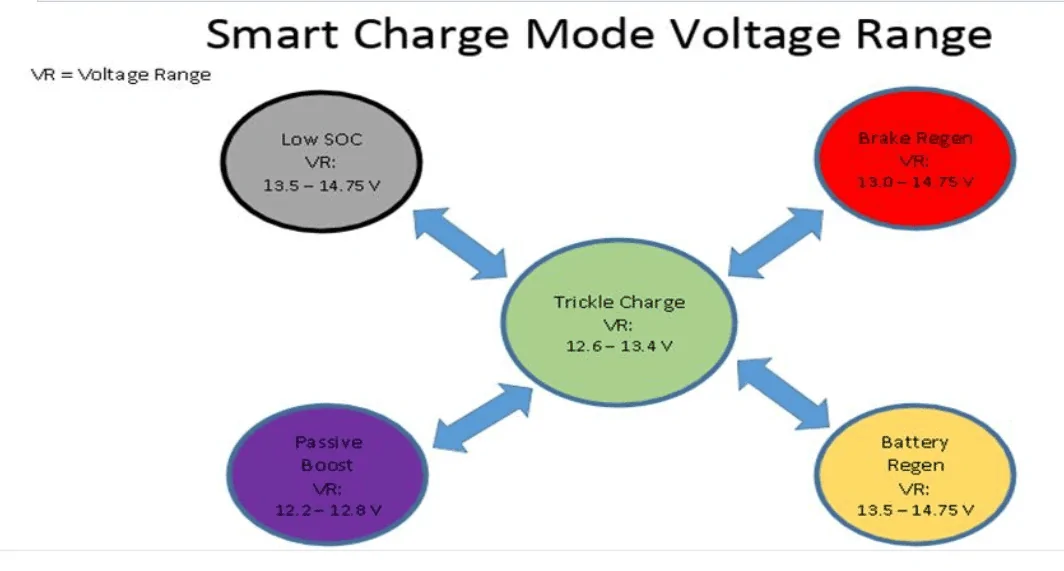
Jeep Gladiator Charging system ? 1696444978535

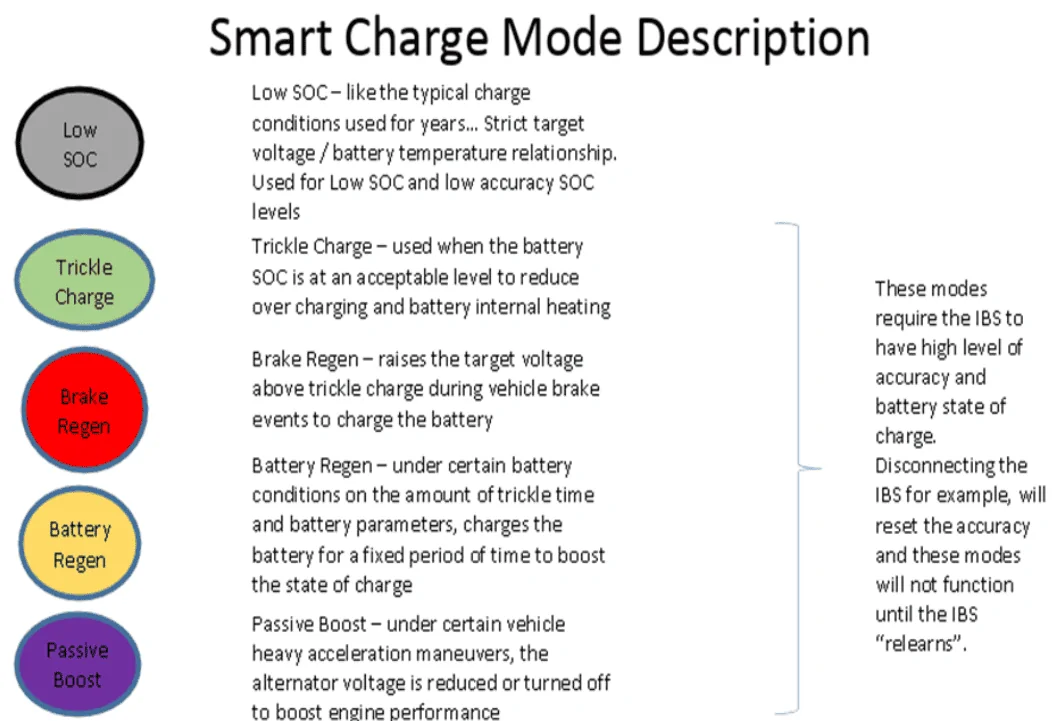
Jeep Gladiator Charging system ? 1696445014435


And yes, that red field is for our JTs. It means that when you are braking it's assumed you need no engine torque so the voltage may rise.
Brake regen does apply to us - it simply means extra power from the alternator during braking to regenerate/recharge the battery, not that it comes from the brakes.
The ABS controller can sense the brake pedal pressure since the brake pedal "switch" isn't a switch but a variable resistor.
 

ShadowsPapa

Well-Known Member
First Name
Bill
Joined
Oct 12, 2019
Threads
247
Messages
40,440
Reaction score
53,854
Location
Runnells, Iowa
Vehicle(s)
'25 JTMX, '23 JLU 4xe, '82 SX4, '73 Javelin
Occupation
Retired auto mechanic, frmr gov't ntwrk security admin
Vehicle Showcase
3
Thanks for this -- I've wondered the same. I initially thought it was because I was running the system hard in the heat and had bigger draws on it with the fan, etc. I've since come to see this as my "normal baseline" as you have.

I also wondered how much this had to do with the smaller battery in parallel. Anyhow, this is a very interesting topic to me as well.
Zero to do with the axillary battery or ESS or anything other than what I describe below.
The alternator's primary function is to provide power to a vehicle's electric systems, lights and so on.
The other duty is to regen or recharge the battery or batteries in the vehicle.

So control has to be configured to accomplish both, and not cause problems for either.
You don't run anything from the battery while the engine is running and/or you are driving. The battery's duties are now over once it starts. It's not there for anything else - other than a buffer should you have momentary loads higher than the alternator/charging system can handle. (well, mostly done - it's required to have the battery there as a load for the alternator otherwise bad things can happen - like when dopes pull cables off of running vehicle batteries)
 

Sponsored

Moe-Jave

Well-Known Member
Joined
Jun 26, 2023
Threads
10
Messages
125
Reaction score
99
Location
AZ
Vehicle(s)
2023 Jeep Gladiator Mojave; 2022 Ford Bronco BL 2-DR/M
This is good stuff and makes sense. I did not realize our JTs have AGM batteries from the factory (both main and aux, I'm now assuming).
 

ShadowsPapa

Well-Known Member
First Name
Bill
Joined
Oct 12, 2019
Threads
247
Messages
40,440
Reaction score
53,854
Location
Runnells, Iowa
Vehicle(s)
'25 JTMX, '23 JLU 4xe, '82 SX4, '73 Javelin
Occupation
Retired auto mechanic, frmr gov't ntwrk security admin
Vehicle Showcase
3
This is good stuff and makes sense. I did not realize our JTs have AGM batteries from the factory (both main and aux, I'm now assuming).
Yes.
 

ShadowsPapa

Well-Known Member
First Name
Bill
Joined
Oct 12, 2019
Threads
247
Messages
40,440
Reaction score
53,854
Location
Runnells, Iowa
Vehicle(s)
'25 JTMX, '23 JLU 4xe, '82 SX4, '73 Javelin
Occupation
Retired auto mechanic, frmr gov't ntwrk security admin
Vehicle Showcase
3
The biggest problem with the Jeep electrical system is the quality of the batteries installed at the factory.
And that goes across the whole line - Compass, Wrangler, Gladiator, Grand Cherokee, even Wrangler and Grand Cherokee 4xe versions.
 

Moe-Jave

Well-Known Member
Joined
Jun 26, 2023
Threads
10
Messages
125
Reaction score
99
Location
AZ
Vehicle(s)
2023 Jeep Gladiator Mojave; 2022 Ford Bronco BL 2-DR/M
Yes, bad batteries plague many makers/industries. Car batteries are really only made by a small handful of major corporations now -- none are actually made by Jeep (Johnson Controls or East Penn likely). Cost at scale drives some of this. There are plenty of examples of huge bad batches in recent history. It is not just the battery, however...

Consider that modern cars with parasitic draw is a real issue too. I can think of several cars from BMW and even Honda that suffer from premature failures as a result -- and specific models get a reputation in the same way we are talking here. The worst in recent memory is easily the new Range Rover Defender. It isn't just "us" in this case. "Creeping Featurism" is to blame when systems get added through multiple committees in production without a better holistic overview of electrical load/issues. They know this, of course. This is why we get imperfect solutions with tweaks along the way...
 

Sponsored

OP
OP
Glad23

Glad23

Member
Joined
Aug 27, 2023
Threads
3
Messages
12
Reaction score
6
Location
N.C.
Vehicle(s)
19 Jeep GC, 25 Glad Mojave, 05 Mustang, 41 Ford PU
:(
Thanks for the explanation ShadowsPapa
I miss the days of a generator and external voltage regulator
 

Outback_Joe

Well-Known Member
First Name
Joe
Joined
Feb 17, 2023
Threads
5
Messages
185
Reaction score
163
Location
Oregon Outback
Vehicle(s)
2022 Jeep Gladiator
Occupation
Retired Civil Engineer
Its not just Jeep that has had problems with the factory batteries. I have had two go bye-bye in a 2017 Ford Explorer and 2019 F-35O. That's four batteries that Ford had to buy under warrantee. Maybe they get a great deal on batteries but it would have been far cheaper to install good batteries and be done with it. Just Say-N!

Crossing my fingers with my 22 JT.
 

ShadowsPapa

Well-Known Member
First Name
Bill
Joined
Oct 12, 2019
Threads
247
Messages
40,440
Reaction score
53,854
Location
Runnells, Iowa
Vehicle(s)
'25 JTMX, '23 JLU 4xe, '82 SX4, '73 Javelin
Occupation
Retired auto mechanic, frmr gov't ntwrk security admin
Vehicle Showcase
3
Its not just Jeep that has had problems with the factory batteries. I have had two go bye-bye in a 2017 Ford Explorer and 2019 F-35O. That's four batteries that Ford had to buy under warrantee. Maybe they get a great deal on batteries but it would have been far cheaper to install good batteries and be done with it. Just Say-N!

Crossing my fingers with my 22 JT.
My son had a Ford Fusion before the Compass - battery was his only problem.
Compass - battery and radio unit were his only problems.
Talked to customers in a NAPA store while I was replacing a 4 year old battery from my 82 SX4 - they were complaining about (drum roll, Ringo...........) battery life in cars in general in the past few years.
 

Kitfoxbill

Active Member
First Name
William
Joined
Aug 24, 2019
Threads
5
Messages
34
Reaction score
36
Location
Austin, TX
Vehicle(s)
1990 Suburban
I just replaced my batterys after 4 years in central Texas. Both batterys fully charged 12.7 and 12.8volts. When starting volts go to 14.2 then drop to 12.5 to 12.6 at idle . When driving it’s stays at 12.6 until i let of the gas then it climbs to 14.2. When stop gos back to 12.6 or when power applied. This is totally different from the last four years. Been doing this for about 12 day now. Is this part of smart battery system?

thanks

william
 

ShadowsPapa

Well-Known Member
First Name
Bill
Joined
Oct 12, 2019
Threads
247
Messages
40,440
Reaction score
53,854
Location
Runnells, Iowa
Vehicle(s)
'25 JTMX, '23 JLU 4xe, '82 SX4, '73 Javelin
Occupation
Retired auto mechanic, frmr gov't ntwrk security admin
Vehicle Showcase
3
I just replaced my batterys after 4 years in central Texas. Both batterys fully charged 12.7 and 12.8volts. When starting volts go to 14.2 then drop to 12.5 to 12.6 at idle . When driving it’s stays at 12.6 until i let of the gas then it climbs to 14.2. When stop gos back to 12.6 or when power applied. This is totally different from the last four years. Been doing this for about 12 day now. Is this part of smart battery system?

thanks

william
Yeah.
Could be result of far better batteries that are truly fully charged along with the IBS being off while you replaced the batteries - doing a reset on the IBS.
Odd that it drops that far so often, I've not observed that (but then I've always been on stock Jeep batteries)
It makes sense that the voltage climbs when you are not needing engine torque or power (coasting, going down hill, etc.)

The tell will be this - if in a month the batteries are still staying up at the fully charged point (12.7-12.8) then it's working better than most of our Jeeps are.
Sponsored


Top