
Sponsored

Rusty PW
Well-Known Member
- First Name
- Russ
- Joined
- Jan 10, 2022
- Threads
- 37
- Messages
- 11,386
- Reaction score
- 30,368
- Location
- Fayette Nam, Pennsyltucky
- Website
- www.youtube.com
- Vehicle(s)
- '22 JTRD, '11 370Z Nismo, '07 Honda VFR
- Build Thread
- Link
- Occupation
- Muff Diver
Good question.

ShadowsPapa
Well-Known Member
- First Name
- Bill
- Joined
- Oct 12, 2019
- Threads
- 247
- Messages
- 40,463
- Reaction score
- 53,908
- Location
- Runnells, Iowa
- Vehicle(s)
- '25 JTMX, '23 JLU 4xe, '82 SX4, '73 Javelin
- Occupation
- Retired auto mechanic, frmr gov't ntwrk security admin
- Vehicle Showcase
- 3
My info only covers the 3.6 operation - but they do have quite a list of stuff that has to be just right before it will shut down.Good question.
Agreed - interesting question. I'd love to find the criteria for the 3.0
Rusty PW
Well-Known Member
- First Name
- Russ
- Joined
- Jan 10, 2022
- Threads
- 37
- Messages
- 11,386
- Reaction score
- 30,368
- Location
- Fayette Nam, Pennsyltucky
- Website
- www.youtube.com
- Vehicle(s)
- '22 JTRD, '11 370Z Nismo, '07 Honda VFR
- Build Thread
- Link
- Occupation
- Muff Diver
Yeah.....it's never a good thing to shut off a turbo motor with the turbo still spinning at high rpms.My info only covers the 3.6 operation - but they do have quite a list of stuff that has to be just right before it will shut down.
Agreed - interesting question. I'd love to find the criteria for the 3.0
ShadowsPapa
Well-Known Member
- First Name
- Bill
- Joined
- Oct 12, 2019
- Threads
- 247
- Messages
- 40,463
- Reaction score
- 53,908
- Location
- Runnells, Iowa
- Vehicle(s)
- '25 JTMX, '23 JLU 4xe, '82 SX4, '73 Javelin
- Occupation
- Retired auto mechanic, frmr gov't ntwrk security admin
- Vehicle Showcase
- 3
I'm not a diesel tech, but assume you are talking oil supply?Yeah.....it's never a good thing to shut off a turbo motor with the turbo still spinning at high rpms.
These are water-cooled, are they not?
Sponsored
Rusty PW
Well-Known Member
- First Name
- Russ
- Joined
- Jan 10, 2022
- Threads
- 37
- Messages
- 11,386
- Reaction score
- 30,368
- Location
- Fayette Nam, Pennsyltucky
- Website
- www.youtube.com
- Vehicle(s)
- '22 JTRD, '11 370Z Nismo, '07 Honda VFR
- Build Thread
- Link
- Occupation
- Muff Diver
Any turbo motor. You don't want to rev the engine up and then shut it down. The impeller inside the turbo can spin over 200,000 rpms in some motors. Most turbo's are babbit bearing, a few are roller bearing. These use grease. The babbit bearings need an oil supply. When you shut down the motor. you shut off the oil supply. If the turbo is spun up, you cook the bearing. When I shut off, I'll let the motor idle for a minute or 2 to let the rpm's drop in the turbo.I'm not a diesel tech, but assume you are talking oil supply?
These are water-cooled, are they not?
OP
OP

IPRoutes
Well-Known Member
- Thread starter
- #7
They are water and oil cooled. And air cooled too because when going downhill on a highway at 60 mph with foot off the pedal, the EGT1 temps quickly start dropping.I'm not a diesel tech, but assume you are talking oil supply?
These are water-cooled, are they not?
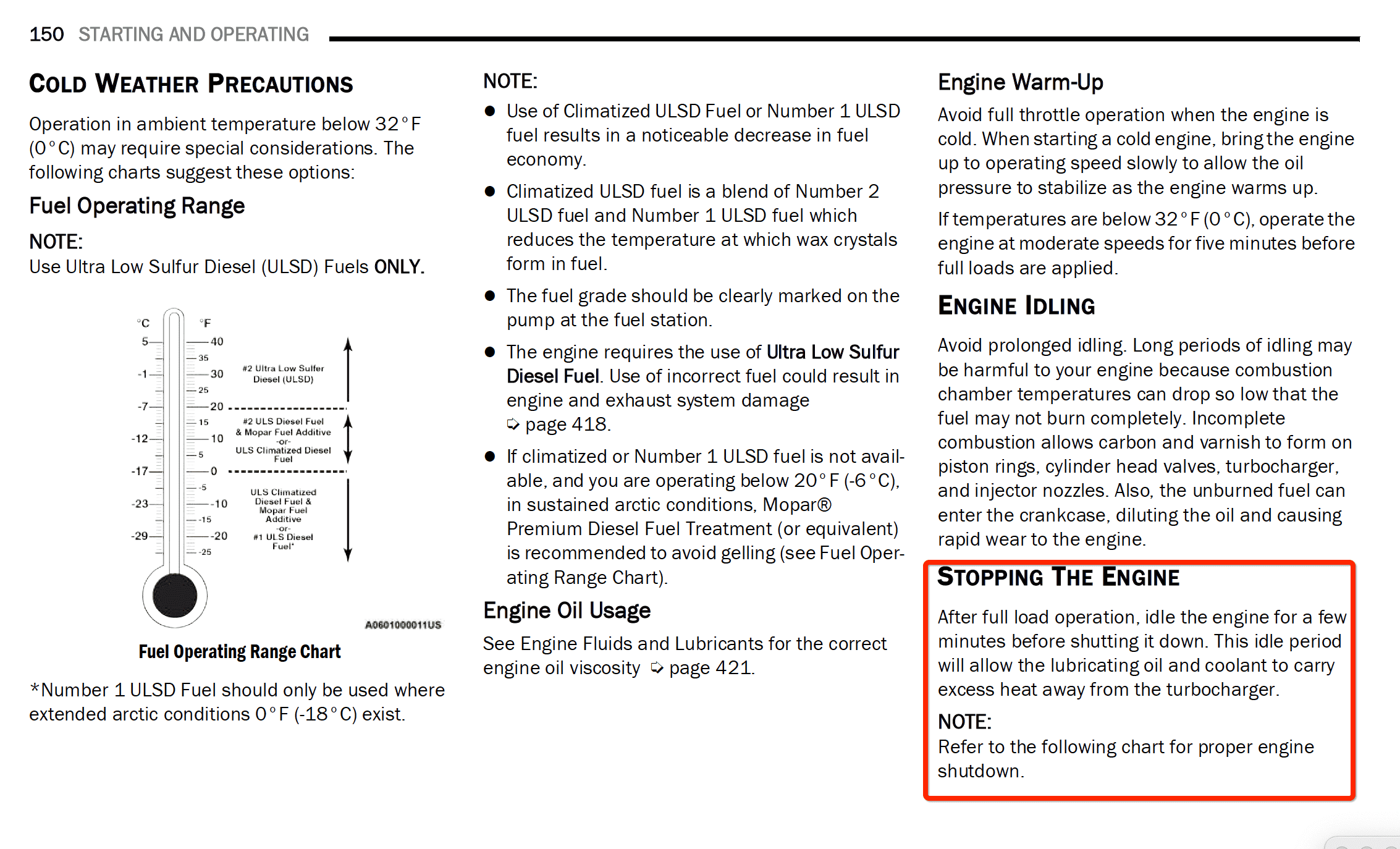
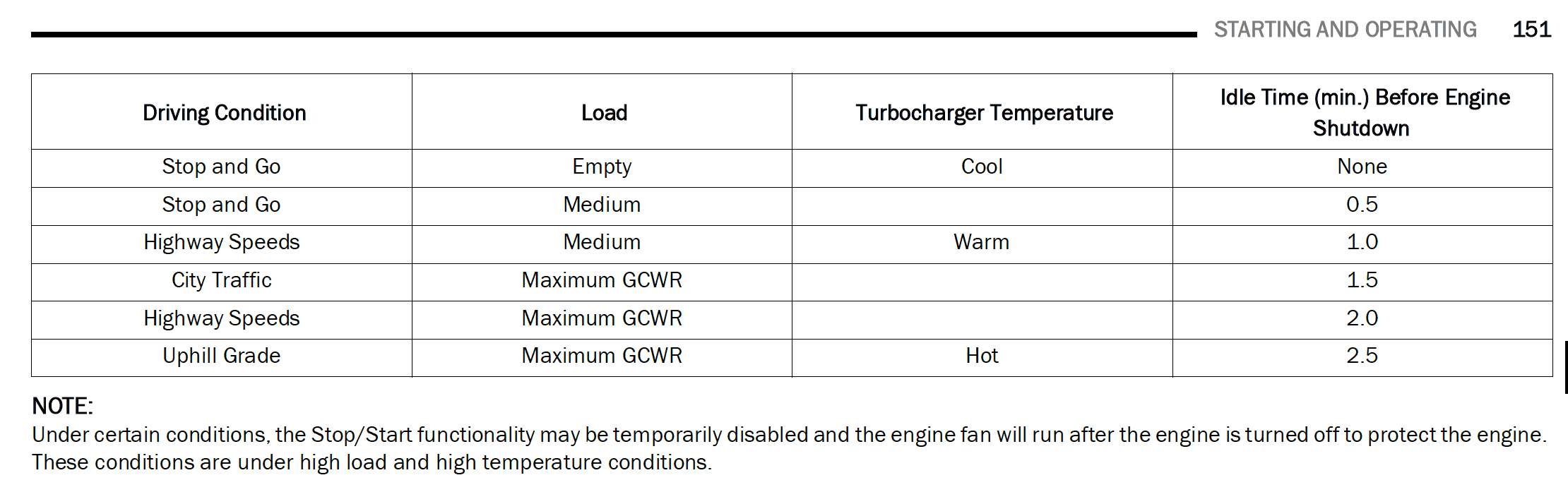
From the manual:
Last edited:
OP
OP
IPRoutes
Well-Known Member
- Thread starter
- #8
Since I am monitoring the temps through Scangauge, I don't shut the motor off till EGT1 temps go to 400 or below. This happens after 1 minute of idle time after a highway run and a couple of minutes driving slow to get to my subdivision.Any turbo motor. You don't want to rev the engine up and then shut it down. The impeller inside the turbo can spin over 200,000 rpms in some motors. Most turbo's are babbit bearing, a few are roller bearing. These use grease. The babbit bearings need an oil supply. When you shut down the motor. you shut off the oil supply. If the turbo is spun up, you cook the bearing. When I shut off, I'll let the motor idle for a minute or 2 to let the rpm's drop in the turbo.


GoatPowder
Well-Known Member
- First Name
- Justin
- Joined
- Feb 13, 2021
- Threads
- 0
- Messages
- 64
- Reaction score
- 68
- Location
- St Charles
- Vehicle(s)
- '21 Gladiator EcoDiesel
- Occupation
- Diesel Mechanic
The concern is usually for coking of the residual oil if the turbo is still hot from a hard run. Anytime you shut the vehicle off oil pressure is cut as well while the turbo slows down. The amount of oil the turbo actually requires to lubricate the bearings (especially a water-cooled as the oil isn't required to extract heat) is pretty minimal. I wouldn't worry about it effecting turbo longevity. During an ESS event the oil supply isn't cut long enough for the oil to truly coke on to the bearing surfaces (not enough time for heart to really build up without the oil extracting it from the metal)
But that said it was one of the first things i requested disabled from my tuner because it was still annoying as all hell.
But that said it was one of the first things i requested disabled from my tuner because it was still annoying as all hell.
Sponsored
ShadowsPapa
Well-Known Member
- First Name
- Bill
- Joined
- Oct 12, 2019
- Threads
- 247
- Messages
- 40,463
- Reaction score
- 53,908
- Location
- Runnells, Iowa
- Vehicle(s)
- '25 JTMX, '23 JLU 4xe, '82 SX4, '73 Javelin
- Occupation
- Retired auto mechanic, frmr gov't ntwrk security admin
- Vehicle Showcase
- 3
I did some generic looking-into on these small diesel engines - turbos.
People had been asking - totally unrelated to ESS, about the issues they've always heard about. More than one came in and said "not an issue with these that are water cooled" and they gave good tech explanations for why not, and said a lot of what's out there comes from years past, bigger rigs, older tech and so on.
Now for this -
I do - My F20 had true babbitt bearings, as well as most of my antique hit and miss engines having babbitt bearings, very early Aeromotor windmill heads used babbitt bearings.
You can melt it with a simple torch - I've poured it. It's mostly lead.
It melts at under 500 degrees (some alloys under 400), pour-point about 700+ depending on the exact blend.
I doubt it's really babbitt as I know and am familiar with.
There'd be a lot of melted parts if these truly hit 500 degrees inside where the babbitt is.
In fact the melting point is so low, many of us make the forms to shape the bearings out of wood and use ordinary torches melting the babbitt in steel pans or lids.
Maybe I'm seeing this all wrong and you aren't actually saying that the bearings reach those temperatures - that's why I hitched onto this thread, to learn more about these diesel specifics, curiosity. so to LEARN more - thus, this post. Just looking for clarity, nothing more.
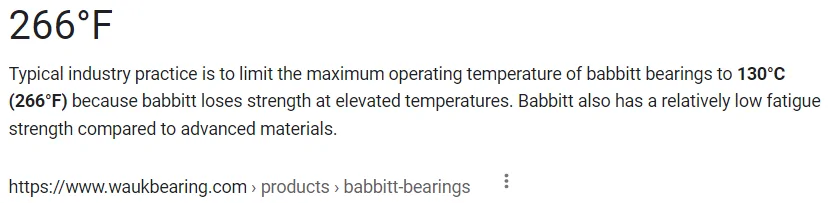
Added honesty bit: I had to look up and refresh my memory on the maximum operating temperature of babbitt bearings - I knew how to pour babbitt bearings, etc. - been there, done that, but could not remember the breakdown temperatures during use - so...............

People had been asking - totally unrelated to ESS, about the issues they've always heard about. More than one came in and said "not an issue with these that are water cooled" and they gave good tech explanations for why not, and said a lot of what's out there comes from years past, bigger rigs, older tech and so on.
Now for this -
Babbitt? You know the melting point of babbitt?Most turbo's are babbit bearing, a few are roller bearing.
I do - My F20 had true babbitt bearings, as well as most of my antique hit and miss engines having babbitt bearings, very early Aeromotor windmill heads used babbitt bearings.
You can melt it with a simple torch - I've poured it. It's mostly lead.
It melts at under 500 degrees (some alloys under 400), pour-point about 700+ depending on the exact blend.
I doubt it's really babbitt as I know and am familiar with.
There'd be a lot of melted parts if these truly hit 500 degrees inside where the babbitt is.
In fact the melting point is so low, many of us make the forms to shape the bearings out of wood and use ordinary torches melting the babbitt in steel pans or lids.
Maybe I'm seeing this all wrong and you aren't actually saying that the bearings reach those temperatures - that's why I hitched onto this thread, to learn more about these diesel specifics, curiosity. so to LEARN more - thus, this post. Just looking for clarity, nothing more.
Added honesty bit: I had to look up and refresh my memory on the maximum operating temperature of babbitt bearings - I knew how to pour babbitt bearings, etc. - been there, done that, but could not remember the breakdown temperatures during use - so...............
Rusty PW
Well-Known Member
- First Name
- Russ
- Joined
- Jan 10, 2022
- Threads
- 37
- Messages
- 11,386
- Reaction score
- 30,368
- Location
- Fayette Nam, Pennsyltucky
- Website
- www.youtube.com
- Vehicle(s)
- '22 JTRD, '11 370Z Nismo, '07 Honda VFR
- Build Thread
- Link
- Occupation
- Muff Diver
When I was at Elliott Turbo Machinery. We had a department that made babbit bearings. They changed the alloy mix to suit the requirements. Some of it had melting points of 800F. I've seen bearings small as 1" to 36" ID's.
What they scraped. I took home and cast my own bullets out of it. The max temp on my electric casting pot was 800F. Some of the stuff wouldn't melt.
Got 2 friends that had to send their turbo's back for repairs from their turbo builds. Cooked the bearings. wiped out the seals, and put oil into the CAC and exhaust.
What they scraped. I took home and cast my own bullets out of it. The max temp on my electric casting pot was 800F. Some of the stuff wouldn't melt.
Got 2 friends that had to send their turbo's back for repairs from their turbo builds. Cooked the bearings. wiped out the seals, and put oil into the CAC and exhaust.
ShadowsPapa
Well-Known Member
- First Name
- Bill
- Joined
- Oct 12, 2019
- Threads
- 247
- Messages
- 40,463
- Reaction score
- 53,908
- Location
- Runnells, Iowa
- Vehicle(s)
- '25 JTMX, '23 JLU 4xe, '82 SX4, '73 Javelin
- Occupation
- Retired auto mechanic, frmr gov't ntwrk security admin
- Vehicle Showcase
- 3
The term Babbitt is obviously applied much more loosely than it was years ago. It used to refer to a more specific white metal. (invented by Babbitt)
Tin based white metal coatings of the bearing shell is now what I'm thinking - higher melting point and higher speed handling and more resistant to pounding forces.
Tin based white metal coatings of the bearing shell is now what I'm thinking - higher melting point and higher speed handling and more resistant to pounding forces.
Rusty PW
Well-Known Member
- First Name
- Russ
- Joined
- Jan 10, 2022
- Threads
- 37
- Messages
- 11,386
- Reaction score
- 30,368
- Location
- Fayette Nam, Pennsyltucky
- Website
- www.youtube.com
- Vehicle(s)
- '22 JTRD, '11 370Z Nismo, '07 Honda VFR
- Build Thread
- Link
- Occupation
- Muff Diver
Get out of the stone age. Times are a changing. I've seen them spray babbit on to the shell. And watched them use a spin caster to apply the babbit. Some applications, it was a few thousands thick. Other's a quarter inch thick. You ever scrap a babbit bearing to get the proper bearing alignment? Oh...... it's a fun process doing it by hand.The term Babbitt is obviously applied much more loosely than it was years ago. It used to refer to a more specific white metal. (invented by Babbitt)
Tin based white metal coatings of the bearing shell is now what I'm thinking - higher melting point and higher speed handling and more resistant to pounding forces.
ShadowsPapa
Well-Known Member
- First Name
- Bill
- Joined
- Oct 12, 2019
- Threads
- 247
- Messages
- 40,463
- Reaction score
- 53,908
- Location
- Runnells, Iowa
- Vehicle(s)
- '25 JTMX, '23 JLU 4xe, '82 SX4, '73 Javelin
- Occupation
- Retired auto mechanic, frmr gov't ntwrk security admin
- Vehicle Showcase
- 3
There are bearing scrapers for that.Get out of the stone age. Times are a changing. I've seen them spray babbit on to the shell. And watched them use a spin caster to apply the babbit. Some applications, it was a few thousands thick. Other's a quarter inch thick. You ever scrap a babbit bearing to get the proper bearing alignment? Oh...... it's a fun process doing it by hand.
Sponsored
Similar threads


- Replies
- 23
- Views
- 9,378
