troverman
Well-Known Member
Yes highway driving. Probably slightly uphill. I live in hilly New England.If your at 80psi oil pressure your on the highway or stuck in a low gear really revving on it . Highway ?
Sponsored

Yes highway driving. Probably slightly uphill. I live in hilly New England.If your at 80psi oil pressure your on the highway or stuck in a low gear really revving on it . Highway ?


55 mph and seeing over 3,000 RPM???Box trailer, 5000lbs. Automatic transmission, not in manual mode. 55mph, basically calm wind conditions. Everything within spec.
Slightly?Yes highway driving. Probably slightly uphill. I live in hilly New England.

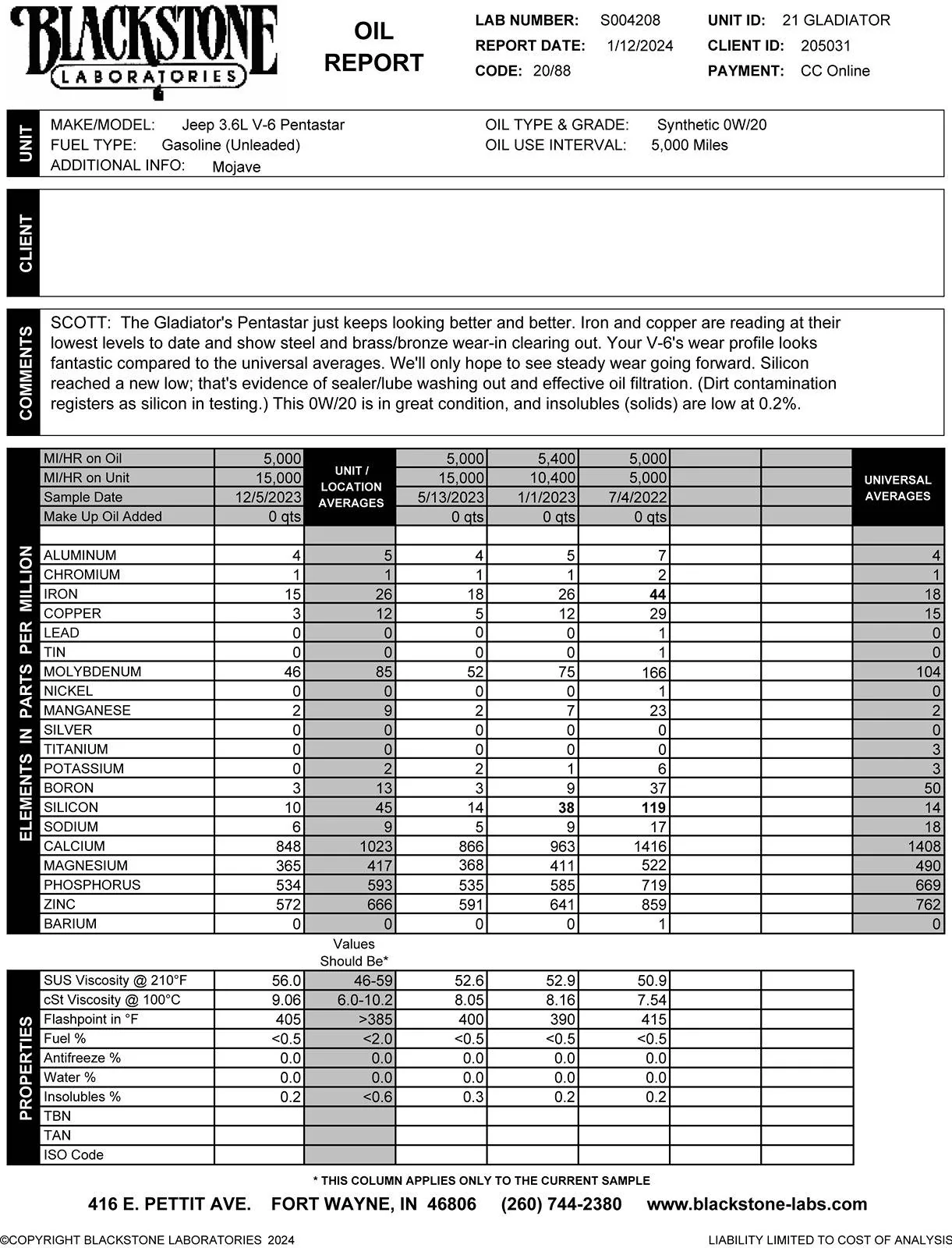
I have an oil test kit ready for the next time i change my oil. It is still a few thousand miles out, but I may go ahead and do it this weekend.I would highly recommend getting an oil analysis done. There is quite a bit of ticking to these engines sometimes that have nothing to do with the valvetrain like injectors, exhaust manifold leaks and even the EGR valve sometimes.
You can take it for a drive, get everything up to operating temperature, then draw oil out the dipstick tube like I do for "in between" testing or when I don't feel like grabbing it from down below.I have an oil test kit ready for the next time i change my oil. It is still a few thousand miles out, but I may go ahead and do it this weekend.
I'd have too look in the book - you may be exceeding the towing specs. It's not all about weight. The book (as well as towing web sites) explain this.The box trailer is 102” wide and a flat nose not a vee nose. It’s considerably taller than the Jeep. Of course there’s significant wind drag at highway speed. Approximately 5000lbs is the accurate weight. The Jeep works pretty hard to pull it at speed.

Many Pentastar engines with VVL last well beyond 100k…Cams going bad is a common problem. It is why I lost interest in furthering the 3.6L platform.
Forget about oils, hardness of metals, or proper lubrication. The part that is frustrating to me is the lack of diagnostics and fail safe operations, from chrysler on the VVT and VVL.
1. The VVL relies on metal on metal, flat tappet operation abover 2800 rpm stock. If you are towing your going to spend a long time with hot oil running flat tappet style
2. The cam timing is important for wear and correct engine characteristics. The phazers are highly susceptible to debris and slow actuation. No diagnostics except for one that happens at a crazy late highly obvious point. Late/early cam timing puts extreme pressure on the flat tappet cam operation and causes tons of misfires.
3. Once metal is circulating in the oil cam position sensors are hall effect and grab all that additional metal and begin to read false positions. This then allows the engine to run rich unessesarily and causes ring wear.
My new.tunes actually take advantage of some diagnostics in the OS and not used. I also sensotize the cam phazing diagnostics. I make.it so the most aggressive air profile is the cams in default position. This way a failure cannot over pressurize a cylinder. Yes power is down, but you van run it all day and not break it.
I could probably put more.in place but time is money and the factory should of done it. I have no doubts that a 3.6 with vvl and vvt will have a valve train problem before 100K
Altitude matters - there's not the air density to remove heat. Towing in the mountains, at elevations it a different animal.On our latest trip to Colorado and Utah about 6 weeks ago we were driving on I-70 going over Vail Pass in Colorado driving about 65 in a blizzard (they closed the interstate about a half hour after we went through).
I hit 238 degrees on the oil and the ambient temperature was 14 degrees!
We were fully loaded near our GVWR but not towing anything so YES these engines can and do run hot…
Really? Mine was smooth as heck, just as good as the MOPAR, but with more options.The Redarc trailer brake also doesn’t work exceptionally smoothly.
And with the millions out there not suffering any mechanical issues at all - it's a safe bet............Many Pentastar engines with VVL last well beyond 100k…