
Sponsored

Engine Oil Analysis: High Silicon

ShadowsPapa

Well-Known Member
First Name
Bill
Joined
Oct 12, 2019
Threads
247
Messages
40,442
Reaction score
53,860
Location
Runnells, Iowa
Vehicle(s)
'25 JTMX, '23 JLU 4xe, '82 SX4, '73 Javelin
Occupation
Retired auto mechanic, frmr gov't ntwrk security admin
Vehicle Showcase
3
Had a look at my first silicon levels for both engines.
#1 90 + coolant detected
#2 47 (but had over double the oil) so maybe would have read 94 ? After all this time and 131k kms (80k miles) silicon reads 7
(and yes, I use a K&N filter, @ShadowsPapa favourite 🫣💥😉)
How many miles was on that oil sample? That's the real tell - not how much was in there, but how much per thousand miles.
So if you had 7 after say, 3,000 miles, and I have 12 after 7,100 miles, I have a lot less silicon than you, meaning that number is higher than mine per thousand miles, so I'm better off with 12 than your 7.
Sponsored

 

Maximus Gladius

Well-Known Member
First Name
Kevin
Joined
Jan 30, 2021
Threads
74
Messages
2,901
Reaction score
3,692
Location
Calgary, AB, Canada
Vehicle(s)
2021 JTR, 2023 JTR
How many miles was on that oil sample? That's the real tell - not how much was in there, but how much per thousand miles.
So if you had 7 after say, 3,000 miles, and I have 12 after 7,100 miles, I have a lot less silicon than you, meaning that number is higher than mine per thousand miles, so I'm better off with 12 than your 7.
Ya, you’d be doing better by a few points. Your math is right. So I guess it’s good I’m doing earlier changes and keeping the numbers lower than running longer and my numbers surpassing you.
 

Maximus Gladius

Well-Known Member
First Name
Kevin
Joined
Jan 30, 2021
Threads
74
Messages
2,901
Reaction score
3,692
Location
Calgary, AB, Canada
Vehicle(s)
2021 JTR, 2023 JTR
so I'm better off with 12 than your 7.
I don’t think a higher number that’s run longer is better than a lower number run shorter. I still have less contaminated oil than you when it gets changed. But it may be interesting to just go swap out for a paper OE filter to see what happens
 

ShadowsPapa

Well-Known Member
First Name
Bill
Joined
Oct 12, 2019
Threads
247
Messages
40,442
Reaction score
53,860
Location
Runnells, Iowa
Vehicle(s)
'25 JTMX, '23 JLU 4xe, '82 SX4, '73 Javelin
Occupation
Retired auto mechanic, frmr gov't ntwrk security admin
Vehicle Showcase
3
I don’t think a higher number that’s run longer is better than a lower number run shorter. I still have less contaminated oil than you when it gets changed. But it may be interesting to just go swap out for a paper OE filter to see what happens
It's contamination per thousand that matters - even by the lab comments.
If you are getting more per thousand miles than I am, then my report is actually better. That's one reason they want to know how many miles are on a sample, to break it down.

If my silicon numbers were higher per thousand miles, then my engine isn't doing as well but it's lower per thousand than yours, meaning potentially less dirt pulled in for every thousand miles driven (although that's NOT the only source of silicon in modern engines, it's an indicator of filtration i general).
So yes, if mine at 7,158 miles showed more silicon than yours at 3,000 or 3,5000 - as long as mine isn't double your number, then mine is actually lower at 3,000 miles than yours.


Jeep Gladiator Engine Oil Analysis: High Silicon 1760973835394-cj
 

Hootbro

Well-Known Member
First Name
Don
Joined
Apr 13, 2019
Threads
57
Messages
10,179
Reaction score
19,944
Location
Delaware
Vehicle(s)
2025 Gladiator Sport
Silicone is a contaminant and not a wear metal. I do not think it necessarily trends on a linear scale with mileage.
 

Sponsored

ShadowsPapa

Well-Known Member
First Name
Bill
Joined
Oct 12, 2019
Threads
247
Messages
40,442
Reaction score
53,860
Location
Runnells, Iowa
Vehicle(s)
'25 JTMX, '23 JLU 4xe, '82 SX4, '73 Javelin
Occupation
Retired auto mechanic, frmr gov't ntwrk security admin
Vehicle Showcase
3
Silicone is a contaminant and not a wear metal. I do not think it necessarily trends on a linear scale with mileage.
If that contaminate is getting in, say, via a filter, yeah, the more you drive, the more will get in there.
It totally makes sense - drive a dirt road with a window partially down - the more you drive, the more dust gets in. IF you get xx dust in per miles, then you'd expect the dust to double in twice the miles driven.

That's why there are time tests on air filters, time until capacity and so on. To compare how much gets through in a given time.

It's the same concept - how much gets in per mile. It's not going to get in and then suddenly stop getting in at 3,000 miles - the more you drive, the more will get in.
ISO test graphs for filters absolutely test over a given time, which in our case, would equate to miles.

I would expect his silicon levels to double if he went out to say, 6,000 miles on a sample. Why would it stop increasing if it's still getting into the oil? The source doesn't matter - getting in from wear, a leaking filter, or other source. About all that should not follow would be fuel contamination - that's going to be very different and not so much additive as longer drives would remove that until next start cycle.
 

Maximus Gladius

Well-Known Member
First Name
Kevin
Joined
Jan 30, 2021
Threads
74
Messages
2,901
Reaction score
3,692
Location
Calgary, AB, Canada
Vehicle(s)
2021 JTR, 2023 JTR
It's contamination per thousand that matters - even by the lab comments.
If you are getting more per thousand miles than I am, then my report is actually better. That's one reason they want to know how many miles are on a sample, to break it down.

If my silicon numbers were higher per thousand miles, then my engine isn't doing as well but it's lower per thousand than yours, meaning potentially less dirt pulled in for every thousand miles driven (although that's NOT the only source of silicon in modern engines, it's an indicator of filtration i general).
So yes, if mine at 7,158 miles showed more silicon than yours at 3,000 or 3,5000 - as long as mine isn't double your number, then mine is actually lower at 3,000 miles than yours.


1760973835394-cj.webp
You’re really making me work my math noodle.
Silicone is a contaminant and not a wear metal. I do not think it necessarily trends on a linear scale with mileage.
maybe not a wear metal but an abrasive source which would first work on the rings and down from there, right?

Looking at all my dozens of reports, Aluminum, copper, chromium are all happy numbers, it’s always been the iron that’s high (for all 80k miles) and the reason for my early changes. Lab explains that the elevated iron can easily be explained in what the block materials are made out of and perhaps changes in block make up was done. He said Ford’s made years ago read very low iron levels, now he sees iron levels @200ppm. 🤷‍♂️ But he did suggest that numbers run through this lab will be different if run through another lab. (Apples to apples comparison) If I had a serious iron wear problem showing 2-4x’s higher numbers than yours, I think this engine would have come apart by 80k miles by now.
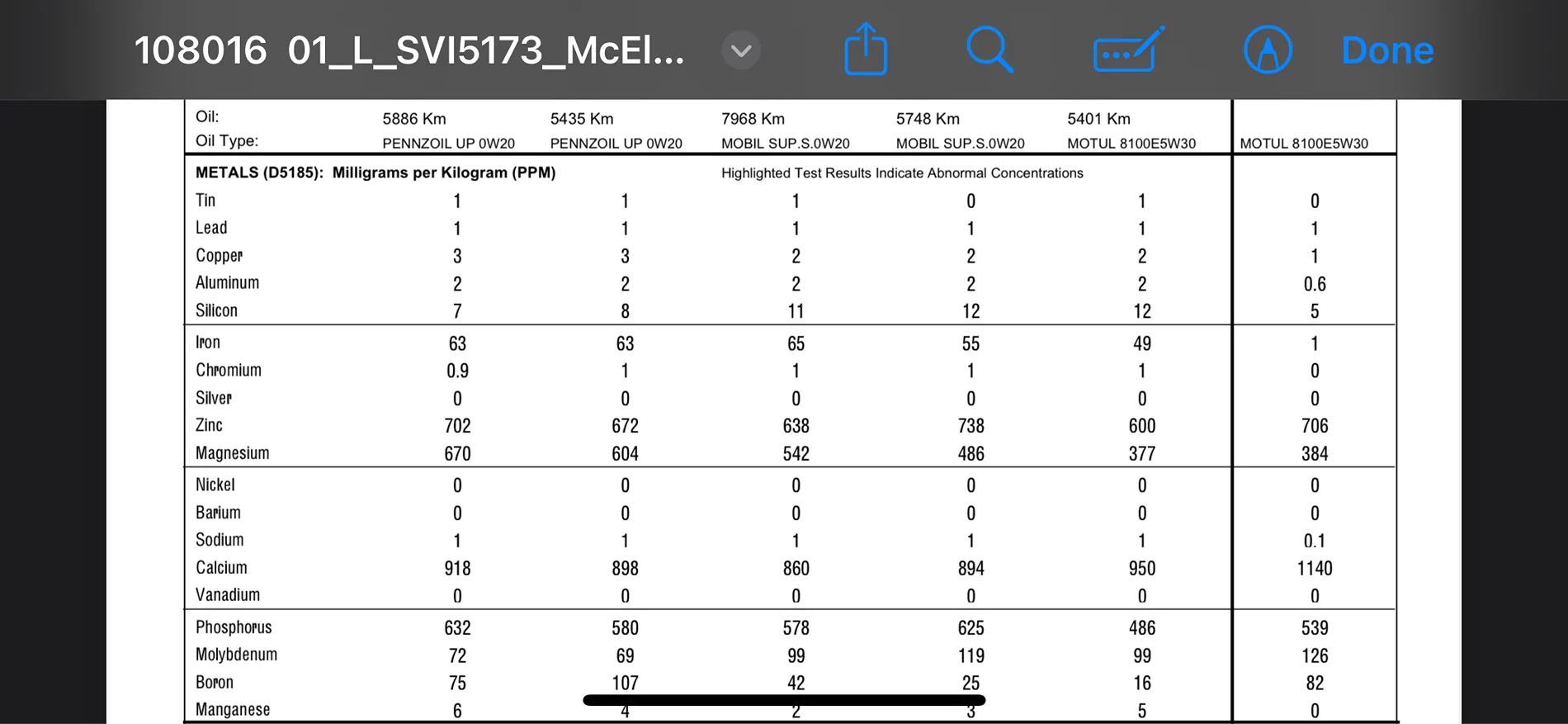
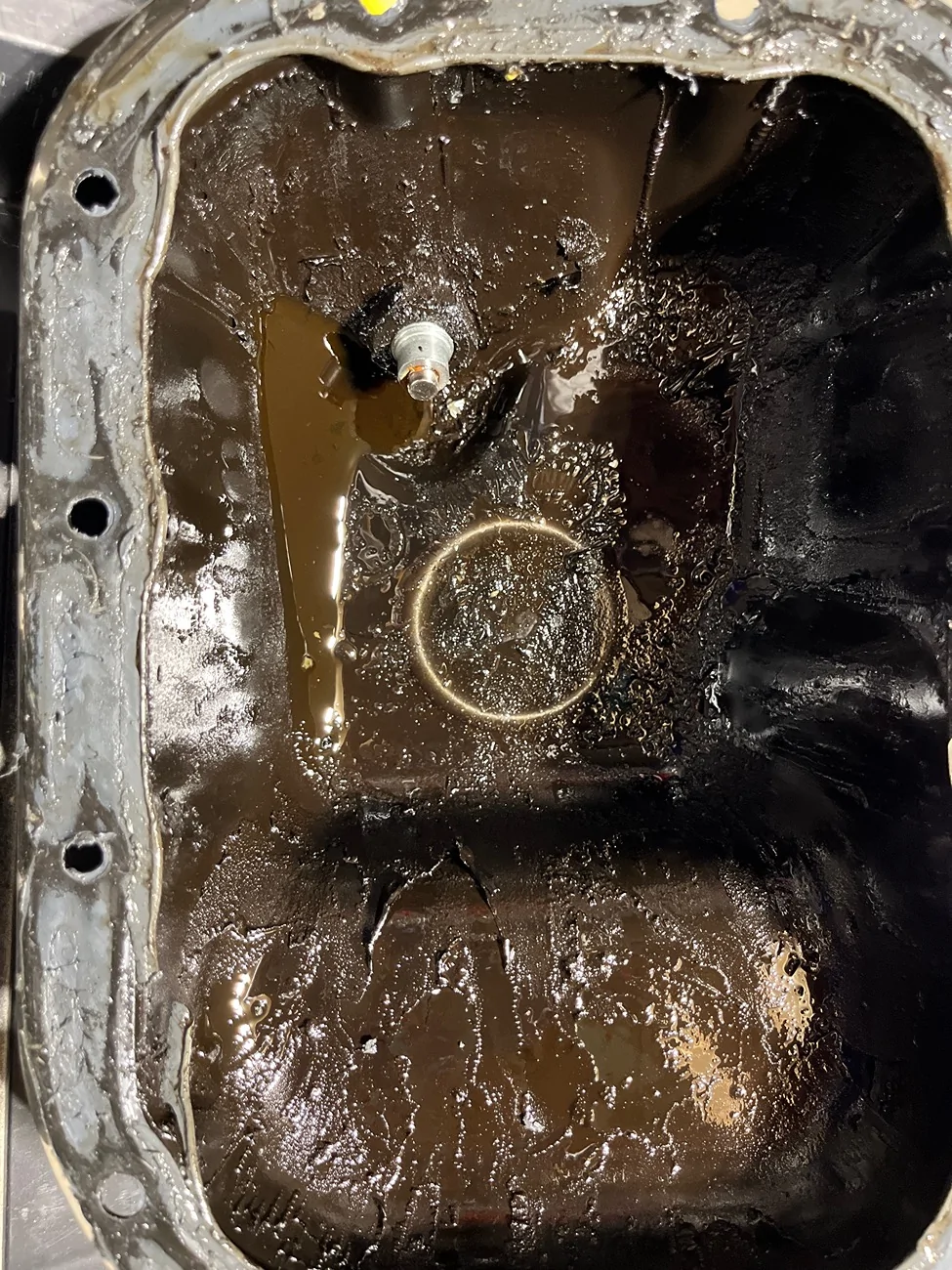
Thinking damage had to of been done while running 12L in my first fill for 1567 kms, is why I’ve kept a close eye on my numbers and early oil changes. The only thorn I have is the high iron so I had a magnetic plug made. No good deed goes unpunished and I was accused of manipulating my numbers with it (Oh well). I didn’t see much on the plug in all my changes and I didn’t see the numbers go down so I took an aggressive approach and slapped on a 700 pull pound fishing magnet on my pan in order to pull the iron out of the oil and you can see it made a difference from (iron 55 to 49).

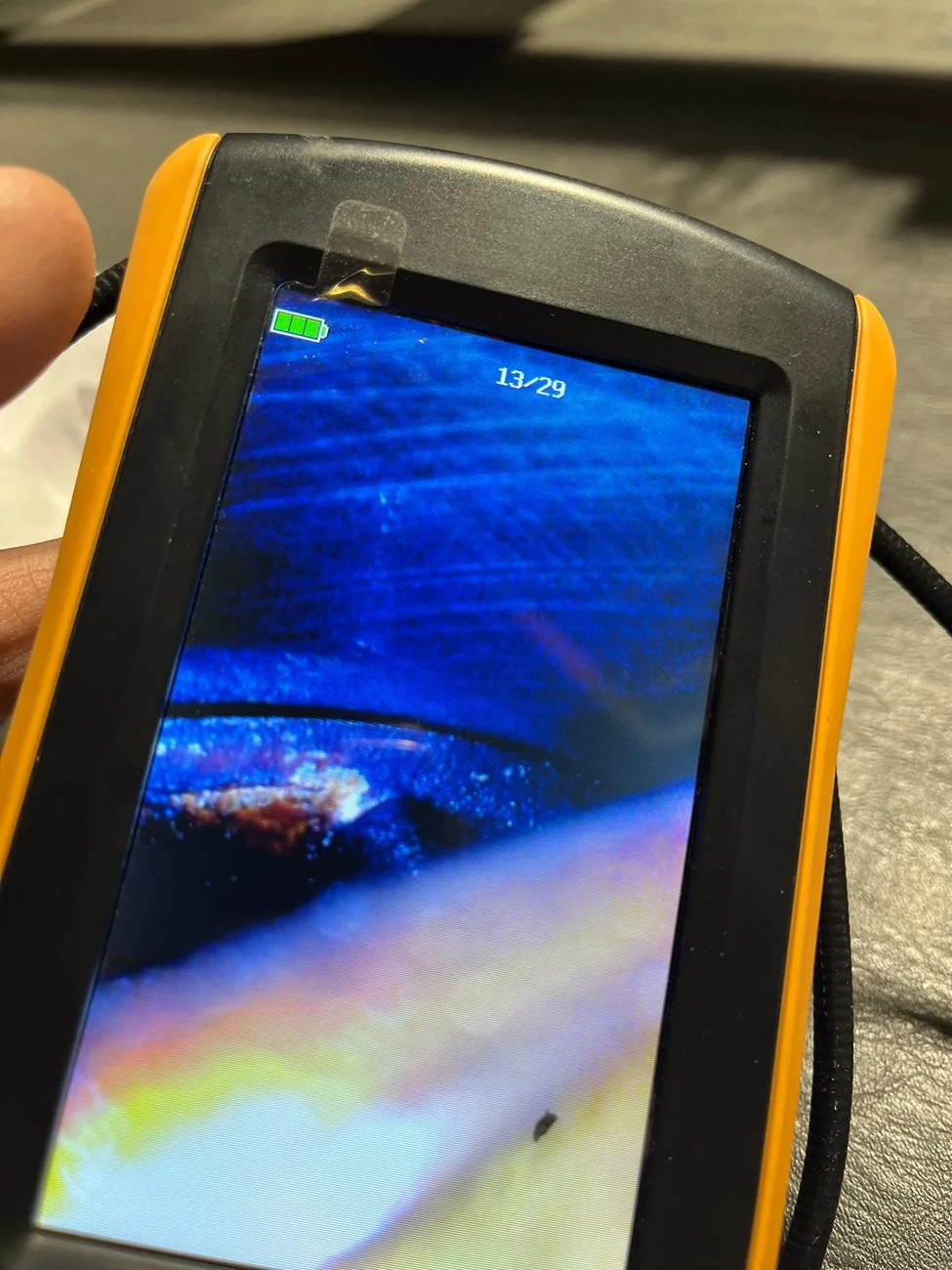
You recall when I dropped my pan to clean things up, there’s a visible “ring” in all the crap,…that’s iron that didn’t get circulated, but it’s still reading too high for my liking. I don’t think that’s from the K&N but for the sake of all things good, research and learning from data points, I would switch to a paper filter just to see if that makes an impact.
Jeep Gladiator Engine Oil Analysis: High Silicon IMG_5290
Jeep Gladiator Engine Oil Analysis: High Silicon IMG_5157
 

Hootbro

Well-Known Member
First Name
Don
Joined
Apr 13, 2019
Threads
57
Messages
10,179
Reaction score
19,944
Location
Delaware
Vehicle(s)
2025 Gladiator Sport
Even if silicone is be introduced via air intake, still will not be linear over mileage unless you driving in a control cloud of dust each time.

It will go up for sure, but not by any graphed straight line of measurement. One can average it to make it look straight but it does not mean it was actually introduced in even amounts across each 1K per threshold.

Still a external uncontrolled contaminant.
 

Hootbro

Well-Known Member
First Name
Don
Joined
Apr 13, 2019
Threads
57
Messages
10,179
Reaction score
19,944
Location
Delaware
Vehicle(s)
2025 Gladiator Sport
You’re really making me work my math noodle.

maybe not a wear metal but an abrasive source which would first work on the rings and down from there, right?

Looking at all my dozens of reports, Aluminum, copper, chromium are all happy numbers, it’s always been the iron that’s high (for all 80k miles) and the reason for my early changes. Lab explains that the elevated iron can easily be explained in what the block materials are made out of and perhaps changes in block make up was done. He said Ford’s made years ago read very low iron levels, now he sees iron levels @200ppm. 🤷‍♂️ But he did suggest that numbers run through this lab will be different if run through another lab. (Apples to apples comparison) If I had a serious iron wear problem showing 2-4x’s higher numbers than yours, I think this engine would have come apart by 80k miles by now.
Thinking damage had to of been done while running 12L in my first fill for 1567 kms, is why I’ve kept a close eye on my numbers and early oil changes. The only thorn I have is the high iron so I had a magnetic plug made. No good deed goes unpunished and I was accused of manipulating my numbers with it (Oh well). I didn’t see much on the plug in all my changes and I didn’t see the numbers go down so I took an aggressive approach and slapped on a 700 pull pound fishing magnet on my pan in order to pull the iron out of the oil and you can see it made a difference from (iron 55 to 49).

You recall when I dropped my pan to clean things up, there’s a visible “ring” in all the crap,…that’s iron that didn’t get circulated, but it’s still reading too high for my liking. I don’t think that’s from the K&N but for the sake of all things good, research and learning from data points, I would switch to a paper filter just to see if that makes an impact.
IMG_5290.webp
IMG_5157.webp
Nothing about your "total" experience and service history would make me use your data to extrapolate regular in service norms because nothing has ever been normal.

You would be an asterisk to any data and an appendix in any report.
 

Maximus Gladius

Well-Known Member
First Name
Kevin
Joined
Jan 30, 2021
Threads
74
Messages
2,901
Reaction score
3,692
Location
Calgary, AB, Canada
Vehicle(s)
2021 JTR, 2023 JTR
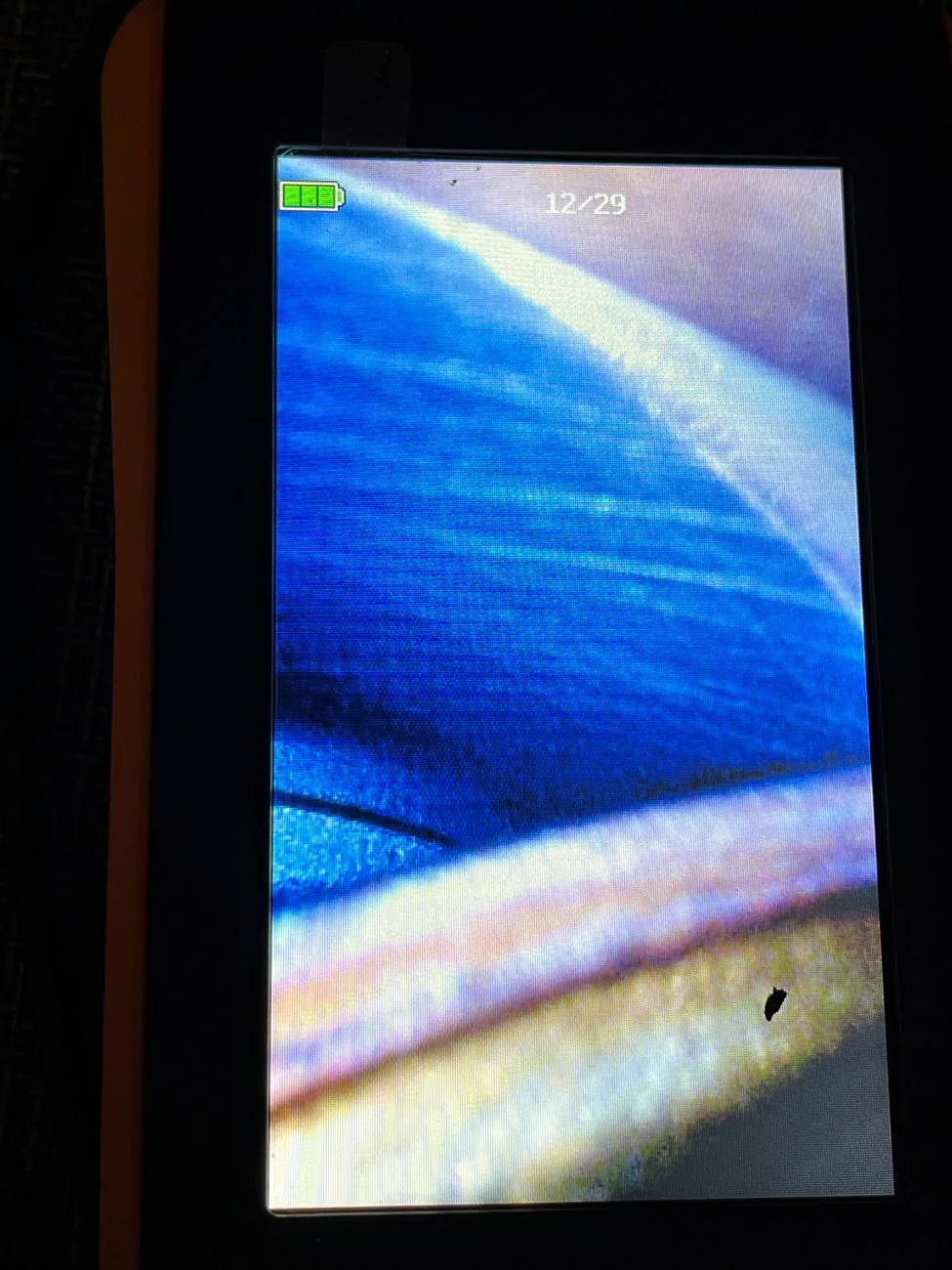
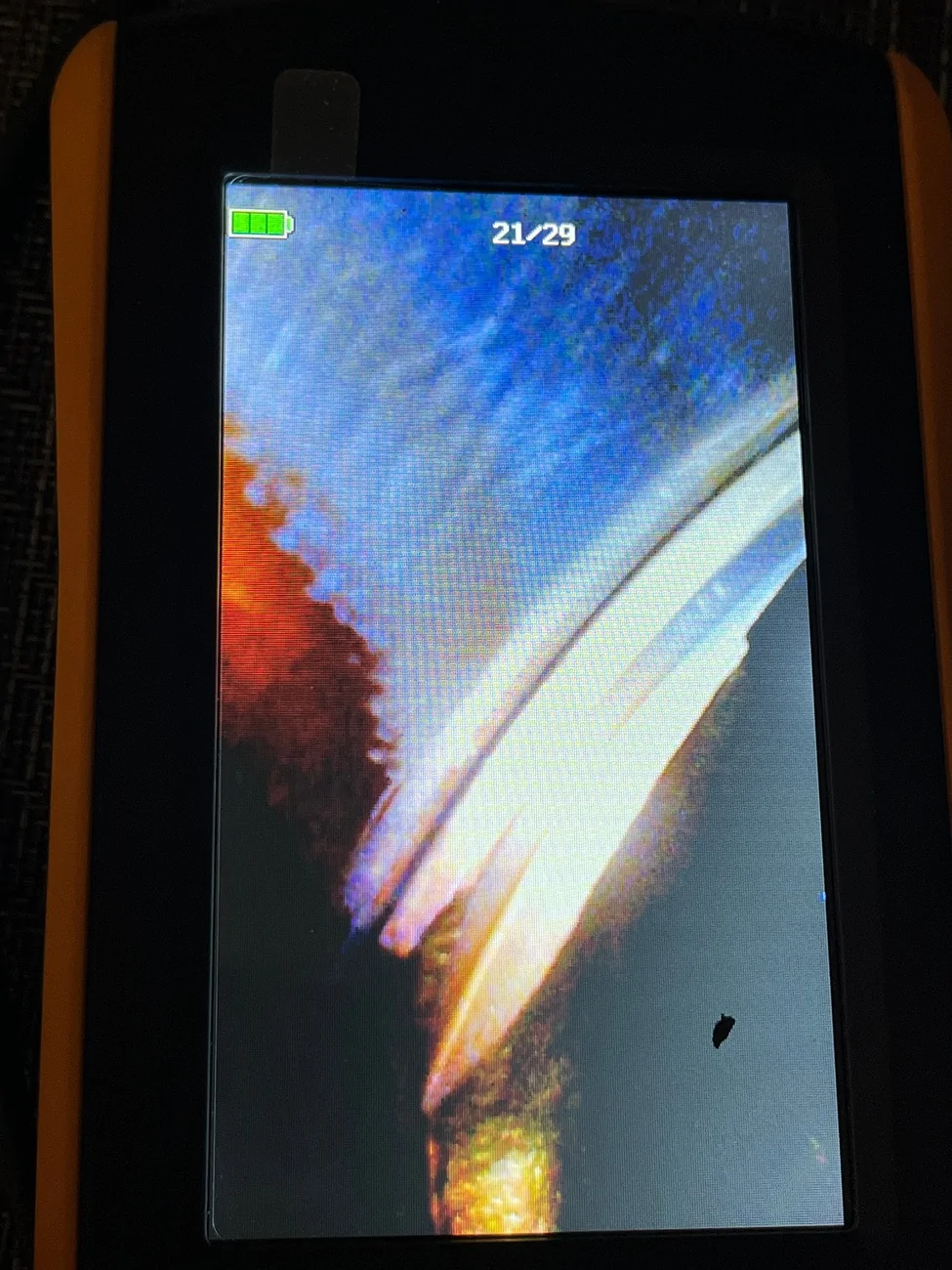
@ShadowsPapa, let’s examine for a moment some facts and let’s make a best guess from that. Firstly, I’ve always run K&N since high school and have maintained them through proper cleaning, drying and oiling. This engine has had it from day one.

Let’s take your argument that my filter is letting in more abrasives than your paper filter. Let’s even agree on it.

The first rubbing in and grinding of this abrasive material is going to hit the rings first, right? What material are the rings made of and what material are the cylinder walls made of? Would this reflect in the numbers you see in my report posted above?

If my numbers are so high because of this abrasion taking place in my cylinders, should I see cross hatch on my cylinder walls?
Jeep Gladiator Engine Oil Analysis: High Silicon IMG_5181
Jeep Gladiator Engine Oil Analysis: High Silicon IMG_5188
Jeep Gladiator Engine Oil Analysis: High Silicon IMG_5171
 

Sponsored

Maximus Gladius

Well-Known Member
First Name
Kevin
Joined
Jan 30, 2021
Threads
74
Messages
2,901
Reaction score
3,692
Location
Calgary, AB, Canada
Vehicle(s)
2021 JTR, 2023 JTR
Nothing about your "total" experience and service history would make me use your data to extrapolate regular in service norms because nothing has ever been normal.

You would be an asterisk to any data and an appendix in any report.
You mean I fall into the “this is what we know,…(long pause) “however”, there’s this guy…(fill in the blank) ?
 

Badunit

Well-Known Member
Joined
Jan 31, 2023
Threads
20
Messages
817
Reaction score
1,346
Location
USA
Vehicle(s)
2023 JT Rubicon, 1997 TJ
Did I miss it or did no one recommend checking the air filter, even after bringing it up as a potential source of silicon. Others mentioned high silicon on the first sample so it may be normal, but, if it was me, I'd sleep better if I took a look at the air filter and intake tube just to be sure everything is as it should be.
 

ShadowsPapa

Well-Known Member
First Name
Bill
Joined
Oct 12, 2019
Threads
247
Messages
40,442
Reaction score
53,860
Location
Runnells, Iowa
Vehicle(s)
'25 JTMX, '23 JLU 4xe, '82 SX4, '73 Javelin
Occupation
Retired auto mechanic, frmr gov't ntwrk security admin
Vehicle Showcase
3
Let’s take your argument that my filter is letting in more abrasives than your paper filter. Let’s even agree on it.

The first rubbing in and grinding of this abrasive material is going to hit the rings first, right? What material are the rings made of and what material are the cylinder walls made of? Would this reflect in the numbers you see in my report posted above?
There are so many ways or reasons our numbers will vary from each other - don't second guess yourself. I suspect your OCD-like habits may make up for any product shortcomings, or you negate them in your own methods. It's working, don't mix it up now.

Low tension rings are going to leave cross-hatch patterns clear into the 100,000 mile range, even higher.
As far as "should I see"............ yeah, very possible. And maybe the oil is doing a good job, it matters.

You aren't in any danger zone - higher than mine per mile doesn't mean bad, just different. Maybe there's other factors, like the oil used. Don't sweat it.

Your numbers are good and don't worry because someone comes up with some that are "better". (for one thing, mine are 'better', but not astronomically better, nothing to brag about, just that I'm in really great shape in that sample.)
Time for another sample as I just went through harvest season here, and I want to get a new baseline before snow plow season, or even colder weather sets in.

Keep up the OCD on your air filter, make danged sure it SEALS (a mistake too often made) and don't sweat it, don't dwell on it. This may be your good luck engine. The one that breaks your losing streak.

ven if silicone is be introduced via air intake, still will not be linear over mileage unless you driving in a control cloud of dust each time.

It will go up for sure, but not by any graphed straight line of measurement. One can average it to make it look straight but it does not mean it was actually introduced in even amounts across each 1K per threshold.
We can say that to some extent about anything in there. If I drive under low loads, easy even driving, there's less pressure on the rings, less wear on them. If I tow and get into hills, I increase the pressure on the rings a large amount. So you have to allow for variations in any test. It's why I marked my reports with notes - highway towing at heavy loading, mostly local driving sub-interstate speeds, and so on. Even wear metals are averaged over the use of the engine for that time frame. It's one reason I did any analysis at all - to satisfy my curiosity - will this sort of driving or loading show much difference, or not? What about the weather at the time? I make notes as far as what sort of driving was done, the use of the truck, and more.

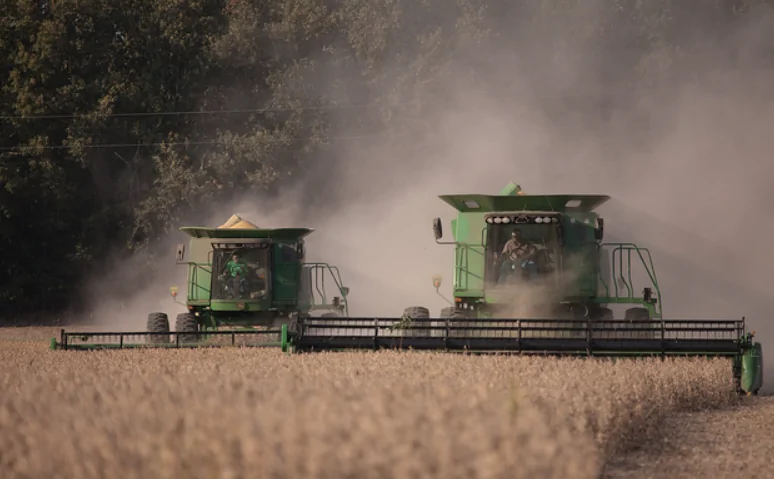
I also make note as to the time of year related to farming - because 2 weeks ago, the air is filled with haze and dust from bean combining. That won't be silicon much, it's a very different dust, but I note it for cabin filters, engine air filters and such.

Jeep Gladiator Engine Oil Analysis: High Silicon 1760985107354-kk


There's little linier about these things unless you always drive the same roads, the same loads, the same speeds. How I use my truck may elevate wear metals and then next sample, it might be way down. You have to account for loading, speed and use as well as time.
 

g2020

Well-Known Member
First Name
David
Joined
Oct 30, 2024
Threads
22
Messages
215
Reaction score
272
Location
Texas USA
Vehicle(s)
2020 Jeep Gladiator Sport
I should have added… first vehicle I’ve owned with an oil life monitor and no mileage based oil change intervals in the owner’s manual.
Please see my post on Motor Oil & Oil Filter Service Intervals.

If you only review the tables in the maintenance schedule, your statement is correct. The first page of the MAINTENANCE PLAN section, in the online version of the owner's manual, does not provide a limit for miles, months (12), or idle time (350 hours) for motor oil & oil filter. The limit on the number of miles depends on the severity of vehicle use. These limits are spelled out seven pages later in the online version.

In the printed version of the owner's manual that came with my vehicle, the service intervals are covered on the page before the maintenance plan. This makes more sense, especially for people who are new to DIY maintenance, because people tend to check the tables first.

As for silicon, I defer to the debate committee :) Except to say that elevated levels of silicon, that decline over time, might be expected. If the level is abnormally high or does not decline, have the engine checked by a dealer while it is still under warranty.

Note: Typical causes of high silicon are as described in the next post in this thread.
Sponsored

 
Last edited:


Top