Sponsored

Engine oil -- what weight and brand do others use?

DanW

Well-Known Member
First Name
Dan
Joined
Mar 2, 2017
Threads
45
Messages
1,878
Reaction score
2,460
Location
Brownsburg, Indiana
Vehicle(s)
21 JT Rubi, 18 JLU Rubi, 2008 JKU Rubi, 07 Vette
If you poke around on BITOG, there is a person on there who was a Pentastar design engineer, screen name OIL_UDDER. They state that the heavier weight oil leads to accelerated wear of the cams and in the head at cold start.

https://bobistheoilguy.com/forums/threads/626-000-mile-pentastar-teardown.329423/#post-5474366
Great find, and LOTS of good info in his post. He'll also tell you flat out to use 0w20 in this engine. He's got one in a Chrysler 300 with well over 150k by now. He runs the specified 5w20 for that engine, even though it was permitted to use 5w30. He'll tell you this new version of the Pentastar was designed from the start for 0w20 and that this is what you should use, warranty concerns or not, for it to perform best and last longest.
Sponsored


DAVECS1

Well-Known Member
First Name
David
Joined
Jan 24, 2020
Threads
56
Messages
1,861
Reaction score
2,538
Location
Peoria, IL
Vehicle(s)
2020 Gladiator Sport S Max Tow
Many 5w30's are in the thin part of the range (Pennzoil Platinum, for one), so you are right that it is not a huge difference. But 5w30's shear more than any 0w20 I've seen, so they wind up thinning into 20w territory pretty quickly anyway. I've never seen a 0w20 shear out of grade, but I've seen 5w30 do it nearly every UOA I ever did with it. That's been my experience, according to UOA's.

As for high performance engines, yeah, many specify heavier oil for track time. But these Pentastars aren't track engines. They have very tight tolerances and the version in our Jeeps has tighter oil journals, again, because they were designed for 0w20 from the outset. And racing engines have moved to thinner oils. Indycars, for example, run straight 0 weight oil for qualifying. Yes, straight 0 weight. Even I was shocked to learn that.

Remember, too, the infamous Promaster with a Pentastar that did 625k miles did it all on 5w20 oil. It was mostly Mobil 1 with some runs of Valvoline in there. He did 7k oil changes with a few going longer. Hard to see any disadvantage of a 20 weight there. And that Pentastar was a Gen 1 which was originally designed with 5w30 in mind.

I really doubt a 5w30 will harm anything, but why bother with it? It really has no advantage if you choose a good 0w20. Any GM Dexos 1 Gen 2 rated oil will do perfectly well in these engines.
Something needs to be accounted for, qhen taking the high lift cam profiles into consideration. Iam a CURRENT engineer and my opinion is 0-20w is not going to cut it longterm. Especially if you are above 2800 rpm alot. You are running, moderate spring pressures, in a very hot place on the engine, with a thin case hardened, non-roller camshaft. I would NEVER entertain 0-20 on any flat tappet engine, just does not make good sense.

Some engineer at Jeep made the call, that your duty cycle below 3000 RPM should be adequate enough to get away with it, and if not, the side effects of failure are not fully detectable.

I have a number of questions for starting an oil upgrade on machine. What can I get away with on my emissions equipment. At what viscosity will clearances start hydro-locking or reducing flow. What effects will higher load have on the oil pressure regulator system.

My instincts tell me that a superbike oil, like Motul 15-40 synthetic would be a similar usage case, as those bikes turn extreme RPM with friction valvetrain compnents, and tight tolerances
 

ShadowsPapa

Well-Known Member
First Name
Bill
Joined
Oct 12, 2019
Threads
247
Messages
40,463
Reaction score
53,912
Location
Runnells, Iowa
Vehicle(s)
'25 JTMX, '23 JLU 4xe, '82 SX4, '73 Javelin
Occupation
Retired auto mechanic, frmr gov't ntwrk security admin
Vehicle Showcase
3
I know a lot of people think he's a hack, and his testing doesn't compare to real-world, and all sorts of other reasons some people totally, fully, absolutely dismiss anything he says - but, I've been following rat540s posts for years, I've chosen my oils based on my experiences and some of his testing - aside from "industry testing" and have yet to lose a cam or lifter or anything else on the engines I've built.
Yes these are different animals, but you still have the sheer forces on the cams, similar to those on a flat tappet I6 or V8.
Some basics come to mind -
Oil film strength protects, not oil pressure. Pressure delivers the oil. (that's why we are seeing engines running much lower pressures today than in the past - 30 psi on the highway? Many guys years ago would demand the dealer fix it if they saw pressures that low)

Engines may be designed to run specific oil viscosities, but that's more for MPG and cafe than anything else. The goal - MPG, the most power you can generate for a given CID (or liters)
This is why there's the SF-6B out there - to get mpg and cut drag losses from the oil. They build engines to get mpg these days as much as anything so....................
The SAE grading system is a range and the requirement for a 5W oil is very broad.

An engineer may say an engine was designed to run xx viscosity oils from day one - but isn't that to meet other goals, like cutting friction losses due to oil sheer, and to gain HP and mpg?
My guess is the cause and effect, or the reasons, aren't what people see or think.
The rules say you MUST get xx mpg by a certain year - they've already cut weight almost as much as possible, safety concerns will only allow so many design changes to the vehicle - what's left? OIL! OIL is costing us HP and mpg, so we'll build this engine to use a thinner oil that will have lower HTHS............
Oil with low HTHS viscosity improves fuel efficiency.
Oil with high HTHS viscosity offers better protection for engine parts.
Low HTHS oil in an engine designed for high HTHS oil can cause damage.

Balancing act..............

"Kinematic viscosity" is where the 5W-30 or 0w20, etc comes from and relates to the flow at specific temperatures. How does the oil flow through a passage at a given temperature but doesn't have a lot of bearing on protection.
Oil with higher HTHS numbers can protect certain areas of the engine better - but you may lose a little bit in the mpg area.
 

DanW

Well-Known Member
First Name
Dan
Joined
Mar 2, 2017
Threads
45
Messages
1,878
Reaction score
2,460
Location
Brownsburg, Indiana
Vehicle(s)
21 JT Rubi, 18 JLU Rubi, 2008 JKU Rubi, 07 Vette
Something needs to be accounted for, qhen taking the high lift cam profiles into consideration. Iam a CURRENT engineer and my opinion is 0-20w is not going to cut it longterm. Especially if you are above 2800 rpm alot. You are running, moderate spring pressures, in a very hot place on the engine, with a thin case hardened, non-roller camshaft. I would NEVER entertain 0-20 on any flat tappet engine, just does not make good sense.

Some engineer at Jeep made the call, that your duty cycle below 3000 RPM should be adequate enough to get away with it, and if not, the side effects of failure are not fully detectable.

I have a number of questions for starting an oil upgrade on machine. What can I get away with on my emissions equipment. At what viscosity will clearances start hydro-locking or reducing flow. What effects will higher load have on the oil pressure regulator system.

My instincts tell me that a superbike oil, like Motul 15-40 synthetic would be a similar usage case, as those bikes turn extreme RPM with friction valvetrain compnents, and tight tolerances
My 08 JK has spent many hours/miles at or above 2800 rpm on long highway trips. 5w20 all the way and 170k miles and counting with no issues. Of course, I didn't run cheap oil, either. It's been 95% Mobil 1. The other 5% were very good oils, too.

My JL doesn't see rpm's north of 2800 except when I'm hammering it, which is often but not sustained.

Read that post on Bitog and see the comments by Oil_Udder. He's told me directly that the valve train is precisely the reason to stick with 0w20 in this engine. He says the 20 weight splashes into the valve guides better than a heavier oil, and that's where the wear is pronounced in this engine if it doesn't get enough rpm's.

They also reduced the diameter of the oil journals in the heads on this generation of Pentastar. Again, with 20w in mind from the start.

Different application than racing engines and flat tappets. But I'm seeing racing engines running on thinner and thinner oils, with HP being the primary goal. But longevity (very different definition of longevity in racing) is becoming more and more important due to costs and regulations. Indycar engines must go 2500 miles. If they use more than 4 engines in a 10k mile season (practice, quals, racing, testing) they get penalized. They used to be completely used up at just over 500 miles. But they are running far thinner oil than they used to run. Again, straight 0 weight in qualifying. My nephew owns a racing engine business and has moved to thinner oils in his racing engines, too. (4 Piston Racing). He said the quality of oils nowadays is by far the best its ever been and their engines are lasting longer between overhauls.
 

DAVECS1

Well-Known Member
First Name
David
Joined
Jan 24, 2020
Threads
56
Messages
1,861
Reaction score
2,538
Location
Peoria, IL
Vehicle(s)
2020 Gladiator Sport S Max Tow
My 08 JK has spent many hours/miles at or above 2800 rpm on long highway trips. 5w20 all the way and 170k miles and counting with no issues. Of course, I didn't run cheap oil, either. It's been 95% Mobil 1. The other 5% were very good oils, too.

My JL doesn't see rpm's north of 2800 except when I'm hammering it, which is often but not sustained.

Read that post on Bitog and see the comments by Oil_Udder. He's told me directly that the valve train is precisely the reason to stick with 0w20 in this engine. He says the 20 weight splashes into the valve guides better than a heavier oil, and that's where the wear is pronounced in this engine if it doesn't get enough rpm's.

They also reduced the diameter of the oil journals in the heads on this generation of Pentastar. Again, with 20w in mind from the start.

Different application than racing engines and flat tappets. But I'm seeing racing engines running on thinner and thinner oils, with HP being the primary goal. But longevity (very different definition of longevity in racing) is becoming more and more important due to costs and regulations. Indycar engines must go 2500 miles. If they use more than 4 engines in a 10k mile season (practice, quals, racing, testing) they get penalized. They used to be completely used up at just over 500 miles. But they are running far thinner oil than they used to run. Again, straight 0 weight in qualifying. My nephew owns a racing engine business and has moved to thinner oils in his racing engines, too. (4 Piston Racing). He said the quality of oils nowadays is by far the best its ever been and their engines are lasting longer between overhauls.
Your JL valvetrain is a completely different animal than the 08 valvetrain. The 08 was full roller. At 2800 RPM your JL engine turnes into a flat tappet engine.

Jeep Gladiator Engine oil -- what weight and brand do others use? 0225221940a
 

Sponsored

WhyNotJeep

Banned
Banned
First Name
Steve
Joined
Mar 14, 2022
Threads
13
Messages
303
Reaction score
260
Location
La Verne
Vehicle(s)
'14 Ram 2500 Diesel 4x4,,, '14 Wrangler JKUR
Occupation
Done with it
It says to use 0-20 so I will. Before 100K miles it will belong to someone else. At 70 years I have learned that nothing is forever.
 

kevman65

Well-Known Member
Joined
Mar 8, 2020
Threads
51
Messages
3,879
Reaction score
5,757
Location
H
Vehicle(s)
J
Seriously?
ILSAC and API are the certifications to look for anyway.. but a quality oil maker won't be shy about getting OEM numbers, either - it costs them not to.
Yes, seriously. There are several oil brands that refuse to pay the $250,000-$400,000 fee that car manufacturers require in order to have their motor oil certified to their "NEW & IMPROVED" specification that they come out with every third or fourth year.
 

DAVECS1

Well-Known Member
First Name
David
Joined
Jan 24, 2020
Threads
56
Messages
1,861
Reaction score
2,538
Location
Peoria, IL
Vehicle(s)
2020 Gladiator Sport S Max Tow
It says to use 0-20 so I will. Before 100K miles it will belong to someone else. At 70 years I have learned that nothing is forever.
Norhing is forever but I expect more than the 26K I got out of my engine following the manufacturer's suggestions
 

DanW

Well-Known Member
First Name
Dan
Joined
Mar 2, 2017
Threads
45
Messages
1,878
Reaction score
2,460
Location
Brownsburg, Indiana
Vehicle(s)
21 JT Rubi, 18 JLU Rubi, 2008 JKU Rubi, 07 Vette
Your JL valvetrain is a completely different animal than the 08 valvetrain. The 08 was full roller. At 2800 RPM your JL engine turnes into a flat tappet engine.

0225221940a.jpg
Everyone, engineers included, said 5w20 would never work in that 3.8 or other engines of the day. That's been proven wrong over and over.

It'll be just fine with 0w20. Especially the latest SP/GF6 formulation which is designed to stand up to much more abuse (DI/turbo) than the 3.6 will ever deliver, even above 2800rpm.

Also, this isn't a boat engine. Few if anyone is ever going to run sustained rpm like that. Unless you have 4.88 gears and 30" Sport tires. Then maybe. But even then, the 0w20 will do just fine.

I'm old enough to remember when the move to 5w30 caused everyone to think the sky was falling because it was too thin. Now its the thick oil. Funny. Meanwhile, engines are on the market running 0w16 and next up will be 0w8. When you think about that, it makes 0w20 sound thick enough to stopy worrying.

My longest run was 8k miles on Mobil 1 AP 0w20. It was in great shape according to the UOA, including staying in viscosity. I've not run a TBN report because I won't run the oil anywhere near the point it would be too low, but I've seen a guy run 0w20 in a Durango out to 20k miles with Mobil 1 EP and the oil was still serviceable with a decent TBN number. So if it will run 20,000 miles in that shape, then it'll handle the 5k I put on it with no trouble at all.
 

DAVECS1

Well-Known Member
First Name
David
Joined
Jan 24, 2020
Threads
56
Messages
1,861
Reaction score
2,538
Location
Peoria, IL
Vehicle(s)
2020 Gladiator Sport S Max Tow
Everyone, engineers included, said 5w20 would never work in that 3.8 or other engines of the day. That's been proven wrong over and over.

It'll be just fine with 0w20. Especially the latest SP/GF6 formulation which is designed to stand up to much more abuse (DI/turbo) than the 3.6 will ever deliver, even above 2800rpm.

Also, this isn't a boat engine. Few if anyone is ever going to run sustained rpm like that. Unless you have 4.88 gears and 30" Sport tires. Then maybe. But even then, the 0w20 will do just fine.

I'm old enough to remember when the move to 5w30 caused everyone to think the sky was falling because it was too thin. Now its the thick oil. Funny. Meanwhile, engines are on the market running 0w16 and next up will be 0w8. When you think about that, it makes 0w20 sound thick enough to stopy worrying.

My longest run was 8k miles on Mobil 1 AP 0w20. It was in great shape according to the UOA, including staying in viscosity. I've not run a TBN report because I won't run the oil anywhere near the point it would be too low, but I've seen a guy run 0w20 in a Durango out to 20k miles with Mobil 1 EP and the oil was still serviceable with a decent TBN number. So if it will run 20,000 miles in that shape, then it'll handle the 5k I put on it with no trouble at all.
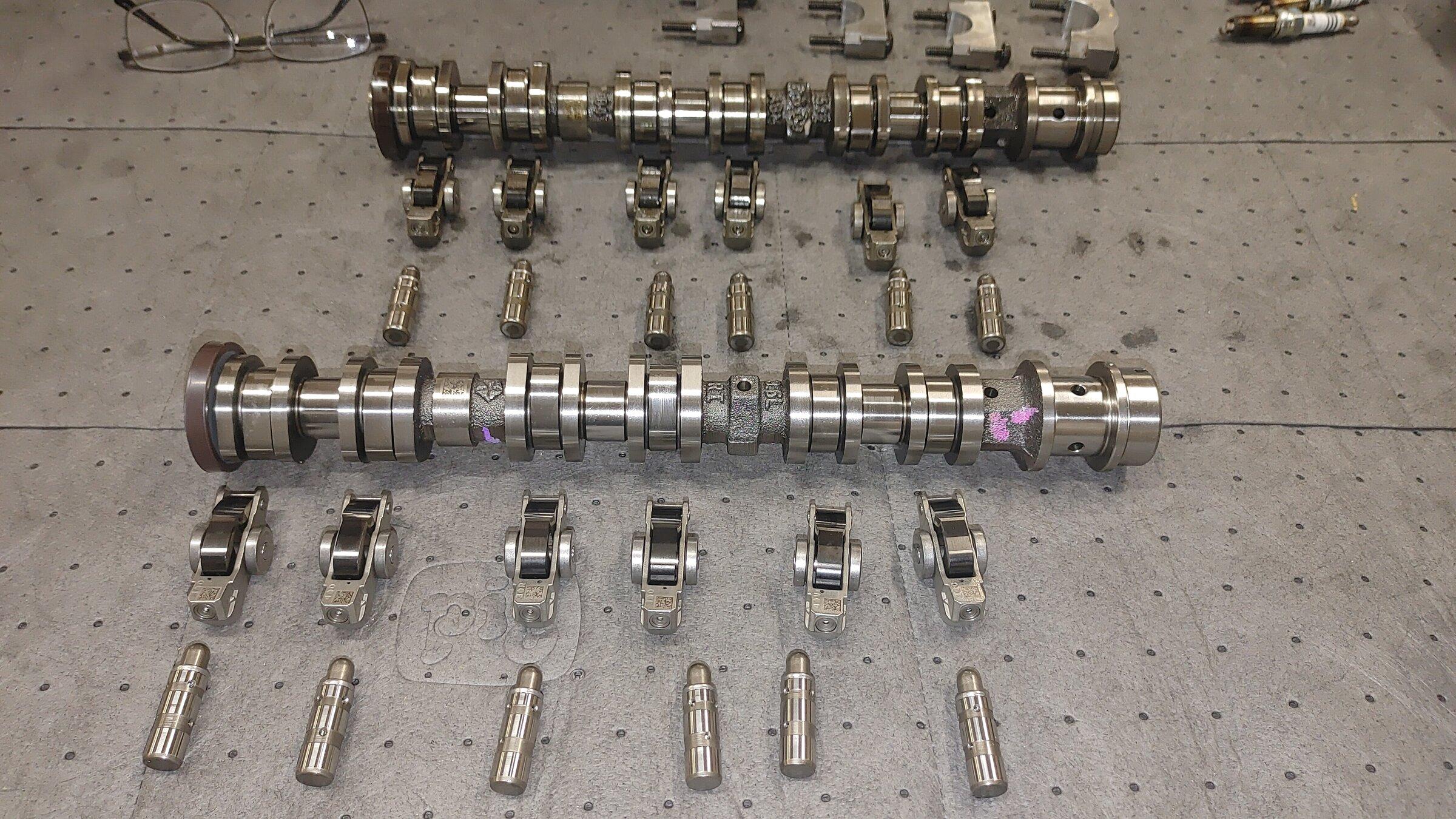
I will keep worrying and I am ok with that. That is my cam above. And it was wiped out at 26K. I use my truck as a truck and will continue to do so. On top of that I had superior tuning to stock. So this failure is real regardless of armchair qbing
 

Sponsored

DanW

Well-Known Member
First Name
Dan
Joined
Mar 2, 2017
Threads
45
Messages
1,878
Reaction score
2,460
Location
Brownsburg, Indiana
Vehicle(s)
21 JT Rubi, 18 JLU Rubi, 2008 JKU Rubi, 07 Vette
I will keep worrying and I am ok with that. That is my cam above. And it was wiped out at 26K. I use my truck as a truck and will continue to do so. On top of that I had superior tuning to stock. So this failure is real regardless of armchair qbing
I'm sorry for your troubles. But if that failed in 26k, it had nothing to do with oil unless you ran something non-spec. These things aren't dropping cams right and left. Or even rarely, for that matter.

I'd be curious what kind of tune you had. I'd also advise if using it as a truck, keep it stock. This engine does fine in Gladiators and Rams everywhere.

I's say getting an aftermarket tune is more of an armchair quarterback move than advising someone to stick to the manufacturer's recommendations.

But again, sorry to see that happen to yours. Not a fun deal, I'm sure.
 

DAVECS1

Well-Known Member
First Name
David
Joined
Jan 24, 2020
Threads
56
Messages
1,861
Reaction score
2,538
Location
Peoria, IL
Vehicle(s)
2020 Gladiator Sport S Max Tow
They are dropping consistently. And I created the "aftermarket" tune after taking a fair amount of data with the factory tune. We can agree to disagree. Also you cannot just lump the other models in with the jeep. Some do not run VVL some run restricted VVT. Some do not use lockpin timing and so on. The jeep specificly relys on getting beyond 3K before making substantial torque and if you use your Jeep you will be in that zone and will be running high cylinder pressures and increase valvetrain stress with an old fashioned metal on metal contact area that in my opinion needs protection. Does not necessarily mean high weight oil, but 0-20 would not be my first pick. I will be curious to see how 2018 and up 3.6s fall out. Many people complain about misfire and avenger lights. The truck will run with a damaged cam. Pretty quietly too. Just complains when you get on it and people will probably be clueless and live with it.
 

ShadowsPapa

Well-Known Member
First Name
Bill
Joined
Oct 12, 2019
Threads
247
Messages
40,463
Reaction score
53,912
Location
Runnells, Iowa
Vehicle(s)
'25 JTMX, '23 JLU 4xe, '82 SX4, '73 Javelin
Occupation
Retired auto mechanic, frmr gov't ntwrk security admin
Vehicle Showcase
3
Also, this isn't a boat engine. Few if anyone is ever going to run sustained rpm like that. Unless you have 4.88 gears and 30" Sport tires. Then maybe. But even then, the 0w20 will do just fine.
Ever towed with one and 3.73 gears? You see 3300 rpm quite a bit. (hills, lots of hills)

The jeep specificly relys on getting beyond 3K before making substantial torque and if you use your Jeep you will be in that zone and will be running high cylinder pressures and increase valvetrain stress with an old fashioned metal on metal contact area that in my opinion needs protection.
Yes, and if you drive I80 east of Altoona while towing 5,000 pounds you see that RPM pretty regular. No big deal, not really, my LS did the same thing - but I saw HIGHER RPM with it, frequently in the 5,000 rpm range. To make power to tow, you see high RPM a lot, especially on our hills (we aren't the mountains but even the big rig drivers complain about our hills and in the 1970s that bicentennial train had to call in extra locomotives to get through parts of this state. It was a big joke at the time as David Letterman on his daytime show had called Iowa "flat".


But if that failed in 26k, it had nothing to do with oil unless you ran something non-spec. These things aren't dropping cams right and left. Or even rarely, for that matter.
Actually, I found that it takes only seconds to find a lot of pictures of cam's exactly like Dave's. It's happening and there's a lot of complaints about it. Not "Common" but more than most engines. I did a search and was blown away by how fast I found pics that closely mirrored his experiences.


I's say getting an aftermarket tune is more of an armchair quarterback move than advising someone to stick to the manufacturer's recommendations.
You do know that he's a former tune writing guy, right? This isn't any experimental thing to try to squeeze HP. He's done this before. (for money) and there's a number of Jeep people running his tunes.

Jeep tunes these things to deal with the quirks of EPA testing - I got that straight out of the Jeep engineer's keyboard. They don't tune for life or what's "best", the whole drivetrain is tuned to take advantage of the EPA's testing scenario. They tune to the quirks to come out better.
 

DanW

Well-Known Member
First Name
Dan
Joined
Mar 2, 2017
Threads
45
Messages
1,878
Reaction score
2,460
Location
Brownsburg, Indiana
Vehicle(s)
21 JT Rubi, 18 JLU Rubi, 2008 JKU Rubi, 07 Vette
They are dropping consistently. And I created the "aftermarket" tune after taking a fair amount of data with the factory tune. We can agree to disagree. Also you cannot just lump the other models in with the jeep. Some do not run VVL some run restricted VVT. Some do not use lockpin timing and so on. The jeep specificly relys on getting beyond 3K before making substantial torque and if you use your Jeep you will be in that zone and will be running high cylinder pressures and increase valvetrain stress with an old fashioned metal on metal contact area that in my opinion needs protection. Does not necessarily mean high weight oil, but 0-20 would not be my first pick. I will be curious to see how 2018 and up 3.6s fall out. Many people complain about misfire and avenger lights. The truck will run with a damaged cam. Pretty quietly too. Just complains when you get on it and people will probably be clueless and live with it.
That's well and good, but the fact is you played with the tune.

We haven't seen a bunch of cam failures here or on the JL side, so not sure where you are getting your data. In fact, yours is the only one i recall seeing. If there are more, you can kindly point me to them.

So this begs two quick questions. What oil were you running in that engine up to 26k? And how were you running it above 3k all the time? Manual transmission? Auto in manual mode? My brother tows a 4500lb boat with his JTR on 35's with stock 4.10 gears and when cruising it doesn't run above 2800rpm. Only for short periods when accelerating. Mine wasn't even there cruising at 80. (4.56 gears, JLUR/manual, 35's)

So far what we have is 1. Custom tune.
2. Non-spec oil weight (implied. Maybe not)
3. Cam failure

Hard to condemn the 0w20 given this data.

Show me other examples of the cam failure here on the forum with the stock setup and factory recommended maintenance. And remember, there are now probably some 2 to 4 million of this version of the 3.6 on the road now. So it'd have to be significan to form a pattern.
 

DAVECS1

Well-Known Member
First Name
David
Joined
Jan 24, 2020
Threads
56
Messages
1,861
Reaction score
2,538
Location
Peoria, IL
Vehicle(s)
2020 Gladiator Sport S Max Tow
Up to 26k I ran Mopar 0-20 as recommend.

I personally have helped 16 different JL owners who could not make any headway with their dealer. When I showed them what data to log or worked with their dealer the diagnosis was quick and obvious.

The rattle at 3000 RPM is a well documented phenomenon, that laughably has had software update TSBs. That rattle is the clearance between the high lift cam and ground down cam closing as the oil is turned off from the VVL solenoid.

I don't spend a phenomenal amount of time above 3K. Infact my tune for my supercharger works to spend more time under 3K, and utilize the extra airflow to keep stress off the engine. I did not realized I had failed a cam until I was pulling my trailer loaded withe a car and the misfire code came up.

Would you run 0-20w in a flat tappet cam engine capable of turning 6000 rpm.

If your answer is yes, then we plainly disagree. If it is no, then you need to think aboit this everytime your engine sees 3000 rpm because that is what you are doing.

To boot Jeep has neglected to use all the safety strategies available with this OS that operates the 3.6L so it has little to no course correction when fuel is bad, weather is extreme, or your plain just giving it the beans for extended periods of time. There are routines that reduce timing, release cylinder pressure via cam VVT, and add fuel cooling as things get ruff. I have activated all of these and my engine can see extended HD operation and I have data that shows it cranking things down to survive and still perform. Infact when my cams failed, it worked around it and adjusted everything to keep running well.

The factory tune will not do this and if a person goes WOT with these cam problems it qill expire the engine, and I know of at least two machines this has happened to. Both are now running my tune.

I am not making this stuff up. I was a huge proponent of this engine, until I saw this failure mode. Now I am a bit upset and quite frankly extremely critical of the engineering that was executed and sold to us at a premium.

For reference. The challenger VVT and VVL do not start working until 4700 rpm, and there are large timing and cam sweeps that take place when it is activated. My guess is they purposely keep it out of this range as they know the car will never see a work cycle like our jeeps and they can get away with it.
Sponsored


Top