Sponsored

Strike Expanded to Parts Distribution

j.o.y.ride

Well-Known Member
Joined
May 26, 2020
Threads
96
Messages
2,937
Reaction score
3,915
Location
Foster City
Vehicle(s)
20 Gladiator Overland
They had me right up to the "work for 32 hours and get paid for 40 hours" demand.

Come on, man. All the rest make sense. But not that.
Possibly......it was a stupid demand for the Union to make. All it did was illustrate how ridiculous the Unions have become and galvanize people against them......

Y'all know why they did that right? Because it offers the makers an option of how to compensate them more. They offered more pay and they offered shorter weeks (so they can have more family time or pickup other work). They never expected BOTH more pay AND 32 hours. But if a manufacturer decided they would prefer the hour route vs cash pay, why not make it an option.
 

Aj58

Well-Known Member
Joined
Oct 31, 2022
Threads
28
Messages
546
Reaction score
713
Location
id
Vehicle(s)
24 Mojave X
Problem is it’s such an obvious throw away no one will take it serious. It’s also a point that erodes support for the uae and has been working against them.

just my thoughts but what do I know.
 

Sweetums

Well-Known Member
Joined
Mar 30, 2023
Threads
28
Messages
2,004
Reaction score
4,313
Location
Utah
Vehicle(s)
'05 LJR, '21 JTDR, '00 VFR800, RSV4, '11 MTS 1200
Possibly......it was a stupid demand for the Union to make. All it did was illustrate how ridiculous the Unions have become and galvanize people against them......

That's how negotiations work, both sides start with untenable demands and move towards the middle. No on expected the UAW staring position to be where they end up.
 

Orange01z28

Well-Known Member
First Name
Andrew
Joined
Aug 19, 2020
Threads
69
Messages
1,420
Reaction score
1,814
Location
Queen Creek Arizona
Vehicle(s)
2020 JTR
That's not a bug, it's a feature. The point of a strike is to disrupt and hopefully the C-Suite suits at the Big 3 are factoring that long term impact into their calculus of whether to pay their workers. Strikes end when the cost of prolonging outweigh the cost of settling, the suits think the workers will blink first and capitulate, the union's answer is to tighten the screws.

It will come to an end when the accountants do the math and realize the strike is costing them more than they would lose by settling.

So the purpose is to destroy the whole industry. What happens to the union jobs then?
 

Sponsored

Jefe1018

Well-Known Member
Joined
Mar 4, 2020
Threads
48
Messages
3,116
Reaction score
5,230
Location
NV
Vehicle(s)
Sold the 21 JT Rubi Ecodiesel, now a 4.5 gen Powerwagon
Build Thread
Link
So the purpose is to destroy the whole industry. What happens to the union jobs then?
I don’t think anything has been destroyed quite yet. The cost involved in hiring, vetting and training an entirely new work force would probably break the company, they’ll settle soon enough.
 

Orange01z28

Well-Known Member
First Name
Andrew
Joined
Aug 19, 2020
Threads
69
Messages
1,420
Reaction score
1,814
Location
Queen Creek Arizona
Vehicle(s)
2020 JTR
I don’t think anything has been destroyed quite yet. The cost involved in hiring, vetting and training an entirely new work force would probably break the company, they’ll settle soon enough.
Would it though?
 

Jefe1018

Well-Known Member
Joined
Mar 4, 2020
Threads
48
Messages
3,116
Reaction score
5,230
Location
NV
Vehicle(s)
Sold the 21 JT Rubi Ecodiesel, now a 4.5 gen Powerwagon
Build Thread
Link
Would it though?
Well they are probably losing a pretty penny every day so I would say so.

Let's say they just decide to go out and hire a brand new work force with no representation, the bigger the organization the more red tape you have to get through. Recruiting, interviewing, offers going out, background checks (we might think not a big deal, but their insurers probably do not), on-boarding, orientations, training, getting benefits up and running, etc. I would imagine there would be no 2024 model years hitting the lots for quite some time and when they did, quality probably wouldn't be at its best.

 

Orange01z28

Well-Known Member
First Name
Andrew
Joined
Aug 19, 2020
Threads
69
Messages
1,420
Reaction score
1,814
Location
Queen Creek Arizona
Vehicle(s)
2020 JTR
Well they are probably losing a pretty penny every day so I would say so.

Let's say they just decide to go out and hire a brand new work force with no representation, the bigger the organization the more red tape you have to get through. Recruiting, interviewing, offers going out, background checks (we might think not a big deal, but their insurers probably do not), on-boarding, orientations, training, getting benefits up and running, etc. I would imagine there would be no 2024 model years hitting the lots for quite some time and when they did, quality probably wouldn't be at its best.
Sure, but in the long run?

All a pipe dream afterall
 

Wolf Island Diver

Well-Known Member
Joined
Apr 14, 2021
Threads
26
Messages
1,117
Reaction score
2,450
Location
Virginia
Vehicle(s)
2021 JT Rubicon EcoDiesel
Occupation
Software Engineer
All they are doing is pushing american buyers to Japanese vehicles.

Like most things, it’s quite a lot more complicated than that. I could say that ship has already sailed. But it’s actually sailed multiple times and it’s also sailed back. I’m reluctant to weigh in on this at all. I really don’t understand the uniquely American propensity to vehemently argue against one owns self interest as a working person. Unless you derive your income, mostly or exclusively from the holding of capital you are working person. People all the time self identify as capitalists but that’s sort of like me saying I’m a self-identified billionaire or self-identified Martian. A capitalist is a functional definition not some one who thinks capitalism is a good system. In that sense I’m a capitalist. But I’m a wage earner. The excess of my productivity, like all wage earners, is funneled and aggregated upwards to the maximum benefit of actual capitalists. And they don’t care about my views on that fact. And not being a capitalist doesn’t mean you’re a socialist. You’re a wage earner or you’re on the dole.

It strikes me as as odd and a little Orwellian that so many working Americans are so concerned for the folks at Blackrock and Vanguard. In some ways worrying about capitalists is anti-capitalist since they’re supposed to survive the market, not be coddled. But also it’s the constant drumbeat of propaganda that if anything bad happens to them consumers and workers and tax payers will be made to suffer. It’s a classic shakedown, albeit a sophisticated one powered by think tanks and media.

The first big migration actually happened in the 1970s with the oil crisis. The vehicles that American makers were building in the 1970s were really a slap in the face to normal Americans. Big heavy ugly expensive poorly made gas guzzling junk designed to appeal to the piston-head id of Americans, not the actual needs of consumers. Hey I’d love a Hemi Cuda too, but that’s not what we all needed to be driving. The Japanese came in with cars that worked, got reasonable mileage and served Americans needs far better. They were cheaper, well-enough made and cleverly designed. Mostly not exciting, and mostly not soulful, but they suited the needs of the people. The American automobile industry responded by trying to make fuel efficient vehicles that turned out to mostly be dangerous junk because they tried to do it on the cheap. When it worked, it was usually a case of a rebranded Japanese vehicle.

Unfortunately, God love us, we as a society have to competing and contradictory qualities. We’re natural innovators and American culture not only promotes this, but demands it. At the same time, we’ve baked short term profit-seeking-at-all-costs so fundamentally into the system by the way we compensate corporate leadership that it begins to undermine those better qualities. The story of the big three is a continuous cycle of brilliant innovation coupled with stagnation cynical ploys and cost cutting and cost shifting onto consumers, employees and the environment. There’s a lot of pre-1980 history I’m not going to dig into. Read about Thomas Midgley. Read about Sir Antony Fisher and the Powell Memorandum. Read about the damage us automakers did to the cities where they operated. How they poisoned the Great Lakes and their own employees.

But let’s look at the modern post 70s era.

Case in point is Ford. Ford spent a billion dollars creating the modern sedan with the Taurus. I don’t think people quite appreciate how revolutionary it was. Then they invented the modern SUV with the Explorer. Ford should have become the dominant player in the industry globally. Instead they chased profits via cutting costs, lost market share and went bankrupt. They made dangerous cost-cutting design changes and they made junk. The corporate greed approach doesn’t actually work as well because it focuses on short term gains to the detriment of long term strategy.

American cars across the big 3 in the 1990s were absolute junk and American consumers aren’t fools. At least not for long. I remember this well. It’s when they lost my dad. A Nixon guy. A guy who volunteered for Nam. A self-proclaimed “body and fender man” and a “Ford Man”. Tired of working on Fords, he discovered Mazda and Toyota and Nissan. My first vehicle was a Nissan truck. Having worked on cars his entire life, refusing to take a car to a mechanic on GP, he got to where he said he’d rather work on a Mazda from a badly translated Japanese factory service manual than work on a Ford because it was easier. If American big iron could lose my dad they were in trouble. This was the second big wave of Americans moving to Japanese makes.

The Japanese couldn’t innovate their way out of a cardboard box, but they could refine and improve and reinvest in their own products and production. This state of things really continued until the second decade of the 21st century when American makers started waking up. Americans started coming back. My dad went back or at least like a lot of Americans bought an Chevy pickup and a Toyota SUV. The quality of American cars today is largely on-par with Japanese makes and frequently better.

Of course the other thing people seem to forget is that Japanese vehicles are mostly made here. If you buy a Toyota truck it’s made by Americans. My 91 Nissan was made in Tennessee. Until they got rid of their cars, if you bought a Ford compact, it was made in Mexico. And cars are global. The engines in the Chevy Equinox are made in China. And this isn’t new. The 1980s Chevy Nova was a Toyota. Cars are assemblages of parts from a global supply chain. Covid supply disruptions made that fact crystal clear.

This entire strike is about American workers being paid a fair share of the record profits these globally-owned “American” companies are making. It’s funny to me that this sort of thing is only controversial here. When Volkswagen opened a factory in Tennessee the company itself tried to get the workers to join the union. In Germany Volkswagen is partially owned by the city of Wolfsburg. It’s heavily and uncontroversially unionized as are all European car companies in Europe. Sweden practices a system called Tripartism where the interests of companies, workers and the people through their low-corruption and highly accountable government are considered together. The result is a more competitive workforce and more incentives for private enterprise, not some communist dystopia. They even create more billionaires per capita. In the case of the Volkswagen factory, it was actually American politicians lead by former Senator Bob Corker who pushed back against the wishes of the company itself and convinced the workers to vote against unionization. Why? To further weaken unionization in the United States in general. It was a stunning encroachment on free-enterprise by government actors. Is anyone really so gullible to believe that American companies and by extension politicians are anti-union because they care about employees or consumers? The statistics are clear, that within the same industry union workers make more money. That’s the whole reason they’re anti union. There’s no deeper plot here. Union workers get paid more and more and more companies are seeking higher profits not through innovation but through downward pressure on costs. It’s why jobs went to China. It’s why they’ve spent billions trying to convince Americans to vote against their own self-interest. And I’m not talking about D vs R. I’m talking about politicians and policies across the political spectrum that are engineered to benefit a tiny percentage of the population at the expenses of everyone and everything else.

I’ve been employed as a union Firefighter and by a heavily unionized defense contractor both as an hourly employee, although I didn’t join the union, and as management and as a salaried engineer. Oddly enough any salaried job is considered exempt from unionization. I’ve never received any sort of direct increase in benefits or pay beyond optional and inconsistent “merit” increases or a promotion at any company as a salaried employee except when working for a heavily unionized company as an exempt employee. In those cases every time the union negotiated a better contract salaried employees like myself would get a bump in pay and benefits as well. And yet my moron colleagues in engineering would still complain about the union, not that they’d ever step foot down in production, who despite not representing us got us all an 8% bump in pay or better health insurance. Unlike hourly workers, we still had no rights as employees to collectively address issues with management and zero protection from abuse beyond extremely weak employee laws in my state. The salaried world was a bunch of people complaining about how badly we were treated. The union workers had a myriad of protections. So people complained about that too. That seems like a pretty childish and perverse logic. Let’s take something away from those who pay into a system we don’t have because we’re unwilling to organize.

What will happen is not a move to Japanese vehicles made elsewhere. In fact I don’t think consumers will notice a single thing from a new UAW contract. Cars are going to cost what the markets will bear. Apparently Jeep people are willing to pay $20k for an V8 option. Or maybe they’re not and soon people will be able to get a 392 for 15% off. As far as I’m concerned, since I’m not rich and not an “influencer” Jeep can shove the 392 up their asses. I don’t begrudge anyone who buys their dream V8 Jeep. You do you. Back on track, again, most Japanese vehicles and all trucks are made here! If out of $21B in profit, $4B goes to the workers and the response is to raise the cost of the vehicles to make that back up so Blackrock doesn’t have to take a small haircut then they deserve to loose share to Toyota and its American workers anyway. But that’s not going to happen.

What will happen is a rising tide across the sector. Non-union factories in the South will be incentivized through labor market pressure to increase wages. Salaried employees at these companies will receive increases too. You can’t have engineers making less than assembly line workers in most cases. This will affect the whole market for these jobs as well. In the coming months, my company will begin looking at our pay schedules. Like everyone else they will look at labor data that cuts across sectors to job titles and they will adjust based on going rates. Ignoring for a moment the simple fact that more money in the pockets of employees who are also consumers means more economic activity, more opportunities for markets, more incentives for people to start small businesses, etc., Its never a bad thing for other folks to get a raise even in different industries because it has ripple effects throughout the labor market.

If you are a wage earner or retiree and a consumer you should be rooting for the UAW and not submitting to the threats and lies of the handful of billionaire investors and their manufactured consent industrial complex.
 

Sponsored

legacy_etu

Well-Known Member
First Name
Brian
Joined
May 19, 2021
Threads
3
Messages
1,446
Reaction score
1,786
Location
New England, USA
Vehicle(s)
23 Mojave, 25 Corvette Eray, 16 Wrangler UNLTD,
Balls. I even had an appointment set for the end of October hoping parts would be available.

I still stand with the workers on this, they were asked to give up a ton to keep the automakers afloat during COVID and now that the car companies are making record profits, they don't want to give it back.
Agreed. What they should have done when they last made concessions is worked into the contract a sunset (sunrise?) clause that gave The UAW everything they gave up and then some on top once a certain level of profitababilty was hit.
Of course then you’d have all sorts of games being played by the accountants with the books but as it stands now they're now starting from scratch.
 
Last edited:

Wolf Island Diver

Well-Known Member
Joined
Apr 14, 2021
Threads
26
Messages
1,117
Reaction score
2,450
Location
Virginia
Vehicle(s)
2021 JT Rubicon EcoDiesel
Occupation
Software Engineer
On the whole 32 hours thing. Again this is a case of the propaganda doing its job.

In the early 20th century weekly hours dropped from 60 to 40 hours. The 40 hour workweek wasn’t brought down from the mountain top by Moses. It was a function of increasing worker productivity. There’s no rule that says humans have to organize civilization around it. At one time humans worked sun up to sun down 7 days a week until they dropped dead. The decline from that to the terrible working conditions of the early 20th century to the standard 40 hour work week was the natural decline in hours from productivity gains and more importantly workers rights movements through….unions. It lead probably the most important economist in human history, in terms of effect, John Maynard Keynes to predict in 1930 that by the late middle-twentieth century the average worker would put in about 15 hours a week. This was again based on the trends of worker productivity that lead to previous drops.

Obviously Keynes was wrong. But he was wrong in two critical ways. First the 40 hour work week has remained extremely durable. Although many of us would love to be able to work only 40 hours a week. I’m on call 24/7/365. I work on vacation and carry a laptop with me all the time. I also am highly compensated. But what also happened is that worker productivity not only continued increasing with no obvious upper bound far exceeding the point where hours would drop to 15 hours a week while maintaining the same net aggregate output, but productivity has actually increased non-linearly at times. According to Keynes we should have been at 15 hours back in the 60s or 70s. What happened?

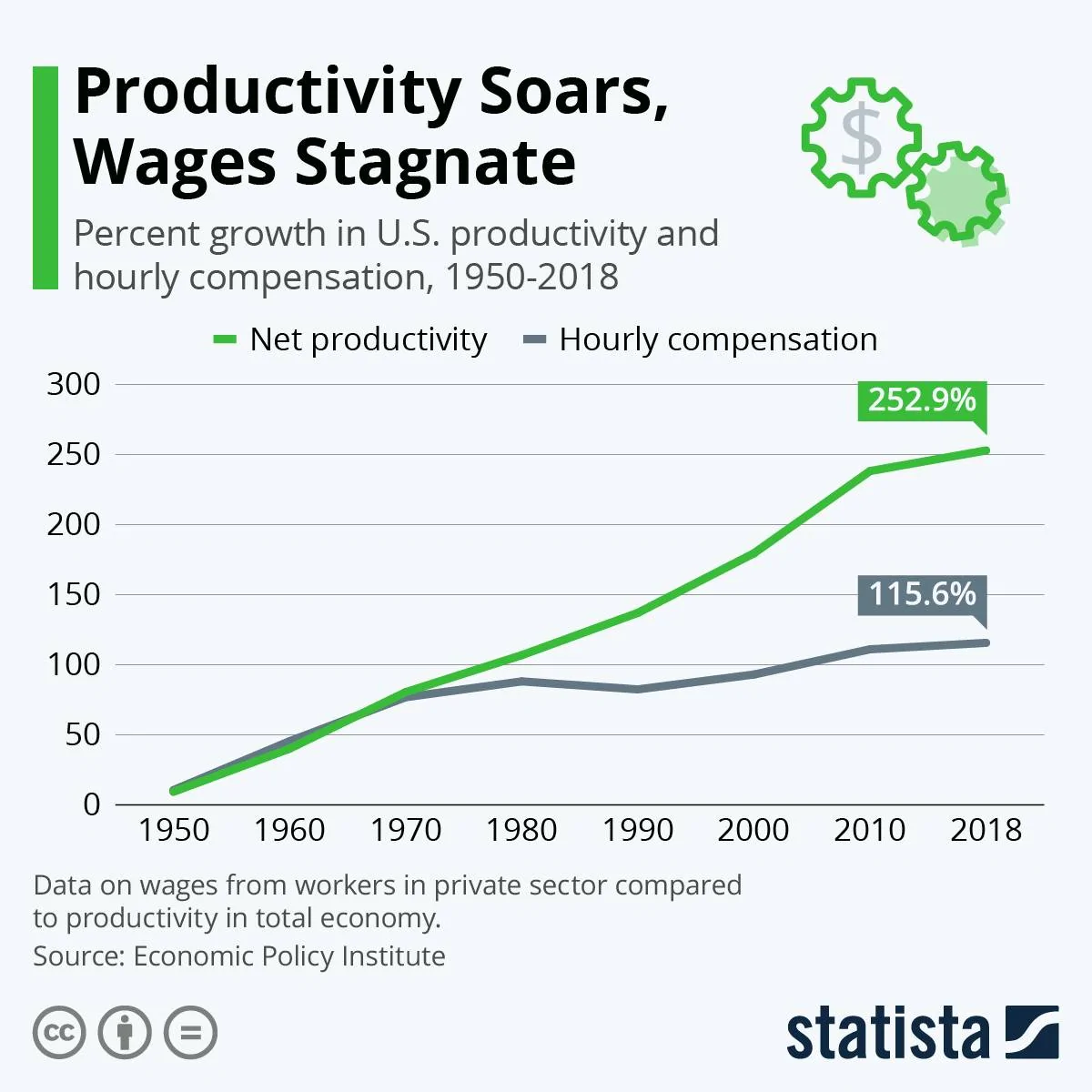
Theres many versions of this same chart all over the place but they all say the same thing.
Jeep Gladiator Strike Expanded to Parts Distribution IMG_2231


What Keynes didn’t even address, let alone predict is what economists call The Great-Divide or the Wage-Productivity Gap. Since the early 1970s wages and productivity has become decoupled. Where did that money go? It didn’t go to welfare queens or government excess, or illegal migrants. It investors, banks, and essentially the people who own the controlling interest in major corporations. And today there exists a wealth disparity that exceeds the gilded age and is heading back toward what existed during feudalism. At that point, there will be little functional difference between an Employer and a Lord. Keynes would have been shocked that not only did hours not decrease despite and steady increase in productivity, but that wages actually have gone down simultaneously.

This speaks to what the UAW is asking for. Either more wages or less hours. But critically everyone in the labor market has lost out on both counts, working more hours for less wages. Nothing they are demanding brings them back in line with productivity gains. They’re asking for a larger amount of the crumbs. American workers today effectively make less than they did even in the 1970s when the decoupling began.

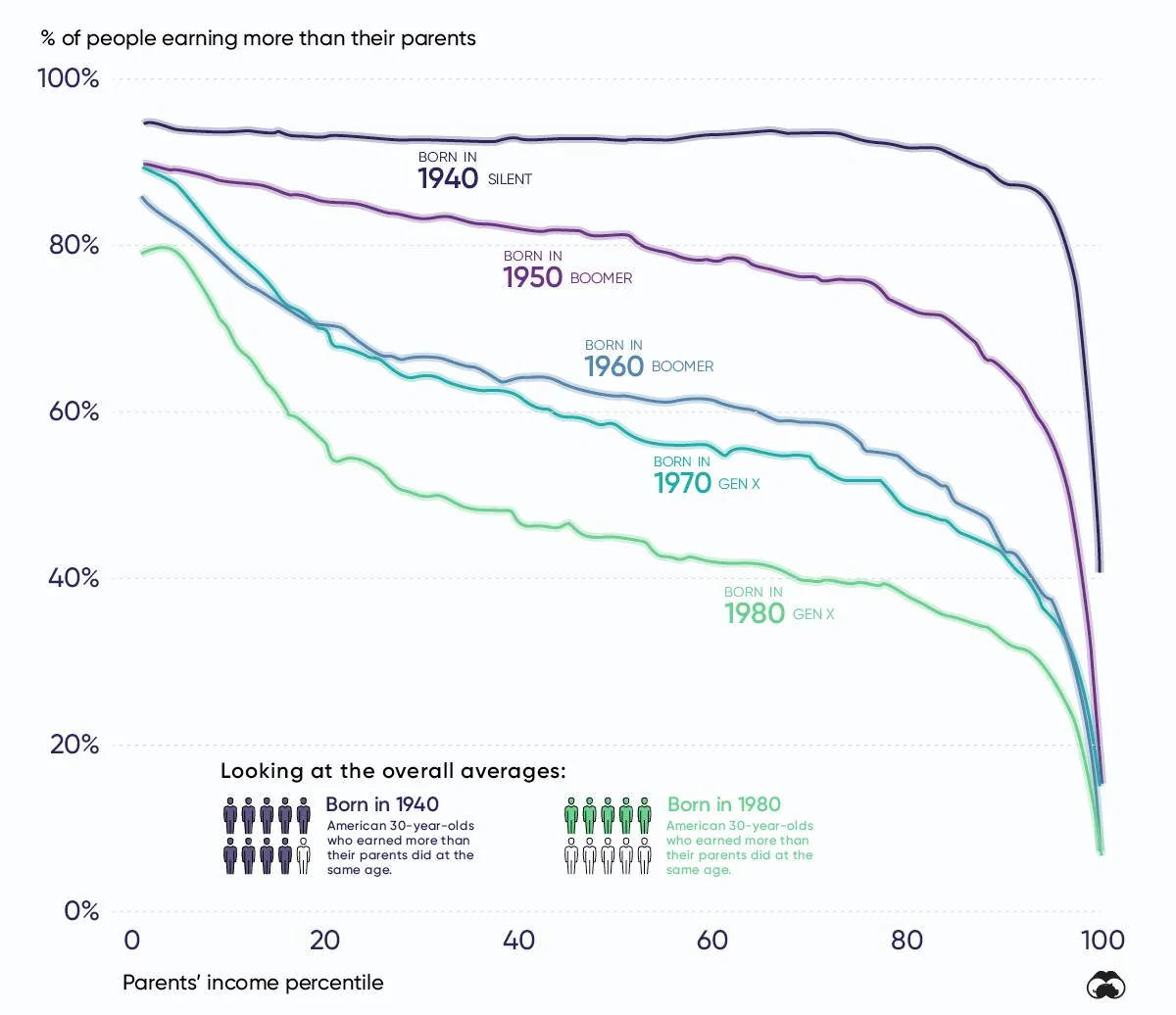
The net affect of this loss is loss of upward mobility.
Jeep Gladiator Strike Expanded to Parts Distribution IMG_2232


So again, unless you’re one of these people who own massive amounts of capital, you’re not benefiting from this. The statistical probability of you breaking out of this pattern and becoming wealthy are essentially zero. The single largest predictor of your future wealth is your parent’s wealth. The merely affluent, the upper 10% or even 1% actually have essentially zero upward mobility. Nor are you benefiting from complaining about UAW workers working less hours. Middle income people complaining about middle income people making more money is like two subway rats fighting over an abandoned slice of pizza.

Now, I know some people “who do their own research” on YouTube will quickly jump on the first chart and note that “that’s when we left the gold standard.” This is more manufactured propaganda. Actually it’s more like flat eartherism. It’s not even correct that we left the gold standard in 1971. We did that in 1933. We left abandoned the Bretton-Woods regime in the 1970s. If you don’t understand Bretton-Woods, please don’t talk about metal-based vs fiat currencies. No serious economist thinks the gold standard caused the wage-productively gap nor thinks returning to the gold standard is a good idea but that topic could fill a book. There’s a much more direct, obvious and logical explanation for the productivity-wage gap that’s existed for as long as humans began organizing into societies and it’s borne out in the date. The explanation is greed and power.
 

Hootbro

Well-Known Member
First Name
Don
Joined
Apr 13, 2019
Threads
57
Messages
10,176
Reaction score
19,942
Location
Delaware
Vehicle(s)
2025 Gladiator Sport
Y'all know why they did that right? Because it offers the makers an option of how to compensate them more. They offered more pay and they offered shorter weeks (so they can have more family time or pickup other work). They never expected BOTH more pay AND 32 hours. But if a manufacturer decided they would prefer the hour route vs cash pay, why not make it an option.
It is the Union dues coffers that will make out if they get either or both their demands.

Union dues are usually based on 2X to 2.5X hourly rate per month or in some cases 1%-2% of a workers gross.

Going to 32 hour work week is goes out the window in reality if plant operations go to added shifts and/or a 7 day work week. That means either getting existing employees to fill out those spots with extend hours paying time and half or even double time beyond certain hours worked and/or the company has to hire in more workers and that means more dues paying members.
 

Sweetums

Well-Known Member
Joined
Mar 30, 2023
Threads
28
Messages
2,004
Reaction score
4,313
Location
Utah
Vehicle(s)
'05 LJR, '21 JTDR, '00 VFR800, RSV4, '11 MTS 1200
So the purpose is to destroy the whole industry. What happens to the union jobs then?
Why is it the union that's "destroying the entire industry" and not the c-suite suits being paid millions every year to *not* pay workers a fair wage? The automakers could have avoided this by offering fair and sustainable compensation.

Auto company profits have never been higher, but you're blaming blue collar workers who just want a fair share of what they produce when the boardroom is sitting on a dragon's hoard of cash.
 

Sweetums

Well-Known Member
Joined
Mar 30, 2023
Threads
28
Messages
2,004
Reaction score
4,313
Location
Utah
Vehicle(s)
'05 LJR, '21 JTDR, '00 VFR800, RSV4, '11 MTS 1200
On the whole 32 hours thing. Again this is a case of the propaganda doing its job.

In the early 20th century weekly hours dropped from 60 to 40 hours. The 40 hour workweek wasn’t brought down from the mountain top by Moses. It was a function of increasing worker productivity. There’s no rule that says humans have to organize civilization around it. At one time humans worked sun up to sun down 7 days a week until they dropped dead. The decline from that to the terrible working conditions of the early 20th century to the standard 40 hour work week was the natural decline in hours from productivity gains and more importantly workers rights movements through….unions. It lead probably the most important economist in human history, in terms of effect, John Maynard Keynes to predict in 1930 that by the late middle-twentieth century the average worker would put in about 15 hours a week. This was again based on the trends of worker productivity that lead to previous drops.

Obviously Keynes was wrong. But he was wrong in two critical ways. First the 40 hour work week has remained extremely durable. Although many of us would love to be able to work only 40 hours a week. I’m on call 24/7/365. I work on vacation and carry a laptop with me all the time. I also am highly compensated. But what also happened is that worker productivity not only continued increasing with no obvious upper bound far exceeding the point where hours would drop to 15 hours a week while maintaining the same net aggregate output, but productivity has actually increased non-linearly at times. According to Keynes we should have been at 15 hours back in the 60s or 70s. What happened?

Theres many versions of this same chart all over the place but they all say the same thing.
IMG_2231.jpeg


What Keynes didn’t even address, let alone predict is what economists call The Great-Divide or the Wage-Productivity Gap. Since the early 1970s wages and productivity has become decoupled. Where did that money go? It didn’t go to welfare queens or government excess, or illegal migrants. It investors, banks, and essentially the people who own the controlling interest in major corporations. And today there exists a wealth disparity that exceeds the gilded age and is heading back toward what existed during feudalism. At that point, there will be little functional difference between an Employer and a Lord. Keynes would have been shocked that not only did hours not decrease despite and steady increase in productivity, but that wages actually have gone down simultaneously.

This speaks to what the UAW is asking for. Either more wages or less hours. But critically everyone in the labor market has lost out on both counts, working more hours for less wages. Nothing they are demanding brings them back in line with productivity gains. They’re asking for a larger amount of the crumbs. American workers today effectively make less than they did even in the 1970s when the decoupling began.

The net affect of this loss is loss of upward mobility.
IMG_2232.jpeg


So again, unless you’re one of these people who own massive amounts of capital, you’re not benefiting from this. The statistical probability of you breaking out of this pattern and becoming wealthy are essentially zero. The single largest predictor of your future wealth is your parent’s wealth. The merely affluent, the upper 10% or even 1% actually have essentially zero upward mobility. Nor are you benefiting from complaining about UAW workers working less hours. Middle income people complaining about middle income people making more money is like two subway rats fighting over an abandoned slice of pizza.

Now, I know some people “who do their own research” on YouTube will quickly jump on the first chart and note that “that’s when we left the gold standard.” This is more manufactured propaganda. Actually it’s more like flat eartherism. It’s not even correct that we left the gold standard in 1971. We did that in 1933. We left abandoned the Bretton-Woods regime in the 1970s. If you don’t understand Bretton-Woods, please don’t talk about metal-based vs fiat currencies. No serious economist thinks the gold standard caused the wage-productively gap nor thinks returning to the gold standard is a good idea but that topic could fill a book. There’s a much more direct, obvious and logical explanation for the productivity-wage gap that’s existed for as long as humans began organizing into societies and it’s borne out in the date. The explanation is greed and power.
Hey, get out of here with your "data" and "facts" and "evidence based policies" - this is a place for blind internet rage and unfounded emotional responses.
Sponsored


Top