
Sponsored
KurtP
Well-Known Member
c’mon man. You remember what happened the last time you tried going down this road. are we really going to do it again?Thermodynamically superior? Please show me your proof?
Is that why they (roots style) blowers have to sit at the track for about an hour between passes or you have to ice the crap out of the manifold? I've had 3 roots vehicles and they are good for one good hit/pull and the rest is heat soak and pull a bunch of timing.
As for mechanically superior? We use a non Newtonion fluid that changes properties so that creates traction and creates the grip to the bearings. Thus there is no whine and can spin 90k rpm.
More Whine = making more heat.
https://www.jeepgladiatorforum.com/...jave-and-why-tvs-is-better-than-centri.48306/
itsdapk
Peak Sponsor (Level 2)
- First Name
- PK
- Joined
- Feb 20, 2020
- Threads
- 18
- Messages
- 296
- Reaction score
- 431
- Location
- Forked River,NJ
- Website
- www.hamburgerssuperchargers.com
- Vehicle(s)
- 2021 Mojave , 2019 Ram
- Occupation
- Sales Manager @ Hamburger's Superchargers
The thermal image is not from Procharger since we are NOT Procharger.. If you are going to lie, there is nothing more to discuss. As for abandoning the post, I don't live my life on the internet. I let people drive my Mojave kit all over the country. If you compare our stock powertrain warranty file to a custom tuned file it is not a fair comparison anywhere, anytime. We have over 150 Gladiators around the world running the same tune. Just like this individual switched from our to another, there are plenty of people who switched from theirs to ours. Its a matter of preference.Ooooh. Newtonian fluid!?! Zomg.
i dont have time to answer this in detail now, but given the last time we did this dance you decided the best option was to abandon the thread and disappear for a while, Im quoting it so I can deal with it later.
I REALLY hope you try to use that “thermal image” from Procharger again. You were about to last time and thought better of it, but I’ll gladly unpack it again.
people following along can start here. I’ll check back later and see if you want to go down this road a second time. ?
https://www.jeepgladiatorforum.com/...jave-and-why-tvs-is-better-than-centri.48306/
itsdapk
Peak Sponsor (Level 2)
- First Name
- PK
- Joined
- Feb 20, 2020
- Threads
- 18
- Messages
- 296
- Reaction score
- 431
- Location
- Forked River,NJ
- Website
- www.hamburgerssuperchargers.com
- Vehicle(s)
- 2021 Mojave , 2019 Ram
- Occupation
- Sales Manager @ Hamburger's Superchargers
Again, If your kit requires a custom tune after you spent all that $, how is it better? I visit literally several hundred shops a year. I may not be as technical which I am willing to admit. But after owning all types of power adder vehicles from 600-1000 rwhp, Faster recovery goes to any centrifugal from heat soak. As for our kits, we don't chase hp numbers. We make a street kit with good power, part throttle boost that no other kit has, and amazing drivability. And the most superior of the roots blowers is Whipple. 
KurtP
Well-Known Member
sigh. ok. Look, Hamburger and procharger both make a fine hardware kit and people over all seem happy with the components and the service, but that isnt what we are talking about.The thermal image is not from Procharger since we are NOT Procharger.. If you are going to lie, there is nothing more to discuss. As for abandoning the post, I don't live my life on the internet. I let people drive my Mojave kit all over the country. If you compare our stock powertrain warranty file to a custom tuned file it is not a fair comparison anywhere, anytime. We have over 150 Gladiators around the world running the same tune. Just like this individual switched from our to another, there are plenty of people who switched from theirs to ours. Its a matter of preference.
-you abandoned the post because you were spectacularly called out. Nothing more.
-you never posted your thermal image. You set up for it, and were about to, and thought better of it after I talked about it. That was wise on your part, if not too late. I still think it was going to be the procharger one because that’s where you used to work. In the end, procharger or hamburger is irrelevant, its the same.
the rest of your post is meaningless sales points.
previously, We asked over and over again for your thermal data. You never posted it, either because you dont have it or you dont like what it said.
the facts:
-a centri blower heats up air more per psi than a TVS does.
-dave posted his thermal data showing the IC system manages IAT’s just fine.
-edelbrock has posted thermal data showing their system does as well.
-the file is irrelevant. Your file IS a custom file for your kit. last I checked, you dont have CARB compliance on account of your emissions. Which means you’re leaning the cams and cooling the charge with fuel to make your performance numbers. Dave does the same thing. The “factory” File for edelbrock and mag have carb compliance, with all the restrictions that comes with, and still make more tq than your kit. That isnt a surprise, is it? TVS rotors make more boost earlier and more tq, and I know you arent trying to argue that.
-we previously discussed and showed data both from blowers and phenolic spacers that conductive heat from manifolds or rotor housings has very VERY little impact on IAT’s, so while the “thermal image” cameras work great for marketing, it doesnt fool people who know to look for IAT info.
-its a scientific fact that water pulls heat ~24x faster than air.
what else do we want to talk about?
Sponsored
KurtP
Well-Known Member
goodness. Stop with the marketing speak. Please.Again, If your kit requires a custom tune after you spent all that $, how is it better? I visit literally several hundred shops a year. I may not be as technical which I am willing to admit. But after owning all types of power adder vehicles from 600-1000 rwhp, Faster recovery goes to any centrifugal from heat soak. As for our kits, we don't chase hp numbers. We make a street kit with good power, part throttle boost that no other kit has, and amazing drivability. And the most superior of the roots blowers is Whipple.
yes. A gen 5 whipple runs about half a degree more efficient per psi than a TVS, but doesnt have the same bottom end hit a TVS does. Both are great rotor packs.
faster recovery based on what? With sufficient pump speed you can run back to back to back to back. If you want to run a ton of boost, change from a 7gpm pump to a 20gpm. It’s almost impossible to heat soak the system at that point.
again, there is a reason cars arent aircooled anymore. Heck. Turbo cars dont even run AA ic’s from factory anymore, for the most part.
DAVECS1
Well-Known Member
- First Name
- David
- Joined
- Jan 24, 2020
- Threads
- 56
- Messages
- 1,861
- Reaction score
- 2,538
- Location
- Peoria, IL
- Vehicle(s)
- 2020 Gladiator Sport S Max Tow
I would be interested in doing a tune for the Hamburger kit, you can have it, and use it for your production kit. I have looked over your current calibration and there is some low hanging fruit. If I had a bit more data, there looks to be some airflow we can capture down low.
itsdapk
Peak Sponsor (Level 2)
- First Name
- PK
- Joined
- Feb 20, 2020
- Threads
- 18
- Messages
- 296
- Reaction score
- 431
- Location
- Forked River,NJ
- Website
- www.hamburgerssuperchargers.com
- Vehicle(s)
- 2021 Mojave , 2019 Ram
- Occupation
- Sales Manager @ Hamburger's Superchargers
sigh. ok. Look, Hamburger and procharger both make a fine hardware kit and people over all seem happy with the components and the service, but that isnt what we are talking about.
-you abandoned the post because you were spectacularly called out. Nothing more.
-you never posted your thermal image. You set up for it, and were about to, and thought better of it after I talked about it. That was wise on your part, if not too late. I still think it was going to be the procharger one because that’s where you used to work. In the end, procharger or hamburger is irrelevant, its the same.
the rest of your post is meaningless sales points.
previously, We asked over and over again for your thermal data. You never posted it, either because you dont have it or you dont like what it said.
the facts:
-a centri blower heats up air more per psi than a TVS does.
-dave posted his thermal data showing the IC system manages IAT’s just fine.
-edelbrock has posted thermal data showing their system does as well.
-the file is irrelevant. Your file IS a custom file for your kit. last I checked, you dont have CARB compliance on account of your emissions. Which means you’re leaning the cams and cooling the charge with fuel to make your performance numbers. Dave does the same thing. The “factory” File for edelbrock and mag have carb compliance, with all the restrictions that comes with, and still make more tq than your kit. That isnt a surprise, is it? TVS rotors make more boost earlier and more tq, and I know you arent trying to argue that.
-we previously discussed and showed data both from blowers and phenolic spacers that conductive heat from manifolds or rotor housings has very VERY little impact on IAT’s, so while the “thermal image” cameras work great for marketing, it doesnt fool people who know to look for IAT info.
-its a scientific fact that water pulls heat ~24x faster than air.
what else do we want to talk about?
I would be interested in doing a tune for the Hamburger kit, you can have it, and use it for your production kit. I have looked over your current calibration and there is some low hanging fruit. If I had a bit more data, there looks to be some airflow we can capture down low.
So your saying engine heatsoaked water/coolant cycled on a closed system is more efficient ambient air? And the simplest reason for OEMS(even our 800- 1100 hp vehicles) for air to water is packaging. It is so much easier to do a heat exchanger in comparison of real estate of big air to air.goodness. Stop with the marketing speak. Please.
yes. A gen 5 whipple runs about half a degree more efficient per psi than a TVS, but doesnt have the same bottom end hit a TVS does. Both are great rotor packs.
faster recovery based on what? With sufficient pump speed you can run back to back to back to back. If you want to run a ton of boost, change from a 7gpm pump to a 20gpm. It’s almost impossible to heat soak the system at that point.
again, there is a reason cars arent aircooled anymore. Heck. Turbo cars dont even run AA ic’s from factory anymore, for the most part.
KurtP
Well-Known Member
yes.So your saying engine heatsoaked water/coolant cycled on a closed system is more efficient ambient air? And the simplest reason for OEMS(even our 800- 1100 hp vehicles) for air to water is packaging. It is so much easier to do a heat exchanger in comparison of real estate of big air to air.
AW setups are more efficient than AA setups. everyone who has tested this has come to the same conclusion, which is why even OEM’s are switching to it.
Audi. Mercedes. Bmw. Mclaren. Porsche. Department of Boost. APR. Dinan. AWE.
The list goes on. Heck. Even ProCharger offers an AW ic setup now, I think?
To have an AA system test higher thermal efficiency, you need a mix of a couple things. First, the AA core and the compressor have to be gargantuan.
Then, you need an AW system without either a HX or pump or both, or drive the size or speed of the rotorpack past the capabilities of one of the IC components. The pump is usually the weak link.
where the AA people get off comparing their systems usually works like this: “here is our oversized compressor flowing high cfm to low boost ratio, look at our peak hp. We have this massive AA intercooler core, and see? We’re cooler.” then you come to find out the car they are comparing it to is a small rotorpack being beaten within an inch of it’s life, with a factory half size HX and a ~5gpm fluid pump. By the time you correct the HX core size, fluid pump flow rate, and sometimes reservoir size, temps get managed to the extent possible.…and that’s before it get plumbed through the AC system.
but you are correct in a big way: Packaging is EXACTLY the reason they use AW setups, not AA. It is so much more efficient, you need a much smaller set up to manage temps.
And the end of the day, the laws of physics can’t be ignored.
-heat from compressed air has a higher impact on IAT than conductive heat
-fluid pulls heat 24x faster than air
-centri blowers generate more heat per psi of compressed air than TVS
to get around that, games have to be played (intentionally or innocently) with the testing protocol. Either restricting airflow over the HX, incomparable cooling system sizes, incomparable compressor sizes.
it’s like I told you in the previous thread. Disproving everything I am saying is super, super easy. All you have to do is make a bunch of back to back pulls, log air temps pre and post IC, kpa air flow, and post them. If your system really is more efficient and cooler, the data is right there. And that would completely negate consideration such as a CARB tune that allows combustion chamber cooling. We can look at what your air temps are at peak boost and compare it to the air temps of the TVS.
i dont mind telling you exactly how to do it, because Ive done it before and seen the data.
what we are going to see is this: you’ll have lower temps lower in the rev range because you arent making any boost or torque. We’ll be at 6-8psi when you’re at .5, 1, 1.5, 2, etc. so youll see about 10-20deg cooler temp, depending on instrument sensitivity. as your boost climbs, youll see that number eventually invert where the AW/TVS system becomes cooler. That’s typically what Ive seem first hand before.
Ultimately I dont fully get the temp argument anyway. The real reason people in trucks generally want a blower is because they want more bottom end tq, which is where the TVS simply shines.
some people like the way a centri setup drives. Cool. They should get a centri kit. The hamburger is a good centri kit and by all accounts ham standa behind their products. Thats great for the centri preferring customer. Kraftwerks will probably be a rocketship of power based on the size of their system. But a lot of us want a table top of tq available at any rpm at any time to turn big tires, carry a load in a bed, get up hills at elevation, and tow. For that, the TVS is undisputedly the king.
itsdapk
Peak Sponsor (Level 2)
- First Name
- PK
- Joined
- Feb 20, 2020
- Threads
- 18
- Messages
- 296
- Reaction score
- 431
- Location
- Forked River,NJ
- Website
- www.hamburgerssuperchargers.com
- Vehicle(s)
- 2021 Mojave , 2019 Ram
- Occupation
- Sales Manager @ Hamburger's Superchargers
Some good reading...
https://enginebasics.com/Advanced Engine Tuning/Water vs Air Intercooler.html
https://www.enginelabs.com/news/the-differences-between-air-to-air-and-air-to-water-intercoolers/
https://www.mechanic.com.au/news/th...vs-air-to-water-vs-refrigerated-intercoolers1
Most experts state that it comes down to preference. We tried an A2W on our Jeep kit and made zero hp difference fwiw and added too much to the cost of the kit..
https://enginebasics.com/Advanced Engine Tuning/Water vs Air Intercooler.html
https://www.enginelabs.com/news/the-differences-between-air-to-air-and-air-to-water-intercoolers/
https://www.mechanic.com.au/news/th...vs-air-to-water-vs-refrigerated-intercoolers1
Most experts state that it comes down to preference. We tried an A2W on our Jeep kit and made zero hp difference fwiw and added too much to the cost of the kit..
Sponsored

Josh00333
Well-Known Member
And the sales guy is back again.

You don’t win with this kind of post dumping.
Yay you love your product and think it’s better than everything. Here’s your trophy.
no one even Kurt has said anything negative, in fact only positive.
I’m sure his review will show differences some good some bad in both.
You showing up all blustery dose nothing fir your cause.
You don’t win with this kind of post dumping.
Yay you love your product and think it’s better than everything. Here’s your trophy.
no one even Kurt has said anything negative, in fact only positive.
I’m sure his review will show differences some good some bad in both.
You showing up all blustery dose nothing fir your cause.
KurtP
Well-Known Member
so, I looked at the links, and they are pretty far behind the level of discussion we are having right now. For someone trying to understand the functional difference, they are a great primer/starting point.Some good reading...
https://enginebasics.com/Advanced Engine Tuning/Water vs Air Intercooler.html
https://www.enginelabs.com/news/the-differences-between-air-to-air-and-air-to-water-intercoolers/
https://www.mechanic.com.au/news/th...vs-air-to-water-vs-refrigerated-intercoolers1
Most experts state that it comes down to preference. We tried an A2W on our Jeep kit and made zero hp difference fwiw and added too much to the cost of the kit..
You are pushing what? 6psi-8psi I think?
Centri 8psi X 14deg per psi = 112deg temp increase added to ambient
TVS 8 x 13 per psi = 104 added to ambient.
It's only an 8deg difference at these boost levels...again, it is largely academic the conversation we are having at these boost pressures.
most tuners look for something between 120-140deg IAT for when they start pulling timing, depending on environmental, fuel, and how aggressive they are as a tuner. So, without inter cooling, either kit is pulling timing.
The lowest that air to air could get would theoretically be ambient + 10deg/psi (10deg per psi of air compression is theoretical minimum of compressed air) You never see that, because the IC core creates resistance/friction, the compressor has to work a little harder to see boost, the core itself carries heat, etc.
Where the AW set up starts to see advantage is the molecular density and it's ability to thermally conduct. From our HS chem and physics classes, we remember:
-water is more molecularly dense than air, and can store roughly 24-25x the amount of heat/energy of air
-water is about a 20x better thermal conductor than air...meaning heat moves through water 20x faster than it does air. This is why it is difficult for the body to hit hypothermia in 60deg air, but easy to do it in 60deg water.
This is how AW systems gain so much leverage over AA..... my hot air passes through my IC brick, and can pull out 24-25x the amount of heat 20x faster per in^3 of intercooler brick. The brick in the Magnuson side car set up is, for the application, massive.
It then discharges out the hot port and immediately starts dissipating heat. Reservoir, lines, pump, then to the HX. HX's come in a variety of flavors: single, dual, and now even triple pass. Edelbrock runs a double pass (down half and back the other half, entering and exiting same side) Magnuson runs a single pass, bottom one side to top of the other. typically dual and triple pass systems historically run better, but testing by Department of Boost has shown a single pass bottom to top is as efficient as a dual pass and nearly as efficient as triple pass, so we give up nothing. Now that radiator gets a chance to bleed off energy at the same 20x rate as it absorbed it before. I get to leverage the physics coming and going...given that my heat medium is the fluid, I can "dwell time" that fluid for comparatively longer, but can amp the flow rate up and leverage the 20x faster absorption through the IC brick itself.
this is why the size of the HX and GPM flow rate of the pump on a AW system are key to the system efficiency. Test an AW setup with a 20-30GPM fluid pump, a 1000ci HX, large intercooler brick, and extra fluid onboard and you aren't going to have the issues you see is basic bitch kits with small ass single pass radiators and 5gpm pumps.
I'll say it again, but at 6-8psi this is largely theoretical. The only reason I stay hounding on it is because of the level of misinformation about what units do what with heat and at what result. I don't think you're a bad guy, you're just wrong, and I'm trying to help you understand. IMO, Hamburger should stick to what they do best- deliver a high quality centri kit for those that prefer that style, and provide a good customer experience with product and support. That said, bringing up this newtonian fluid and thermal management stuff over and over again is a losing battle, because you're wrong.
Here is a fun at home experiment that replicates what we are doing with an AW set up. do it with your kids!
https://thermtest.com/thermal-resources/thermal-conductivity-experiments/heating-water-balloon
Last edited:
OP
OP

DC3
Well-Known Member
- First Name
- Carl
- Joined
- Jul 14, 2020
- Threads
- 47
- Messages
- 367
- Reaction score
- 938
- Location
- Willmar, MN
- Website
- dilabs.cc
- Vehicle(s)
- '21 JT GDE Ecodiesel, 22 Polestar 2
- Occupation
- engineer
- Thread starter
- #58
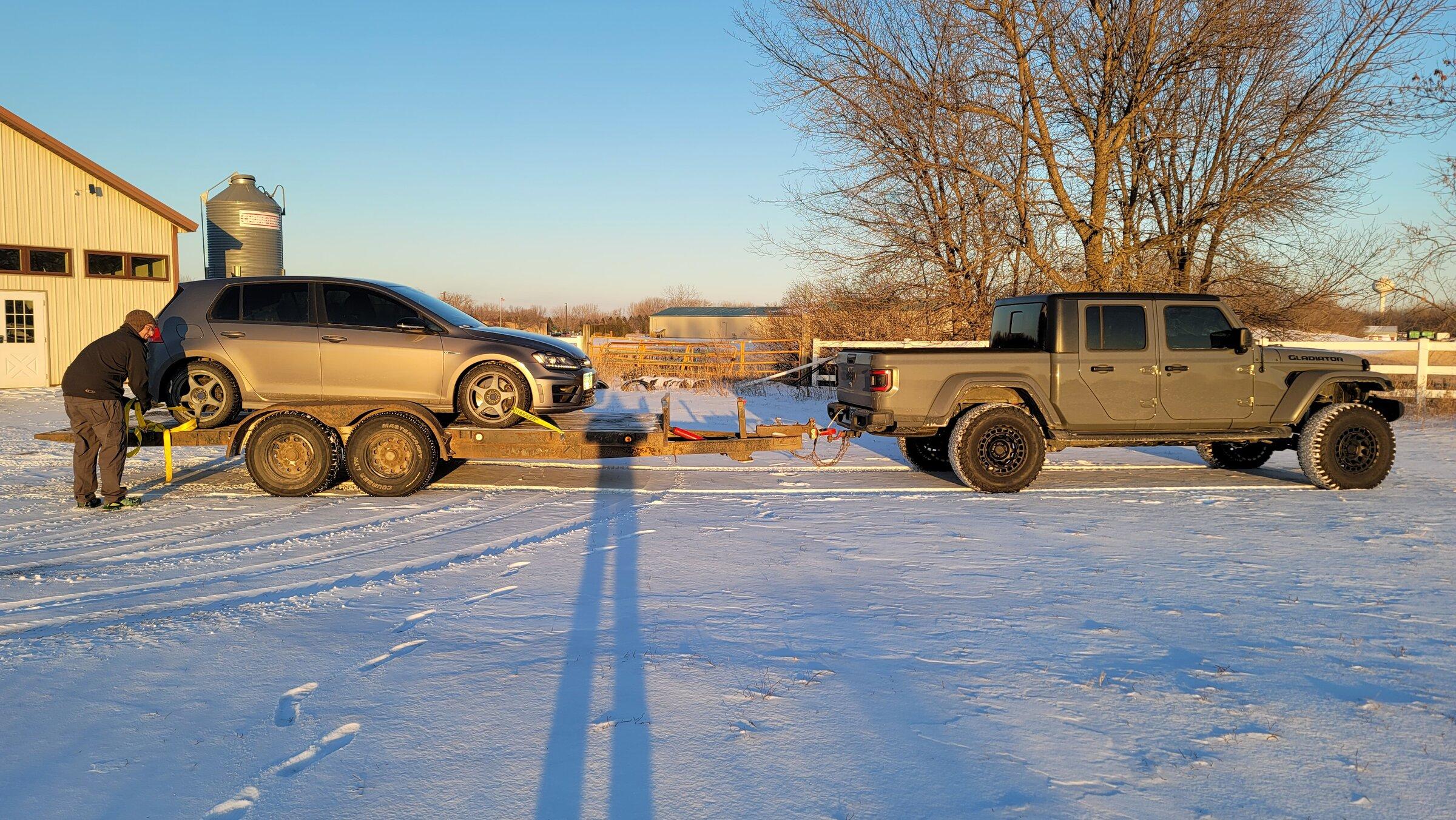
I had the serendipitous opportunity to do a short haul, and not having to dig deep into the RPMs was sure nice, much to Kurt's points above. I am loving the Gladiator more and more!
I will be doing a more comprehensive comparison by the end of the week.

I will be doing a more comprehensive comparison by the end of the week.

ShadowsPapa
Well-Known Member
- First Name
- Bill
- Joined
- Oct 12, 2019
- Threads
- 247
- Messages
- 40,465
- Reaction score
- 53,924
- Location
- Runnells, Iowa
- Vehicle(s)
- '25 JTMX, '23 JLU 4xe, '82 SX4, '73 Javelin
- Occupation
- Retired auto mechanic, frmr gov't ntwrk security admin
- Vehicle Showcase
- 3
I have a question or two since I dream of SC - and likely it will stay just that but then who knows.....I had the serendipitous opportunity to do a short haul, and not having to dig deep into the RPMs was sure nice, much to Kurt's points above. I am loving the Gladiator more and more!
I will be doing a more comprehensive comparison by the end of the week.
People talk about "digging into the RPMs" as if they really have to wrap these up tight.
Mine did hit ~4300 or so once in a while on a large long hill, but otherwise most of the time it was 2300-3300 unless the hill was longer or steeper (talking I80 east half of Iowa where even OTR guys have trouble keeping speed at times if fully loaded)
I don't see 2300 RPM as digging deep at all. In fact I wish these would run about 200-300 rpm higher as a norm. Mine spent a lot of time around 2,000-2300 rpm (trying to keep the speed about 65 mph)
Your pic looks like a heavier load than mine - I was hauling about 5,000 pounds (car hauler with car) and I was shocked/surprised that my Overland kept the RPM well below what my Chevy with V8 LS had to do to make those exact same hills. My JT actually wound up less than my Chevy had to.
No question that RPM = wear. As a long-time mechanic I get that. Non-issue there. But I don't consider the 2,000s as high rpm when my Chevy wrapped up into the 5s and was often into the 4s and this truck doesn't seem to need to do that.
Maybe it's because you were pulling a lot more than I was at only 5,000 pounds.
dcmdon
Well-Known Member
- First Name
- Don
- Joined
- Mar 31, 2021
- Threads
- 60
- Messages
- 3,656
- Reaction score
- 4,427
- Location
- Boston Metro-West, Northern NH
- Vehicle(s)
- .
I also yearn for forced induction. There is nothing like the swell of torque at 3000 rpm that builds as a turbo spools up.I have a question or two since I dream of SC - and likely it will stay just that but then who knows.....
People talk about "digging into the RPMs" as if they really have to wrap these up tight.
Mine did hit ~4300 or so once in a while on a large long hill, but otherwise most of the time it was 2300-3300 unless the hill was longer or steeper (talking I80 east half of Iowa where even OTR guys have trouble keeping speed at times if fully loaded)
I don't see 2300 RPM as digging deep at all. In fact I wish these would run about 200-300 rpm higher as a norm. Mine spent a lot of time around 2,000-2300 rpm (trying to keep the speed about 65 mph)
Your pic looks like a heavier load than mine - I was hauling about 5,000 pounds (car hauler with car) and I was shocked/surprised that my Overland kept the RPM well below what my Chevy with V8 LS had to do to make those exact same hills. My JT actually wound up less than my Chevy had to.
No question that RPM = wear. As a long-time mechanic I get that. Non-issue there. But I don't consider the 2,000s as high rpm when my Chevy wrapped up into the 5s and was often into the 4s and this truck doesn't seem to need to do that.
Maybe it's because you were pulling a lot more than I was at only 5,000 pounds.
I've owned and played with turbocharged cars since the 1970s. (My dad had an ex-Saab rally car with alcohol injection driven by a windshield washer pump. primitive)
And I also agree that higher RPM = more wear.
But, and this is a big but, when was the last time you actually saw a modern engine worn out.
Back in the 90s Subaru, Saab and some others did tests where they ran their cars flat out at redline at full throttle round and round and round a huge oval for 30,000 to 60,000 miles. None of the cars broke. Modern engines suffer more from a cold weather start than they do from 50 trips to redline.
Its all theory, but when was the last time you heard of a modern engine actually wearing out?
RPM are not to be feared.
One other thing. I you need to make X amount of power and you aren't revving, then you are making more torque with more manifold pressure. This adds its own kinds of stresses.
They aren't the kinds of stresses that impact pistons and wrist pins and valves from moving quickly. Rather its increased ring tension from the combustion pressure working its magic behind the rings. Its more stress on the crank. Its more thermal stress on the aluminum pistons.
You get my point. I think that within reason neither of these kinds of stresses. (high rpm vs high manifold pressure) are going to cause a problem on a practical level. So the motor wears out at 300,000 miles instead of 400,000 miles.
Thoughts?
Sponsored
Similar threads


- Replies
- 12
- Views
- 5,856

