Sponsored

Tire volume calculations

Darel

Well-Known Member
First Name
Darel
Joined
Apr 29, 2020
Threads
51
Messages
393
Reaction score
299
Location
Mountain Top, PA
Vehicle(s)
'21 JT Rubi Sarge Green; '08 JK
Occupation
Military
Trying to figure out how much air is in a 35x12.5/17 tire at 38 psi, vs. a 5-gal tank (or multiple 5-gal tanks) at 125 psi, and if I were to mount say, 2 of those 5-gal tanks under the bed of my truck, and fill them to 125psi before I leave to go fourwheeling, would that be enough air to fill my 35s up from, say, 17psi back to 38 psi at the end of the day?

I have a monstrous compressor in my garage and wouldn't mind saving a couple hundred bucks on a vehicle-mounted one if I can.

I know this is a simple math problem (and there's probably even an online calculator) but I can't seem to find an easy answer.
Sponsored

 

Rahkmalla

Well-Known Member
First Name
Jim
Joined
Oct 20, 2021
Threads
38
Messages
2,036
Reaction score
4,714
Location
NJ
Vehicle(s)
22 Gobi Manual Mojave
Build Thread
Link
you can't find an easy answer because a tire is not a normal shape.

If you want to get a rough estimate, you can take the volume of a cylinder where r=17.5 and h=12.5 and then subtract the volume of a cylinder r=8.5 h=12.5

To my knowledge the density of air has a linear relationship with it's pressure (did a quick google search and couldn't find any easy evidence to the contrary, so if someone knows this for a fact please correct me), so 38psi OVER 14.7 (to my knowledge "0 psi" on an air pressure gauge is actually 14.7psi which is atmospheric pressure at sea level) is roughly 3.6 times the pressure of standing air. So take cylinder T and subtract cylinder W then multiply the result by 3.6 and you've got your total amount of air contained in the donut.

BUT... a tire is far from a perfect cylinder, and the exterior measurements are very far from telling the interior measurements (for example, the tread is probably an inch thick, making your cylinder more like r=16.5, your sidewall width will vary based on load rating, maybe your 12.5 h is only 11.5) not to mention the bulging of the sidewalls and the constricting shape as almost all of us are running tires wider than our wheels. Plus wheels are not a perfect cylinder either. form the mounting face most wheels have a recess. Maybe call your 17s (r8.5) 16s for this purpose (r8). It's all very nitpicky abotu what estimations you need to make to estimate with the most reasonable degree of accuracy.
 

kb5zcr

Well-Known Member
First Name
Tim
Joined
Sep 24, 2021
Threads
25
Messages
393
Reaction score
558
Location
Texas
Vehicle(s)
2023 Diesel Rubi Gladiator
Occupation
Retired
I think the easiest way to test is to take one of those 6 gal pancake compressors ( I'm sure you know someone with one) and air it up the tank, unplug it, and see if it will air up your deflated tire.
At least you will have an idea where your at on this whole idea.

Or, you could take your big compressor and do the same thing to see how many times it will refill your tire, then divide its size (say 60 gal) by 5 gal, and you have an idea.
 

sharpsicle

Well-Known Member
Joined
Apr 29, 2021
Threads
22
Messages
2,767
Reaction score
6,257
Location
Tampa, FL / Milwaukee, WI
Vehicle(s)
2020 Gladiator Overland, 2002 VTX1800
Don’t forget that figuring out the change in the air in tire is just 1/2 of the equation. You also have to consider the change in the pressure and air contained inside the cylinder(s) as they feed the tire. The more you try to inflate the tire, the less effective the air cylinder will be. You’re dealing with two separate systems, and need to do the math on both systems and then bring them together.

And let’s not forget, a tire is not solid. It will change shape and stretch based on the amount of air that’s in it and the weight that is on it. For this reason, the math on the cylinder is easier.


That’s why pumps are great, they just go until you’re done. No math required.

Your best bet is to do trial and error.
 

Sponsored

ShadowsPapa

Well-Known Member
First Name
Bill
Joined
Oct 12, 2019
Threads
247
Messages
40,442
Reaction score
53,860
Location
Runnells, Iowa
Vehicle(s)
'25 JTMX, '23 JLU 4xe, '82 SX4, '73 Javelin
Occupation
Retired auto mechanic, frmr gov't ntwrk security admin
Vehicle Showcase
3
Don’t forget that figuring out the change in the air in tire is just 1/2 of the equation. You also have to consider the change in the pressure and air contained inside the cylinder(s) as they feed the tire. The more you try to inflate the tire, the less effective the air cylinder will be. You’re dealing with two separate systems, and need to do the math on both systems and then bring them together.

That’s why pumps are great, they just go until you’re done. No math required.

Your best bet is to do trial and error.
Plus - wheels matter.
Wider wheels with the SAME tire means more volume, and the shape of the wheel itself matters.
All he can do is get sort of close.
Your point on the diminishing pressure in the tank vs. the increasing pressure in the tire - seen easily when I use an air tank to carry air to various tires.

I think the trial and error bit is the best way - but it's going to matter if you use the same size tank for the experiment as what's intended to use in the end.
 

sharpsicle

Well-Known Member
Joined
Apr 29, 2021
Threads
22
Messages
2,767
Reaction score
6,257
Location
Tampa, FL / Milwaukee, WI
Vehicle(s)
2020 Gladiator Overland, 2002 VTX1800
Plus - wheels matter.
Wider wheels with the SAME tire means more volume, and the shape of the wheel itself matters.
All he can do is get sort of close.
Your point on the diminishing pressure in the tank vs. the increasing pressure in the tire - seen easily when I use an air tank to carry air to various tires.

I think the trial and error bit is the best way - but it's going to matter if you use the same size tank for the experiment as what's intended to use in the end.
Yep. You can’t do the test with a 5 gallon tank and then assume a 10 gallon will just be twice that.
 

bleda2002

Well-Known Member
Joined
May 11, 2021
Threads
24
Messages
2,751
Reaction score
4,493
Location
34655
Vehicle(s)
2021 JTR Firecracker Red
I believe you can do this using multiple steps. First you need the volume of the tire, which you can get by doing it as a cylinder then subtracting the rim out (won't be perfect but close enough).

Then plug that in to the ideal gas law formula for 17 psi and 38 psi (convert all units to needed units for formula). That will tell you how much more air the tire contains at 38 than 17.

Now figure out how much air your 5 gallon has in moles at 38 psi by using the gas law, and then see what pressure you would need to get it to to have that amount + 4 times the difference in air from the tires.

This makes some assumptions about temperature, but should give you a reasonable ball park for if this will even be feasible. (My gut says no unless it's cranked to some pretty high psi)
 

Volt0

Well-Known Member
First Name
Tim
Joined
Apr 27, 2022
Threads
31
Messages
762
Reaction score
989
Location
MidMo
Vehicle(s)
JTM,JTHA
Although this may be a fun project for you, your time is worth something. Save your time from math problems, and do a diy power tank; then you won’t have to worry about whether you have enough compressed air, and it’ll take up less space.
 

ShadowsPapa

Well-Known Member
First Name
Bill
Joined
Oct 12, 2019
Threads
247
Messages
40,442
Reaction score
53,860
Location
Runnells, Iowa
Vehicle(s)
'25 JTMX, '23 JLU 4xe, '82 SX4, '73 Javelin
Occupation
Retired auto mechanic, frmr gov't ntwrk security admin
Vehicle Showcase
3
First you need the volume of the tire, which you can get by doing it as a cylinder then subtracting the rim out (won't be perfect but close enough).
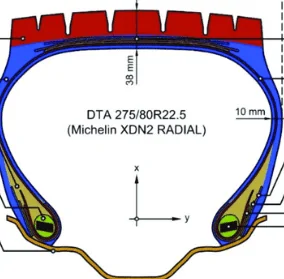
Since the rim has a drop, is it not part of that cylinder? Or is it small enough you are discounting it?
A xxx size tire on one rim will also be either a larger volume, or smaller, depending on the width rim it's installed on.


Jeep Gladiator Tire volume calculations 1699327009902
 

Sponsored

Badunit

Well-Known Member
Joined
Jan 31, 2023
Threads
20
Messages
817
Reaction score
1,346
Location
USA
Vehicle(s)
2023 JT Rubicon, 1997 TJ
---
 
Last edited:

MPMB

Well-Known Member
First Name
Michael
Joined
Apr 30, 2021
Threads
12
Messages
1,820
Reaction score
2,716
Location
Utah
Vehicle(s)
'21 JTR - SG
Occupation
Check your inbox.
Since the rim has a drop, is it not part of that cylinder? Or is it small enough you are discounting it?
A xxx size tire on one rim will also be either a larger volume, or smaller, depending on the width rim it's installed on.


1699327009902.png
I would say it evens out when you calculate the volume in the tire, since you're not calculating based off inside measurements.

Find the cubic volume of a cylinder 37"x12.5" or 35"x12.5" and subtract cubic volume of cylinder 17"x9" (or whatever the rim is). That should give the volume of air needed.

That's how much space you need to fill to X psi. I'm sure there are online calculators that can give volume & psi numbers. Probably volume x Xpsi = total volume needed.

But jumping to conclusions based on my experience, a small 5gal air tank aired to 100psi wouldn't air up 4 big, off-road tires. 18psi to 38psi is 20psi change. 80psi total. I used one for racing and toted that for years. At the most, it would air up 4 28"x10"x15" tires about 8-10psi per tire. So 40psi on small tires vs. 80psi on large tires.

Here's the rub: When your tank gets down to 40-45psi, it's trying to air up a tire 30-35psi, and that is a miniscule amount of force. If you're trying to air up to 37psi, your tank will stop airing up at around 40psi - equalization.

Might as well take a small nitrogen bottle that holds 2000psi and deal with that.
 

ParatusExpeditions

Well-Known Member
Joined
Mar 18, 2022
Threads
10
Messages
442
Reaction score
378
Location
CA
Vehicle(s)
22 JT Rubicon EcoDiesel
This is what I noted on paper a while ago; as others pointed out, it's very approximative. Anyone can correct any mistake I might have made. I have measured that I would need a 28 Gal tank at 150 PSI to do four 37" tires from 12 PSI to 37 PSI. OP can redo the math with 35 inch tires instead of 37 and it could be that 5 Gal *per tire* work since it's about 7 Gal @ 150 PSI per tire for 37s.

All measurements in SI:
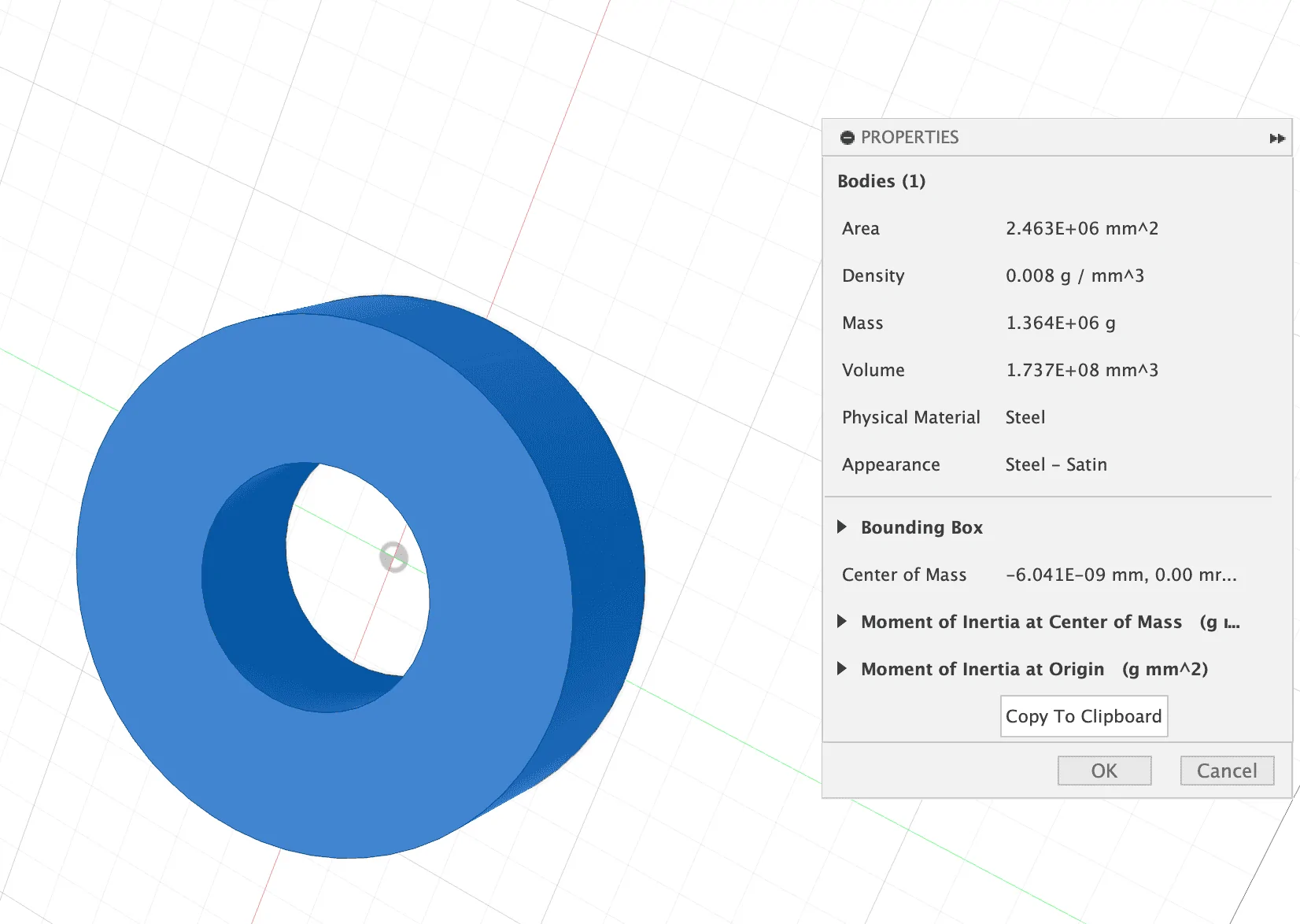
  • 0.1737 Cubic meters per tire or 173.7L (see Image, I've modeled the approximate volume on CAD software, it's approximate and if we had the CAD designs of some wheels and tires it would make this way easier.)
  • 37PSI is 255.106kPa
  • 12PSI is 82.737kPa
  • Temperature 21C is 294.15K
  • Ideal gas constant: R = 8.314kPaâ‹…L/Kâ‹…mol
PV = nRT
Pressure . Volume = “Amount of substance” . “Ideal gas constant” . Temperature

P1 . V1 = nRT
P2 . V2 = nRT

Solve for n1:
n1 = (P1 . V1) / RT
n1 = 82.737 * 173.7 / (8.314 * 294.15) = 5.87652672

Since V is a constant, R ant T fixed, we have
P1 / P2 = n1 / n2

If we solve for the new n2 = n1 * P2 / P1
n2 = 5.87652672 * 255.106 / 87.737 = 17.08671627

The number of moles of air we need to go from P1 to P2 is n2 - n1.
Solve for:
  • P1 = 12PSI
  • P2 = 37PSI
n3 = n2 - n1 = 17.08671627 - 5.87652672 = 11.21018955

Now, with an air compressor pushing P3 = 150PSI (1034.21kPa):
  • Solve for V = (n2 - n1) * 4 * R * T / P3
  • This is the tank size needed to store enough air to inflate 4 tires from 12 to 37PSI
V = 11.21018955 * 4 * 8.314 * 294.15 / 1034.21 = 106.03349767L or ~28Gal

Jeep Gladiator Tire volume calculations 1699332764310


I spent an hour more translating all this into a spreadsheet to create a calculator so it could be easily tweaked. It's not perfect, but there are no ads, and you can see what it's calculating yourself. I've run some numbers for you as well:


Looks like the required tank size is about 6.63 Gal per tire.

Modify/see it yourself here.
 
Last edited:

Stuntman Mike

Well-Known Member
First Name
Joerg
Joined
Sep 9, 2023
Threads
6
Messages
526
Reaction score
1,047
Location
Essen, Germany
Vehicle(s)
2022 JTOD, 2005 TJ 4.0, 1989 XJ 4.0, 2004 XK8
Occupation
Rotating Equipment Consultant
I would go with a vehicle mounted compressor.
Sponsored


Top