
Sponsored

S&B COLD AIR INTAKE

ShadowsPapa

Well-Known Member
First Name
Bill
Joined
Oct 12, 2019
Threads
247
Messages
40,442
Reaction score
53,859
Location
Runnells, Iowa
Vehicle(s)
'25 JTMX, '23 JLU 4xe, '82 SX4, '73 Javelin
Occupation
Retired auto mechanic, frmr gov't ntwrk security admin
Vehicle Showcase
3
I am going to try and find and post the Banks video talking about NEW motors and air velocity. Apparently things are so sensitive now without tuning to match that the MAF sensors, and the manifold pressure sensors basically have to read OEM flow or check engine lights start popping up. This to me explains why there was so much lag with getting any intake out and why such high emphasis was put on “no check engine light” claims are being made… maf position, air velocity are now critical.

Regardless, I looked to the S&B to reduce air intake temps- without the additional scoop I would be willing to bet under stock ecu tuning there is literally no “gain” in performance or efficiency. Motor is calling for x air to provide y power. Increasing the flow of still limited by a maf and manifold pressure sensor (with differential parameters) it’s all a wash.
Newer engines sense air temperature, flow and pressure. It knows the exact volume going in - it's got the formulas and knows how much oxygen there is going into the engine based on those three things. Balance that against the oxygen left in the spent charge going out and there you have it.

Besides, look at the bottom of the stock intake - at least on the gasser, it's taking air from the grill area and is shielded from the air in the engine bay for the rest of the air. It's not like your father's (or grandfather's ??) 1969 Camaro pulling air right out of the engine bay behind the radiator.
Heck, even in the 1980s the air going into the air filter came from the headlight and grill area of the car. I've got the ductwork from my car sitting in my parts bins. All of the air going into that engine came from the front of the car, not the engine bay, once the operating temperature of the engine reached a certain point. Modern vehicles certainly aren't pulling all of the air from the engine bay if they didn't in 1980.
So the term CAI is a total joke because stock air intakes have been CAI since the 1980s in most vehicles. In a sense, again, a gasser, my JT's 3.6 has ram air as it's got an intake tube smack between two of the grill ribs, in that right hand slot area.

The proof that it works is the fact I vacuum bugs out of my air filter housing now and then.
Call it a modern "bug catcher scoop".
Sponsored

 

Minty JL

Well-Known Member
First Name
Jeremy
Joined
May 15, 2019
Threads
25
Messages
4,793
Reaction score
7,612
Location
Ft Meade, MD - AOR
Vehicle(s)
23 JTM - 19 JLUR - 22 Compass LTD - 04 355 ZQ8
Occupation
USA(R), DoD - MD TM lead - Field Operations
What happened
Kept throwing CEL on my JLUR 2.0t eTorque. I was actually the beta tester for Mishimoto. Flawless as soon as they installed it at their R&D facility in Delaware
 

MBJeep

Member
First Name
Brad
Joined
Sep 19, 2022
Threads
0
Messages
12
Reaction score
21
Location
Myrtle Beach, SC
Vehicle(s)
2017 JKU Rubicon
Occupation
Firefighter
Had the S&B installed about two weeks now. No check engine lights. It's noticeably louder at low torque / early turbo spool, but it has been too short of a time to tell any differences in mpg, or anything else for that matter. Though anecdotal, the old seat of the pants measurement doesn't notice anything different on the pro or con side of the house.
 

Escape.idiocracy

Well-Known Member
First Name
Rich
Joined
Jan 23, 2022
Threads
37
Messages
1,569
Reaction score
1,822
Location
PNW
Vehicle(s)
Jt
Occupation
Hitchhiker
Newer engines sense air temperature, flow and pressure. It knows the exact volume going in - it's got the formulas and knows how much oxygen there is going into the engine based on those three things. Balance that against the oxygen left in the spent charge going out and there you have it.

Besides, look at the bottom of the stock intake - at least on the gasser, it's taking air from the grill area and is shielded from the air in the engine bay for the rest of the air. It's not like your father's (or grandfather's ??) 1969 Camaro pulling air right out of the engine bay behind the radiator.
Heck, even in the 1980s the air going into the air filter came from the headlight and grill area of the car. I've got the ductwork from my car sitting in my parts bins. All of the air going into that engine came from the front of the car, not the engine bay, once the operating temperature of the engine reached a certain point. Modern vehicles certainly aren't pulling all of the air from the engine bay if they didn't in 1980.
So the term CAI is a total joke because stock air intakes have been CAI since the 1980s in most vehicles. In a sense, again, a gasser, my JT's 3.6 has ram air as it's got an intake tube smack between two of the grill ribs, in that right hand slot area.

The proof that it works is the fact I vacuum bugs out of my air filter housing now and then.
Call it a modern "bug catcher scoop".
I am not familiar with how the gas motor intake draws in air- the diesel it’s through the fender ish area.

The 1:00 mark on this video kind of shows it.https://youtu.be/HAxAFNCB8gg?si=U4TFrChQlGs_pISh

I am in my mid 30’s so, my experience mechanically is with two TJ’s, a JK, and this diesel JT… outside of Jeeps Cummins, powerstroke and a ton of TDI’s… all of my diesels have been pretty extensively worked and tuned- this is the only diesel I haven’t really done anything to yet. Usually they like cold air, water methanol (or just water ;)), and as much air as you can get to them… I was drawn to the hook scoop design that S&B put together for their gas intakes, if it does not ever come to fruition, I’ll look to go with a snorkel & separator… cold air and up high out of the main dust stream.


The intake is obviously good enough for FCA engineers… my comment about the the various sensors is how particular they are is not wow gee whizz look at these fancy new electronic bits- but more from a “wow look fca is making this a pain to monkey with…. Nothing a tuner can’t work around, just seems like there isn’t a point in changing anything until it’s “all” going to be changed; intake, tune, weight loss, etc….
 

ShadowsPapa

Well-Known Member
First Name
Bill
Joined
Oct 12, 2019
Threads
247
Messages
40,442
Reaction score
53,859
Location
Runnells, Iowa
Vehicle(s)
'25 JTMX, '23 JLU 4xe, '82 SX4, '73 Javelin
Occupation
Retired auto mechanic, frmr gov't ntwrk security admin
Vehicle Showcase
3
The intake is obviously good enough for FCA engineers… my comment about the the various sensors is how particular they are is not wow gee whizz look at these fancy new electronic bits- but more from a “wow look fca is making this a pain to monkey with…. Nothing a tuner can’t work around, just seems like there isn’t a point in changing anything until it’s “all” going to be changed; intake, tune, weight loss, etc….
I don't blame the FCA engineers - there's a higher "authority" forcing companies into corners.
It's chemistry and the science of combustion, I don't go really deep into it, but it's not that bad for those who specialize in such areas. Take a given amount of oxygen, want a complete burn, you need a given amount of fuel - were we close (O2 sensors answer), no, which way do we need to adjust (trim tables). To know how much oxygen is in the cylinder, they need to measure air temperature (for density) air flow, and pressure.

Yeah, it's not like stick the beast on a dyno, stick a sniffer up it's tail pipe, and adjust the metering rods and jets until you hit your goal.
Which reminds me - I need to order tuning kits for my AVS2 carbs - seems to be a touch lean by the spark plugs but rich by smell. Weird, gotta git a sniffer in the pipes. Maybe just weld bungs onto the header collectors, a couple of O2 sensors and buy a unit to mount on the dash.

Cool air, humid air (or some simple water injection), or nitrous to get more oxygen in there and nitrogen to control the burn....................
thinking about that, since many diesels run a bit rich anyway, nitrous injection would seem like a fun way to get rid of turbo lag and improve performance a bit.
 

Sponsored

Vtur

Well-Known Member
First Name
Le
Joined
Mar 6, 2021
Threads
11
Messages
1,922
Reaction score
2,270
Location
Norcal
Vehicle(s)
JTOD
Occupation
Electrical Foreman
The diesel also draws air from the front grille along with the gap between the hood and fender.
 

@californiajeeping

Well-Known Member
Joined
Apr 1, 2020
Threads
16
Messages
953
Reaction score
1,002
Location
California
Vehicle(s)
2022 Jeep Gladiator diesel, 1977 cj5 LS swapped
Newer engines sense air temperature, flow and pressure. It knows the exact volume going in - it's got the formulas and knows how much oxygen there is going into the engine based on those three things. Balance that against the oxygen left in the spent charge going out and there you have it.

Besides, look at the bottom of the stock intake - at least on the gasser, it's taking air from the grill area and is shielded from the air in the engine bay for the rest of the air. It's not like your father's (or grandfather's ??) 1969 Camaro pulling air right out of the engine bay behind the radiator.
Heck, even in the 1980s the air going into the air filter came from the headlight and grill area of the car. I've got the ductwork from my car sitting in my parts bins. All of the air going into that engine came from the front of the car, not the engine bay, once the operating temperature of the engine reached a certain point. Modern vehicles certainly aren't pulling all of the air from the engine bay if they didn't in 1980.
So the term CAI is a total joke because stock air intakes have been CAI since the 1980s in most vehicles. In a sense, again, a gasser, my JT's 3.6 has ram air as it's got an intake tube smack between two of the grill ribs, in that right hand slot area.

The proof that it works is the fact I vacuum bugs out of my air filter housing now and then.
Call it a modern "bug catcher scoop".
The diesel monitors for low PCV/CCV vaccum. It is measuring your IAT/air pressure boost etc but the only thing it looks for is high boost or low boost. It doesnt seem to have any parameters based on too little or much mass airflow. Even with a disconnected intake tube it starts and runs without codes (might throw one going down the highway or something).

A high flow intake will throw a CEL for CCV/PCV unless you have the correct amount of restriction or vaccum preturbo. None of these intakes do anything unless they throw the CCV code.

Then the ccv needs to be addressed separately to mitigate that code. The reason a prefilter on a AEV snorkel doesnt throw the ccv code is because it is as restrictive as factory and has the correct amount of vaccum on the ccv/pcv sensor.

KN mitigates this by extending the tube nearly completely to the turbine which has more "suction" or vaccum on the sensor. Best option is to turn that code off and run a catch can.

I will say a 20 degree ambient air intake change does NOTHING to the boost air density in the intake. Why? The turbo is spitting out 250-300 degree pre intercooler air. 20 degrees in dropping 20 degrees out does nothing and thats a best case.

On a NA motor this is more important but on these diesels they are limited by the small turbo pumping out major amounts of heat.

This is using datalogging to compare. Ive been researching a larger intercooler option for hot weather and monitoring closely. Cold air intake vs hot air intake really doesnt matter on the ecodiesel.

The larger intake tube and filter does seem to make more part throttle or "leaning" into it boost. It will peak up to 30psi much quicker with a high flowing intake. Its that point just before your 70-80% and it tries to downshift. The boost does peak higher and come on sooner.
 

ShadowsPapa

Well-Known Member
First Name
Bill
Joined
Oct 12, 2019
Threads
247
Messages
40,442
Reaction score
53,859
Location
Runnells, Iowa
Vehicle(s)
'25 JTMX, '23 JLU 4xe, '82 SX4, '73 Javelin
Occupation
Retired auto mechanic, frmr gov't ntwrk security admin
Vehicle Showcase
3
Cold air intake vs hot air intake really doesnt matter on the ecodiesel.
How is it a hot air intake since it draws from outside the engine bay anyway?
These draw from the grill slot area and between fender and hood. Not engine bay air. So it's all "cold air" in that respect.
That's what many of us have been saying for a long time - how is a CAI doing anything the stock intake isn't? Even my car pulls air from the area of the headlights - it can't get any colder than that, plus - it's higher pressure air up there.
Cutting a hole on the side of the hood and pulling in air actually is not going to help get more air or colder air because there's low pressure areas on the sides of the hood.

If you want more air, it needs to come from a higher pressure area - grill, cowl and so on. Not the side of the hood.

If you want cold air - it doesn't get much better than that - you care getting ambient air from outside the vehicle, the same air that anyone walking outside is getting.
The diesel also draws air from the front grille along with the gap between the hood and fender.
So calling any of these a "cold" air intake is a joke. It's not taking air from any place the factory isn't taking air from.
If the air hitting the grill and side of the truck isn't "cold" compared to the engine bay, I don't know what is.
 

Vtur

Well-Known Member
First Name
Le
Joined
Mar 6, 2021
Threads
11
Messages
1,922
Reaction score
2,270
Location
Norcal
Vehicle(s)
JTOD
Occupation
Electrical Foreman
How is it a hot air intake since it draws from outside the engine bay anyway?
These draw from the grill slot area and between fender and hood. Not engine bay air. So it's all "cold air" in that respect.
That's what many of us have been saying for a long time - how is a CAI doing anything the stock intake isn't? Even my car pulls air from the area of the headlights - it can't get any colder than that, plus - it's higher pressure air up there.
Cutting a hole on the side of the hood and pulling in air actually is not going to help get more air or colder air because there's low pressure areas on the sides of the hood.

If you want more air, it needs to come from a higher pressure area - grill, cowl and so on. Not the side of the hood.

If you want cold air - it doesn't get much better than that - you care getting ambient air from outside the vehicle, the same air that anyone walking outside is getting.


So calling any of these a "cold" air intake is a joke. It's not taking air from any place the factory isn't taking air from.
If the air hitting the grill and side of the truck isn't "cold" compared to the engine bay, I don't know what is.
I agreed. The term CAI from some aftermarket companies are misleading. Sucking hot air in an engine bay is not cold air. To considered as CAI, either the filter is located outside of an engine bay or fresh cold air is draw/pipes to the filter element (Factory Setup).

Market it as a high volume intake system and getting for looks or sounds, but don't call it CAI.
 

@californiajeeping

Well-Known Member
Joined
Apr 1, 2020
Threads
16
Messages
953
Reaction score
1,002
Location
California
Vehicle(s)
2022 Jeep Gladiator diesel, 1977 cj5 LS swapped
How is it a hot air intake since it draws from outside the engine bay anyway?
These draw from the grill slot area and between fender and hood. Not engine bay air. So it's all "cold air" in that respect.
That's what many of us have been saying for a long time - how is a CAI doing anything the stock intake isn't? Even my car pulls air from the area of the headlights - it can't get any colder than that, plus - it's higher pressure air up there.
Cutting a hole on the side of the hood and pulling in air actually is not going to help get more air or colder air because there's low pressure areas on the sides of the hood.

If you want more air, it needs to come from a higher pressure area - grill, cowl and so on. Not the side of the hood.

If you want cold air - it doesn't get much better than that - you care getting ambient air from outside the vehicle, the same air that anyone walking outside is getting.


So calling any of these a "cold" air intake is a joke. It's not taking air from any place the factory isn't taking air from.
If the air hitting the grill and side of the truck isn't "cold" compared to the engine bay, I don't know what is.
hard to have a cold air intake when a turbo is turning into oven temp. Does your oven work better when it’s 55 in the house or 75? I would love a true ram air intake for these. Using the 392 hood and hydro guide on a large aftermarket airbox.
 

Sponsored

HomebrewJT

Well-Known Member
First Name
Paul
Joined
Aug 23, 2021
Threads
54
Messages
131
Reaction score
82
Location
Washington
Vehicle(s)
21 Gladiator sport
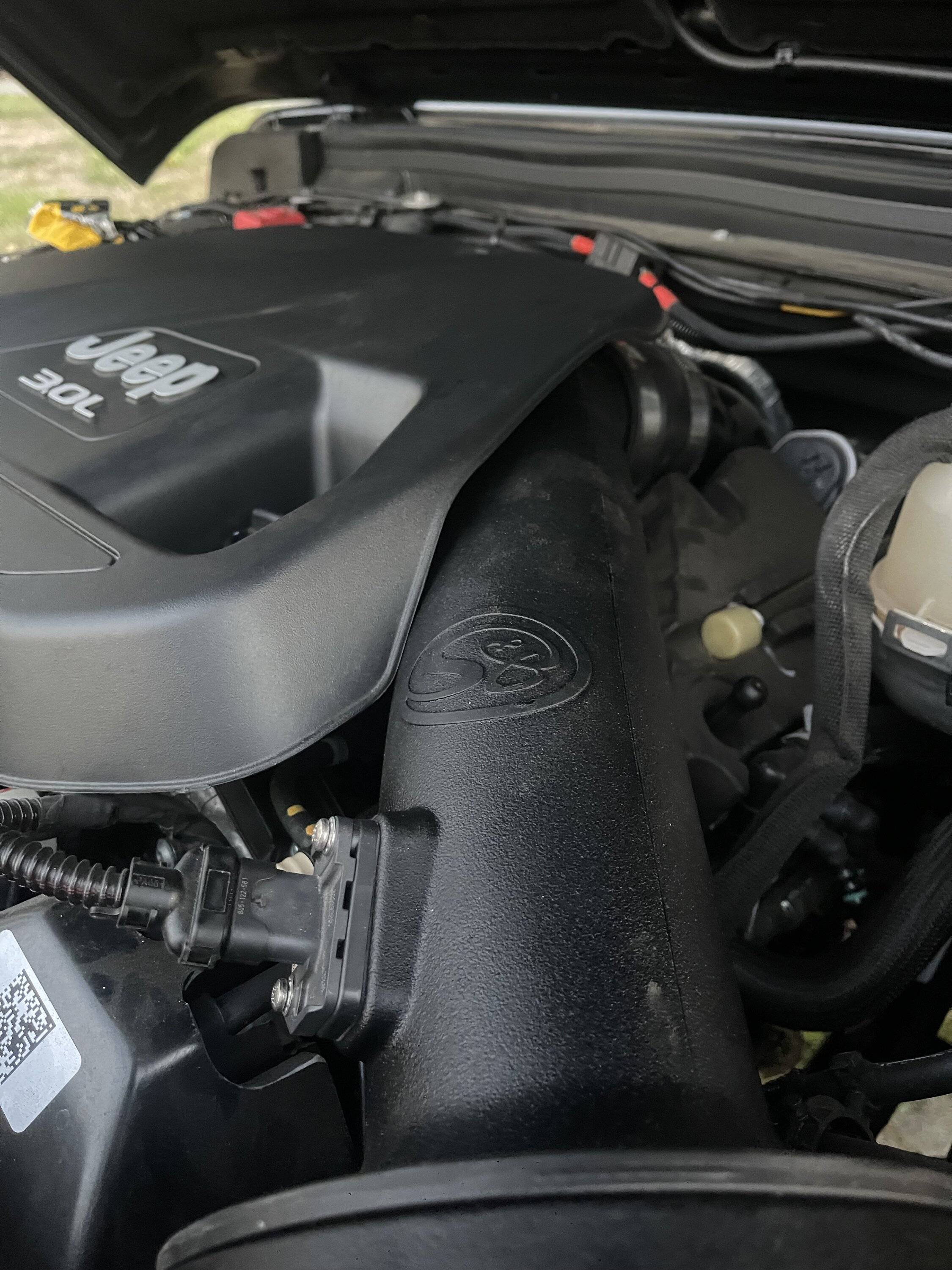
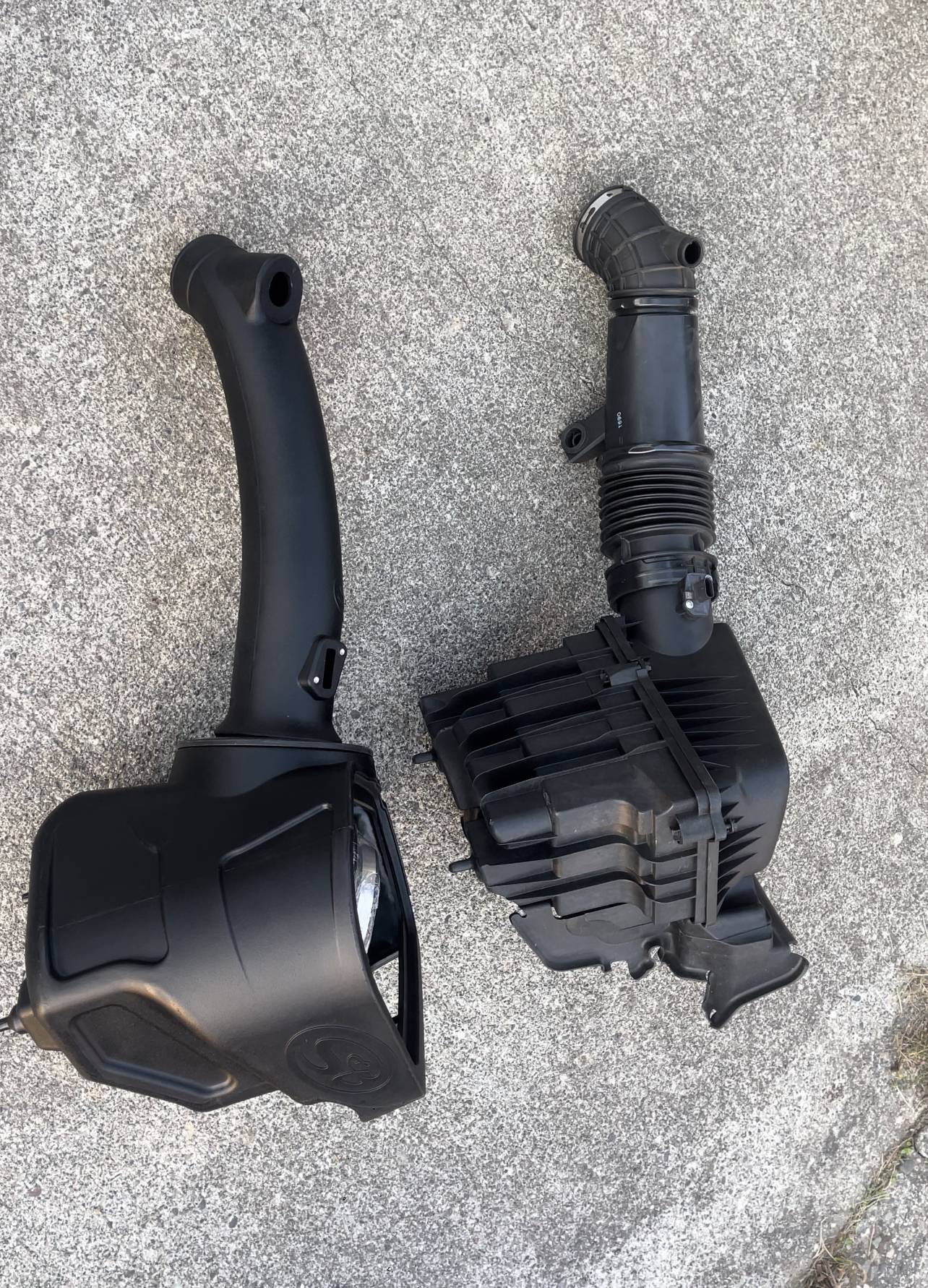
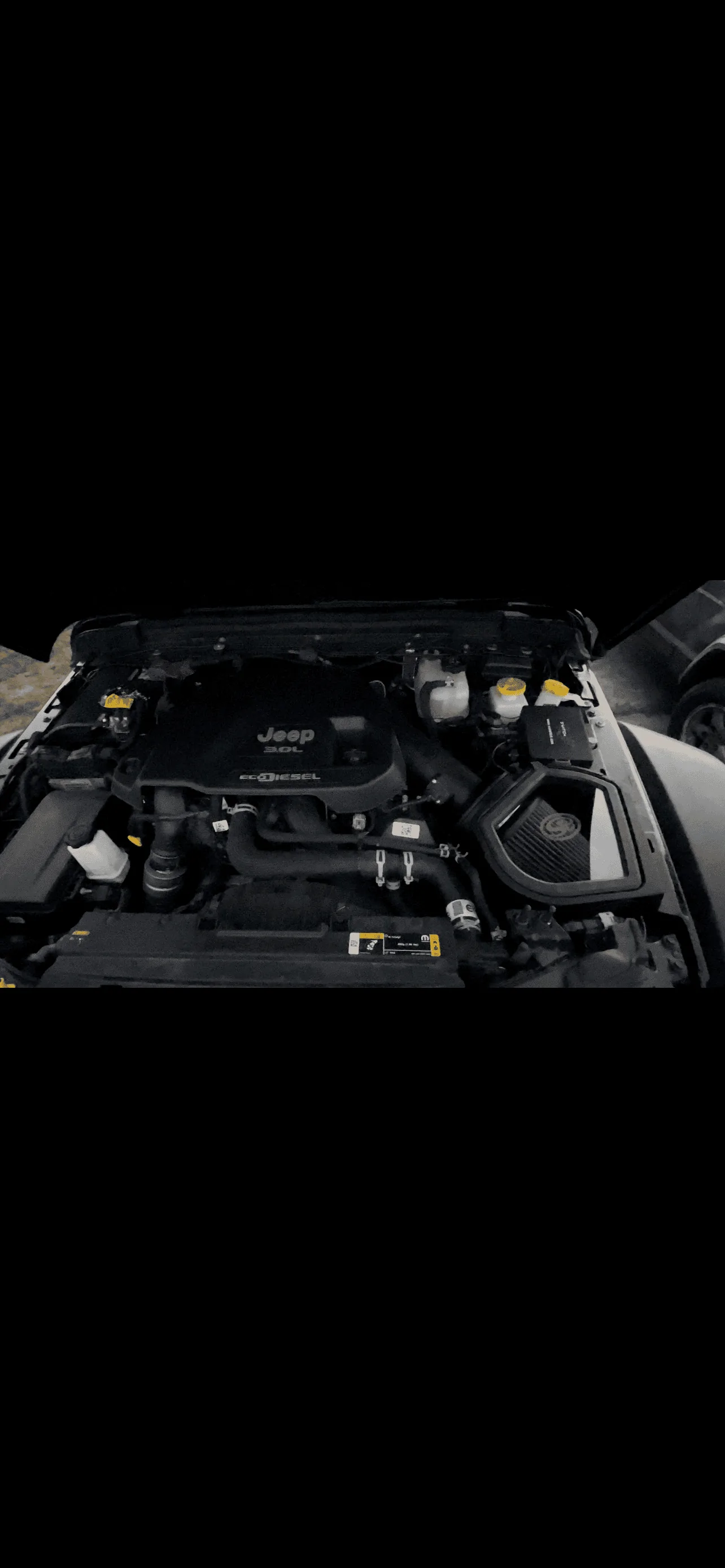
Just got mine installed. I noticed during the install the clearance is tight between the cover and the ccv hose and the intake tube.

Jeep Gladiator S&B COLD AIR INTAKE IMG_8994


Jeep Gladiator S&B COLD AIR INTAKE IMG_8991


Jeep Gladiator S&B COLD AIR INTAKE IMG_8997
 

Escape.idiocracy

Well-Known Member
First Name
Rich
Joined
Jan 23, 2022
Threads
37
Messages
1,569
Reaction score
1,822
Location
PNW
Vehicle(s)
Jt
Occupation
Hitchhiker
The diesel monitors for low PCV/CCV vaccum. It is measuring your IAT/air pressure boost etc but the only thing it looks for is high boost or low boost. It doesnt seem to have any parameters based on too little or much mass airflow. Even with a disconnected intake tube it starts and runs without codes (might throw one going down the highway or something).

A high flow intake will throw a CEL for CCV/PCV unless you have the correct amount of restriction or vaccum preturbo. None of these intakes do anything unless they throw the CCV code.

Then the ccv needs to be addressed separately to mitigate that code. The reason a prefilter on a AEV snorkel doesnt throw the ccv code is because it is as restrictive as factory and has the correct amount of vaccum on the ccv/pcv sensor.

KN mitigates this by extending the tube nearly completely to the turbine which has more "suction" or vaccum on the sensor. Best option is to turn that code off and run a catch can.

I will say a 20 degree ambient air intake change does NOTHING to the boost air density in the intake. Why? The turbo is spitting out 250-300 degree pre intercooler air. 20 degrees in dropping 20 degrees out does nothing and thats a best case.

On a NA motor this is more important but on these diesels they are limited by the small turbo pumping out major amounts of heat.

This is using datalogging to compare. Ive been researching a larger intercooler option for hot weather and monitoring closely. Cold air intake vs hot air intake really doesnt matter on the ecodiesel.

The larger intake tube and filter does seem to make more part throttle or "leaning" into it boost. It will peak up to 30psi much quicker with a high flowing intake. Its that point just before your 70-80% and it tries to downshift. The boost does peak higher and come on sooner
“Best option is to turn that code off and run a catch can.”

How? GDE Tune or?
 

@californiajeeping

Well-Known Member
Joined
Apr 1, 2020
Threads
16
Messages
953
Reaction score
1,002
Location
California
Vehicle(s)
2022 Jeep Gladiator diesel, 1977 cj5 LS swapped
“Best option is to turn that code off and run a catch can.”

How? GDE Tune or?
GDE wont do anything anymore. There are canadian tuners that can help you I have heard.
 

HomebrewJT

Well-Known Member
First Name
Paul
Joined
Aug 23, 2021
Threads
54
Messages
131
Reaction score
82
Location
Washington
Vehicle(s)
21 Gladiator sport
It’s loud. I think It sounds like a shop vac, the sound the nozzle makes while vacuuming your interior. No real seat of the pants difference.
Sponsored


Top