
Sponsored

am I doing something wrong in snow/ice Winter driving?

Sweetums

Well-Known Member
Joined
Mar 30, 2023
Threads
28
Messages
2,004
Reaction score
4,312
Location
Utah
Vehicle(s)
'05 LJR, '21 JTDR, '00 VFR800, RSV4, '11 MTS 1200
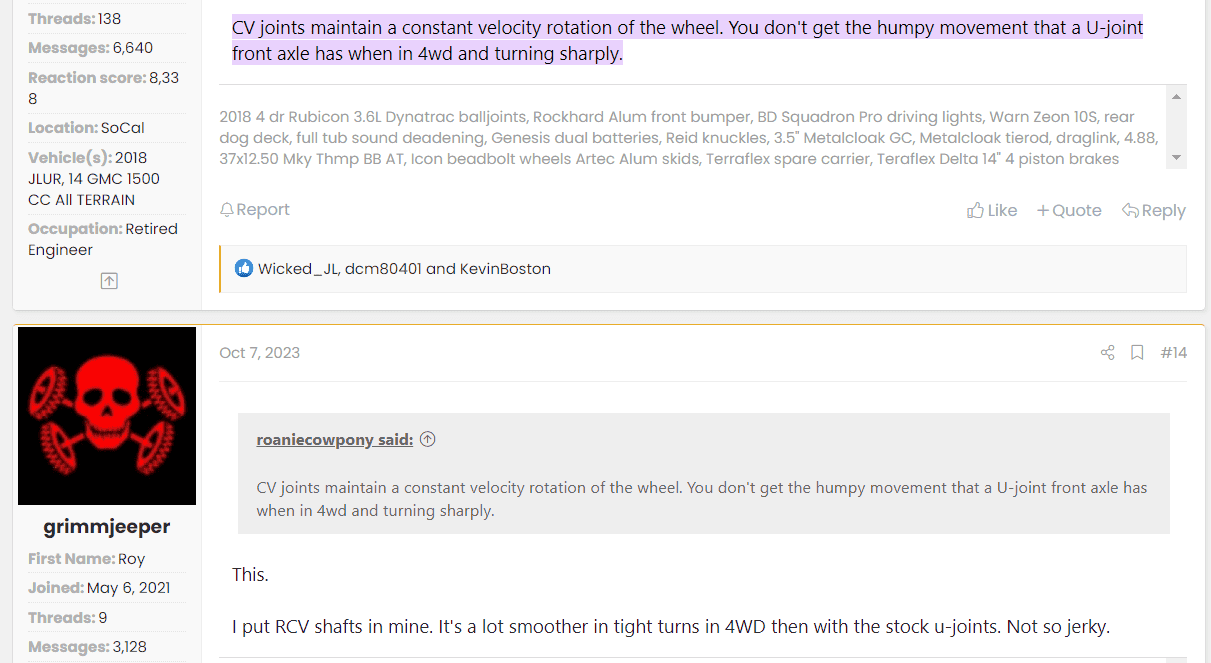
Swap in CVs and I'll bet you get rid of almost all of that "jerking and bouncing".
CVs have nothing to do with it, my last vehicle was an IFS setup with a CV rear driveshaft, neutral front drive shaft, and CV front axles. It behaved exactly the same way as the Jeep because it has a locking transfer case that doesn't allow slippage between the front and rear axles. A full-time 4wd system or AWD system allows the slippage, eliminating driveline binding, and thus eliminating the jerking motion when turning sharply.
Sponsored


ShadowsPapa

Well-Known Member
First Name
Bill
Joined
Oct 12, 2019
Threads
247
Messages
40,440
Reaction score
53,854
Location
Runnells, Iowa
Vehicle(s)
'25 JTMX, '23 JLU 4xe, '82 SX4, '73 Javelin
Occupation
Retired auto mechanic, frmr gov't ntwrk security admin
Vehicle Showcase
3
CVs have nothing to do with it, my last vehicle was an IFS setup with a CV rear driveshaft, neutral front drive shaft, and CV front axles. It behaved exactly the same way as the Jeep because it has a locking transfer case that doesn't allow slippage between the front and rear axles. A full-time 4wd system or AWD system allows the slippage, eliminating driveline binding, and thus eliminating the jerking motion when turning sharply.
Tell that to those who convert. Or to those who put Jeep transfer cases in Eagles - no binding or jerking even with the modified transfer case.
There's also these Wrangler people -

Jeep Gladiator am I doing something wrong in snow/ice Winter driving? 1705445149660


Hmmm, Same locking transfer case, but no jumpy-jumpy.

Jeep Gladiator am I doing something wrong in snow/ice Winter driving? 1705446172336


Jeep Gladiator am I doing something wrong in snow/ice Winter driving? 1705446226223


Jeep Gladiator am I doing something wrong in snow/ice Winter driving? 1705446363847


You have speed differences all the time, so there's always a certain amount of binding unless any wheel is on snow or ice, then it can slip and take the tension off.
What can't be relieved is the u-joint severe velocity changes.
So you have a combo in some conditions, but let one wheel slip and all of the drivetrain binding goes away. What's left is that joint turning at one speed and the wheel starting, stopping, starting, stopping, because of the joint action. it's literally a start/stop situation.
A lot of truck and some Jeep people have done the conversions and noticed the difference - smoother turns in 4H.
 

Sweetums

Well-Known Member
Joined
Mar 30, 2023
Threads
28
Messages
2,004
Reaction score
4,312
Location
Utah
Vehicle(s)
'05 LJR, '21 JTDR, '00 VFR800, RSV4, '11 MTS 1200
I understand how CVs and U-joints work, this is a matter of driveline binding. Yes, CVs can deliver power more smoothly than U-joints - but as I said, I've been driving that setup for the last 15 years and still have driveline binding and slipping in snow when turning sharply. CVs don't eliminate that problem, at best it will make binding consistent throughout the wheel rotation, but it will still bind.

And no offense to the forums, but I've read a lot of wrong information online from people who think they know what they are talking about. I've been driving in mountain snow and off road conditions for 28 years and just about every 4WD configuration you can imagine. Believe me when I say the only four wheel drive setup that eliminates binding is a transfer case that doesn't fully lock. The same grip-release-grip cycle happens on vehicles with CV joints; it may be slightly reduced compared to U-joints, but not much.

The real reason to go with a CV joint conversion is because a CV doesn't get weaker the more steering angle you put on it like a U-joint does. You're far more likely to pop a U-joint at full-lock under load than you are a properly designed CV (looking at you, Toyota, get your crap together and make decent CV already).

The main point is that what OP is experiencing is normal behavior for his setup.
 
OP
OP

ParadiseMo

Active Member
Joined
Nov 17, 2022
Threads
8
Messages
38
Reaction score
25
Location
Virginia
Vehicle(s)
Jeep Gladiator
Summarizing my understanding so far:

- because it's jeep and I don't have the select-trak option, this is normal behavior.
- forcing through the jerking will likely cause damage to transmission.
- replacing the u-joints with cv joints might reduce some of the symptoms.
- replacing oem diff with a limited slip diff might reduce some of the symptoms.
- Add 200-300lbs of weight to the tailgate end for better Winter traction.

Anything else?
Thank you everyone for sharing your in depth knowledge of these trucks!
 

Sweetums

Well-Known Member
Joined
Mar 30, 2023
Threads
28
Messages
2,004
Reaction score
4,312
Location
Utah
Vehicle(s)
'05 LJR, '21 JTDR, '00 VFR800, RSV4, '11 MTS 1200
Summarizing my understanding so far:

- because it's jeep and I don't have the select-trak option, this is normal behavior.
- forcing through the jerking will likely cause damage to transmission.
- replacing the u-joints with cv joints might reduce some of the symptoms.
- replacing oem diff with a limited slip diff might reduce some of the symptoms.
- Add 200-300lbs of weight to the tailgate end for better Winter traction.

Anything else?
Thank you everyone for sharing your in depth knowledge of these trucks!
The limited slip diff won't fix anything, you already are running open diffs that allow slippage left-to-right on the same axle. The problem is with the locking transfer case and the difference in distance traveled between the front and rear of the vehicle in a tight turn - that would require the Select-track transfer case.

I'd suggest adding some weight to the rear (a common trick is to shovel your driveway into the bed, it adds weight and when the weather turns warm it will "unload" itself), and use RWD until you can't make progress, then shift to 4-high. The one thing a limited slip rear diff might help with is allowing you to stay in RWD longer and not engage 4-high as much.
 

Sponsored

staying_tuned

Well-Known Member
First Name
Mike
Joined
Jan 11, 2021
Threads
54
Messages
777
Reaction score
1,215
Location
Kentucky
Vehicle(s)
Previous: TJx2, JKx1, JKUx1
Build Thread
Link
Occupation
Software Architect
Not weight on the tailgate, weight over the rear axle. Lowes/HD sells 40lb bags of sand in 3’ tubes that stay in place over the axle in the bed. I ran 160lbs over the axle and they double as instant ice traction media if you (or someone else) needs it.

Toyo makes a cheap 33” snow and ice tire. Mounted to a set of cheap steelies and you’d not regret it. A dedicated winter tire makes driving on snow & ice a much less anxiety driven event. Over the course of a winter season you’ll chuckle that you didn’t do it sooner.
 

ShadowsPapa

Well-Known Member
First Name
Bill
Joined
Oct 12, 2019
Threads
247
Messages
40,440
Reaction score
53,854
Location
Runnells, Iowa
Vehicle(s)
'25 JTMX, '23 JLU 4xe, '82 SX4, '73 Javelin
Occupation
Retired auto mechanic, frmr gov't ntwrk security admin
Vehicle Showcase
3
The limited slip diff won't fix anything, you already are running open diffs that allow slippage left-to-right on the same axle. The problem is with the locking transfer case and the difference in distance traveled between the front and rear of the vehicle in a tight turn - that would require the Select-track transfer case.

I'd suggest adding some weight to the rear (a common trick is to shovel your driveway into the bed, it adds weight and when the weather turns warm it will "unload" itself), and use RWD until you can't make progress, then shift to 4-high. The one thing a limited slip rear diff might help with is allowing you to stay in RWD longer and not engage 4-high as much.
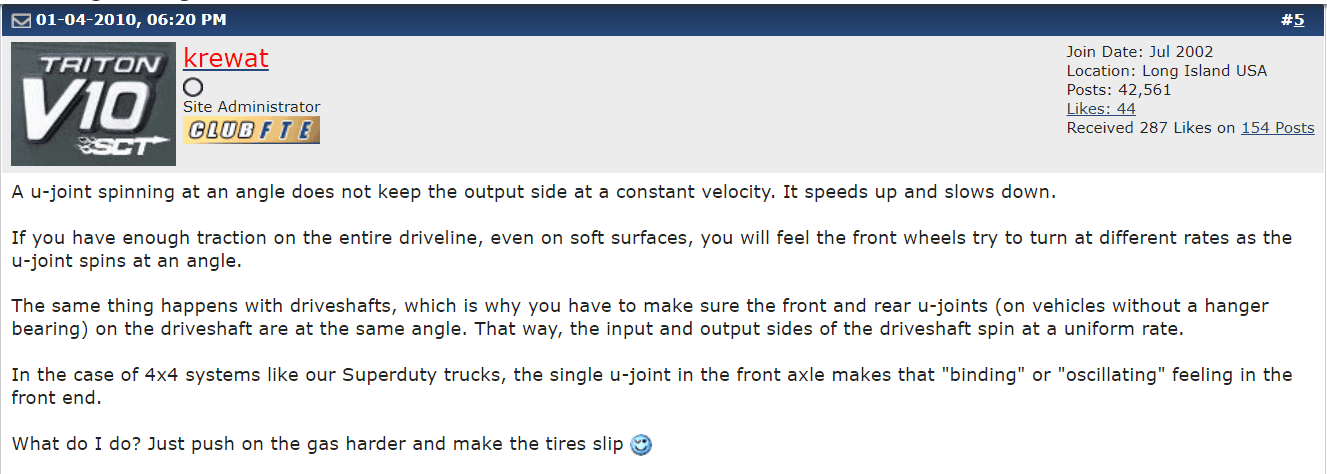
Here's another example showing it's force on those front joints and the associated RPM cycling - for every rotation, the tire tries to speed up to roughly double axle speed, and slow down to roughly half axle speed.

From MotorTrend -

once the joints begin to change degree angles (bend) the U-joint shaft decreases in strength while the CV remains constant. As the U-joint pivots, the wheel speed fluctuates and will often induce a whipping or binding action.

Here's what a guy found when it disconnected his rear driveshaft and drove only with the front running his Jeep -

I'll be honest, I've always thought it was u-joint related, and still do; however, I don't know why always locked hubs like in Jeeps don't do this in two-wheel drive, except I know they do it if you drop the rear driveline and drive in front wheel drive. I had two Jeeps, basically the same front axle in both and I took the rear driveline out of one and drove it for a while in front wheel drive. It had torque steer and had what I call u-joint binding when turning sharp, so my conclusion was that it was related to power going to the front axles somehow, maybe without power to the axles...I don't know the reason behind it really, but I still believe it's related to the u-joints, not the transfer case binding.

The problem is - no one understood the "u-joint effect" so it has for years been explained other ways

Here's an experiment another Ford truck guy ran to show the effect of standard joints on front axles - note - there can be NO drive train binding so this is 100% joint effect -

I jacked up the rear axle of my truck where both rear tires were completly off the ground. I also jacked up one front tire off the ground. I shifted the truck into 4WD Low Range which, appropriately, made 3 tires spin. Turning the steering wheel all the way to the left revealed what many in this thread were talking about: the elevated front tire spun in a jerking motion as the u-joint cycled through its range of motion as the axle rotated.

But the Jeep guy who said he switched to CV joints up front and the jerking motion disappeared, that pretty much lines up with what the science says.
 

Sweetums

Well-Known Member
Joined
Mar 30, 2023
Threads
28
Messages
2,004
Reaction score
4,312
Location
Utah
Vehicle(s)
'05 LJR, '21 JTDR, '00 VFR800, RSV4, '11 MTS 1200
Here's another example showing it's force on those front joints and the associated RPM cycling - for every rotation, the tire tries to speed up to roughly double axle speed, and slow down to roughly half axle speed.

From MotorTrend -

once the joints begin to change degree angles (bend) the U-joint shaft decreases in strength while the CV remains constant. As the U-joint pivots, the wheel speed fluctuates and will often induce a whipping or binding action.

Here's what a guy found when it disconnected his rear driveshaft and drove only with the front running his Jeep -

I'll be honest, I've always thought it was u-joint related, and still do; however, I don't know why always locked hubs like in Jeeps don't do this in two-wheel drive, except I know they do it if you drop the rear driveline and drive in front wheel drive. I had two Jeeps, basically the same front axle in both and I took the rear driveline out of one and drove it for a while in front wheel drive. It had torque steer and had what I call u-joint binding when turning sharp, so my conclusion was that it was related to power going to the front axles somehow, maybe without power to the axles...I don't know the reason behind it really, but I still believe it's related to the u-joints, not the transfer case binding.

The problem is - no one understood the "u-joint effect" so it has for years been explained other ways

Here's an experiment another Ford truck guy ran to show the effect of standard joints on front axles - note - there can be NO drive train binding so this is 100% joint effect -

I jacked up the rear axle of my truck where both rear tires were completly off the ground. I also jacked up one front tire off the ground. I shifted the truck into 4WD Low Range which, appropriately, made 3 tires spin. Turning the steering wheel all the way to the left revealed what many in this thread were talking about: the elevated front tire spun in a jerking motion as the u-joint cycled through its range of motion as the axle rotated.

But the Jeep guy who said he switched to CV joints up front and the jerking motion disappeared, that pretty much lines up with what the science says.
Again, there's a difference between driveline binding resulting in tire slippage and u-joint surge. If you are getting u-joint surging then you probably shouldn't be in 4wd at all. That surging would be mitigated by tire slippage in low traction environments because it wouldn't be transmitted to the truck as much.

These are two different problems, while they can occasionally compound each other when using 4wd at the wrong time, they are not the same.

No one is saying surging with u-joints is a myth, only that it's not the primary cause in OP's example. Rather than buying thousands of dollars of new axles, just put weight on the back and drive in RWD until you are truly in low traction and shift out of 4wd when experiencing binding.

Again, you will experience jerkiness due to driveline binding regardless of using CVs or U-joints; two different phenomena, similar feel in the cab.
 

Throwback

Well-Known Member
First Name
Philip
Joined
Dec 22, 2023
Threads
1
Messages
77
Reaction score
135
Location
New York
Vehicle(s)
Jeep Gladiator
I've got the bog standard 4wd in mine, and it's still a hoot. I grew up in snow and pickup truck country and almost no one had 4wd. Everyone piled sand bags (or something heavy) in back like people are saying here. My first car had a big block, a 4 speed and a Dana 60 out back. Not easy to keep it from breaking loose even on dry pavement. So I learned to drive in the snow. With the Gladiator Sport I've got the worst tires for snow. I have to engage 4 Hi often to get going, then shift to 2wd. But no getting out and locking/unlocking hubs -- what a brave new world!
 

ZoMojave

Well-Known Member
Joined
Feb 20, 2022
Threads
16
Messages
1,099
Reaction score
1,616
Location
MW
Vehicle(s)
Sold
Summarizing my understanding so far:

- because it's jeep and I don't have the select-trak option, this is normal behavior.
- forcing through the jerking will likely cause damage to transmission.
- replacing the u-joints with cv joints might reduce some of the symptoms.
- replacing oem diff with a limited slip diff might reduce some of the symptoms.
- Add 200-300lbs of weight to the tailgate end for better Winter traction.

Anything else?
Thank you everyone for sharing your in depth knowledge of these trucks!
Correct. That is why I ordered my JTM with Selec-Trac.
 

Sponsored

Stuntman Mike

Well-Known Member
First Name
Joerg
Joined
Sep 9, 2023
Threads
6
Messages
526
Reaction score
1,045
Location
Essen, Germany
Vehicle(s)
2022 JTOD, 2005 TJ 4.0, 1989 XJ 4.0, 2004 XK8
Occupation
Rotating Equipment Consultant
Driving onroad with slippery conditions I always use 4H auto which is apart from better traction and slightly lower mpg no difference to 2H.
 

Lost1wing

Well-Known Member
First Name
Tim
Joined
Dec 22, 2020
Threads
24
Messages
2,606
Reaction score
2,845
Location
West Georgia
Vehicle(s)
2020 Jeep Gladiator Rubicon
Occupation
Retired AMT
Summarizing my understanding so far:

- because it's jeep and I don't have the select-trak option, this is normal behavior.
- forcing through the jerking will likely cause damage to transmission.
- replacing the u-joints with cv joints might reduce some of the symptoms.
- replacing oem diff with a limited slip diff might reduce some of the symptoms.
- Add 200-300lbs of weight to the tailgate end for better Winter traction.

Anything else?
Thank you everyone for sharing your in depth knowledge of these trucks!
I would just toss a couple hundred pounds in the back. Modifications are not needed, but like some have said could make it better.

My first car was a 2wd. I had to park on the city street which had a significant crown. Just getting off of the curb was difficult without weight in the trunk. With 6- 40lb bags of salt in the back made it possible to go Just about anywhere with my 2wd.

No that I live in the south, I primarily drive in sand, clay and gravel. 2wd is for everything, I have the RSI cap and my gear in the bed at all times. The only time 4wd is engaged is when I see a possibility of sliding off of the trail. The JTR has not been stuck yet, but I don't go looking for trouble either. The Duramax will get stuck on flat ground in 2wd. Primarily because of the weight on the front axle. I keep the bed empty. Anytime I have 300-400 lbs in the back, I have more confidence of not getting stuck.

Just add some weight in the bed, drop the tire pressure and drive it the way it is. Or do like me move south. I'm not a fan of snow and ice. Recovery of a few trucks on I-94 told me that I am not cut out for cold weather.
 

Not2Late

Well-Known Member
First Name
Tarik
Joined
Jul 2, 2022
Threads
15
Messages
222
Reaction score
392
Location
kansas
Vehicle(s)
2021 Jeep Gladiator Mojave, 2017 Jeep JK
Occupation
Education
If I lived in snow country and hardcore offroading was not my thing, I think the ideal "snow cat" set up would be the max tow (with the Dana 44 wide axles) package, an aftermarket mechanical/gear (not clutch pack) limited rear slip differential, a locker in front (to get me out of any jams), and something like Goodyear duratrac tires.
Sponsored


Top