Sponsored

Best / Largest main battery?

ecidiego

Well-Known Member
First Name
Chris
Joined
Nov 3, 2021
Threads
62
Messages
3,625
Reaction score
5,580
Location
San Diego
Vehicle(s)
2021 Gladiator Mojave
Occupation
IT
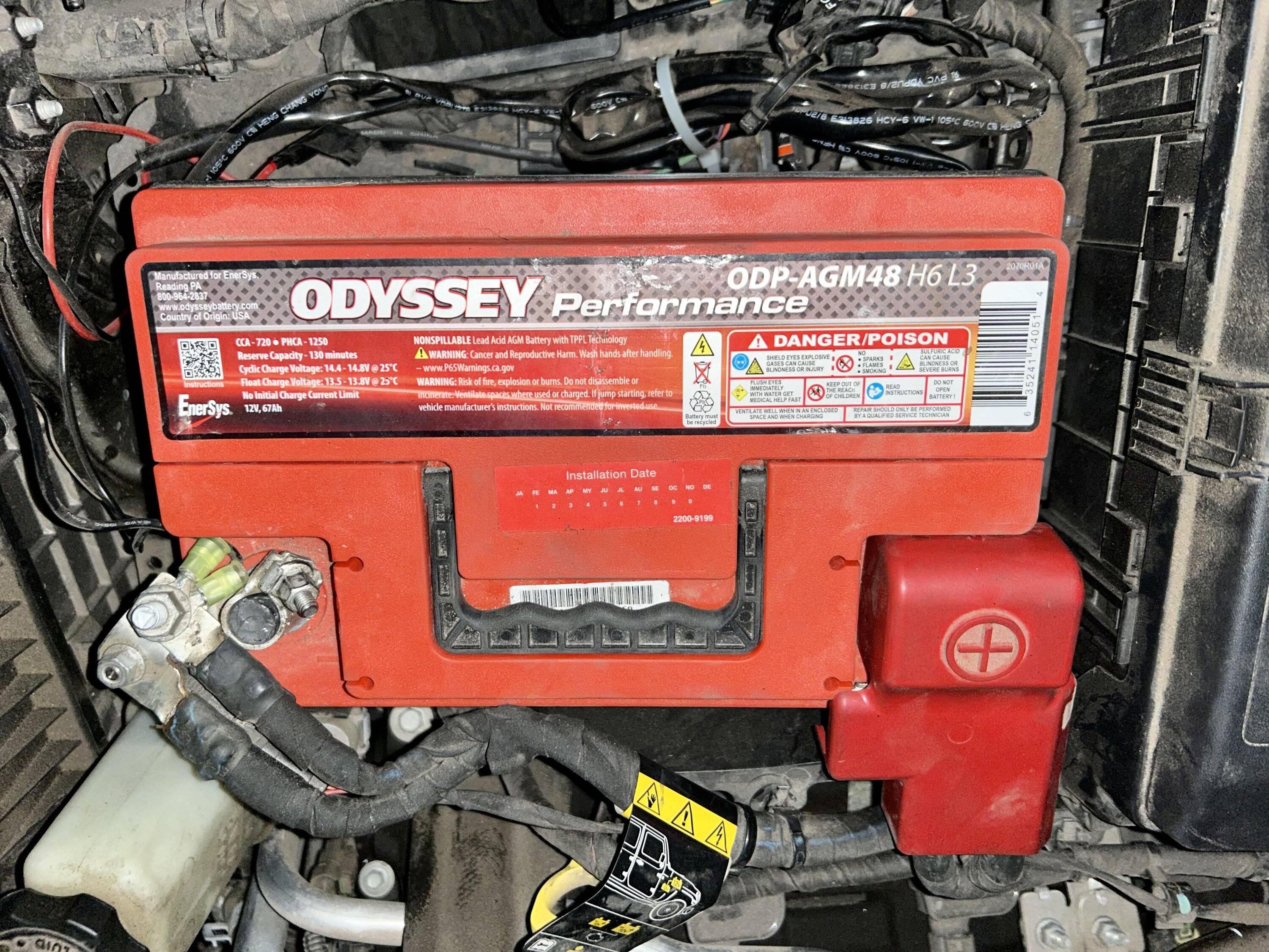
Some of the X2Power and Odyssey literature say they must be charged at 14.3v min - the Jeep "intelligent" charging circuit often forces the charge voltage lower than this. Not sure what I think about that.

 
OP
OP

ducatijosh

Well-Known Member
First Name
Josh
Joined
Oct 6, 2022
Threads
26
Messages
92
Reaction score
74
Location
DFW
Vehicle(s)
2022 Jeep Gladiator Rubicon
Some of the X2Power and Odyssey literature say they must be charged at 14.3v min - the Jeep "intelligent" charging circuit often forces the charge voltage lower than this. Not sure what I think about that.

can that junk be turned off? Replacing an alternator or something ?
 

MojaveLawyer

Well-Known Member
First Name
Agent X
Joined
May 17, 2021
Threads
5
Messages
279
Reaction score
528
Location
Classified
Vehicle(s)
2020 Jeep Gladiator Mojave
Occupation
Law & Veteran
Some of the X2Power and Odyssey literature say they must be charged at 14.3v min - the Jeep "intelligent" charging circuit often forces the charge voltage lower than this. Not sure what I think about that.
Can you educate me on what this means? Interested in learning since I don’t know much about this.

Thanks brotha!

X
 

Sponsored

Borismtngoat

Member
First Name
Heath
Joined
Jan 8, 2024
Threads
1
Messages
24
Reaction score
13
Location
Missouri
Vehicle(s)
2021 Gladiator Willys Diesel
Occupation
Self employed
If you want to keep ESS active, I'd recommend keeping the AUX battery in place. We've seen in other threads where the voltage drop from running the system off only the main has the potential to throw error codes.

I can speak to that. I had a failing aux battery and it even threw a “Service DEF system,” and had to take to the dealer. They printed out the codes and I had that and drl codes that were also active I didn’t know about. Swapped the battery, voltage back up and remote start working (original issue along with others). We’ve seen -25 with wind chill here and I hated not having the remote start at the worst time of the year.
 

chorky

Well-Known Member
First Name
Chad
Joined
Feb 26, 2022
Threads
175
Messages
3,466
Reaction score
3,801
Location
Montana
Website
www.youtube.com
Vehicle(s)
'22JTR, '06 LJ, '06 TJ GE
Build Thread
Link
Occupation
GIS Specialist
Can you educate me on what this means? Interested in learning since I don’t know much about this.

Thanks brotha!

X
It means the battery might not receive a charge while driving. The 'smart charging' systems reduce alternator output to reduce load on the engine and increase fuel mileage. but depending on the battery you have, it may or may not get charged. For example, my battery has a bulk and absorption charge of 14.4-14.7v and a float of 13.6-13.7 volts. So if the alternator is downgraded and only pushing 13 volts, then the battery is not receiving any charging and the alternator is only keeping up with the voltage needs of vehicle operation.


I'm running twin Oddessy batteries with the Genesis Gen3 dual battery kit. Absolutely love this kit and how it manages power.

The genesis kit includes an option to force the vehicle to charge at a higher rate. I honestly don't know how this works though. All that you do is connect one of the leads to the battery combiner to an engine on circuit and somehow the alternator then accounts. Maybe @ShadowsPapa might understand how this is operating? I dont' really understand the specifics of these smart charging systems that much myself to be honest. But, I think I am going to contact genesis and see if they can re-program the G-Screen to offer a in cab way to turn that feature off without disconnecting the extra wire under the hood. Because charging to 15v when it's cold for a few hours is one thing, but doing that for a 8 hour drive is probably not good for the battery and system components.
 

KevinC

Well-Known Member
First Name
Kevin
Joined
Feb 6, 2021
Threads
17
Messages
840
Reaction score
1,596
Location
Central Florida
Vehicle(s)
2023 JT Mojave Sarge
Occupation
Hard Labor

Sponsored

Reddout99

Well-Known Member
First Name
Bob
Joined
Oct 27, 2022
Threads
13
Messages
637
Reaction score
666
Location
Papillion, NE
Vehicle(s)
Black 2021 80th Anniv. JT Sport S
Occupation
Cad Manager - Retired
Vehicle Showcase
1
I recently had my main battery replaced. My shop replaced it with a Motorcraft AGM battery. He said he's been using these as replacements and it will last longer than the OEM.

 

ShadowsPapa

Well-Known Member
First Name
Bill
Joined
Oct 12, 2019
Threads
247
Messages
40,440
Reaction score
53,853
Location
Runnells, Iowa
Vehicle(s)
'25 JTMX, '23 JLU 4xe, '82 SX4, '73 Javelin
Occupation
Retired auto mechanic, frmr gov't ntwrk security admin
Vehicle Showcase
3
With the genesis I'm still seeing it hold the voltage on full charge at 12.7 / 8 and then up to 14.7 if the batteries get low. It is working how it did before the genesis install.
Perfect.
Normal. AGM batteries, typical, some will vary, are fully charged at 12.7-12.8 and I've seen a couple of "brands" say 12.8-12.9.
14.7 is "good" but that depends on ambient temperature as well. When it's below about 40 degrees mine hangs in there about 14.8-14.9 volts when they aren't fully charged and in the winter, 15.0 isn't unusual, and in fact, I can drive 30 minutes in 20 to 30 degree temps and see 15.0 the whole way.
That's higher than my 2020 did. It used to top out at about 14.8 in the winter.

Some of the X2Power and Odyssey literature say they must be charged at 14.3v min - the Jeep "intelligent" charging circuit often forces the charge voltage lower than this. Not sure what I think about that.
Totally depends on the state of charge of the batteries and the temperature.
People get hung up on the voltages in the literature or on the battery label - there's no one correct voltage. It "depends" on many factors.
Cold requires more, hot requires less.
The IBS helps determine need by historical data and battery health and temperatures.

If I feel things are "out of sync" I pull the IBS to reset it and recharge each battery with a good AGM charger over several hours until IT says they are full.

can that junk be turned off? Replacing an alternator or something ?
NO and you do not want to. Charging at a steady rate "like the good old days" can overheat and overcharge batteries and shorten their lives.

my battery has a bulk and absorption charge of 14.4-14.7v and a float of 13.6-13.7 volts.
In a running vehicle -
If a battery is fully charged at 12.8 volts and the system voltage is 12.8 or higher on a fully charged battery, it's hard to see a battery losing charge since what's across the terminals is the natural voltage of the fully charged battery anyway.
Float voltage is intended to compensate for the self-discharge of a battery sitting in waiting. So you don't need to operate at float voltage in an operational setting like driving as there won't be "self discharge".

CCCV - constant current/constant voltage -
With the CCCV method, lead acid batteries are charged in three stages, which are:
constant-current charge,
topping charge
float charge.
The constant-current charge applies the bulk of the charge and takes up roughly half of the required charge time; the topping charge continues at a lower charge current and provides saturation, and the float charge compensates for the loss caused by self-discharge.

You don't need "float" in these vehicles while being driven.

If your batteries are used for solar arrays, standby systems and so on, or stored, or unused, then that's where your float voltage comes in - compensate for the natural self-discharge while sitting around.

Don't get tangled with "float voltage" for a battery used in a vehicle and think that is what you need to see while driving it. That's not what float voltage is. Most can ignore that number unless the battery sits idle, unused. It's more for use with standby operations or battery tenders/minders. Not for a running vehicle.

Here's why I keep preaching on the idea that we are ruining our own batteries by not driving often enough or long enough, or keeping them otherwise fully charged - from "the experts" comes this great quote -
If continually deprived, the battery will eventually lose the ability to accept a full charge and the performance will decrease due to sulfation.

In other words, if you never drive it enough to keep up to a full charge, and say you start out at 12.8 new, but do short drives and it sits, and the voltage gets down to 12.4, then you drive it and the alternator charges it back up to 12.6 then it sits again and drops to 12.2 from sitting, and you take short drives later and it charges up to 12.4 while driving and you do this over and over and over and it never gets back up above 12.6 or 12.7 - eventually it will never again take a full charge, and it will lose capacity.
 

ShadowsPapa

Well-Known Member
First Name
Bill
Joined
Oct 12, 2019
Threads
247
Messages
40,440
Reaction score
53,853
Location
Runnells, Iowa
Vehicle(s)
'25 JTMX, '23 JLU 4xe, '82 SX4, '73 Javelin
Occupation
Retired auto mechanic, frmr gov't ntwrk security admin
Vehicle Showcase
3
I recently had my main battery replaced. My shop replaced it with a Motorcraft AGM battery. He said he's been using these as replacements and it will last longer than the OEM.
He may not be wrong.
Battery in my 1995 F250 lasted over 12 years.
Battery in my 2011 Silverado went 6 years.
Granted, that's decades ago, the battery technology, manufacturers and more has changed, but I had GREAT luck with that Ford battery and it sat around a lot.
 

Lunentucker

Well-Known Member
Joined
Apr 24, 2022
Threads
245
Messages
5,866
Reaction score
15,356
Location
Virginia
Vehicle(s)
2021 Jeep Gladiator Mojave
Occupation
People Work?
My plan is to install an Optima yellow H7 when my OE warranty is up next Fall.
If I were using accessories that required deeper cycles I'd do the red.
Sponsored


Top