Sponsored

Engine oil -- what weight and brand do others use?

DanW

Well-Known Member
First Name
Dan
Joined
Mar 2, 2017
Threads
45
Messages
1,878
Reaction score
2,459
Location
Brownsburg, Indiana
Vehicle(s)
21 JT Rubi, 18 JLU Rubi, 2008 JKU Rubi, 07 Vette
Up to 26k I ran Mopar 0-20 as recommend.

I personally have helped 16 different JL owners who could not make any headway with their dealer. When I showed them what data to log or worked with their dealer the diagnosis was quick and obvious.

The rattle at 3000 RPM is a well documented phenomenon, that laughably has had software update TSBs. That rattle is the clearance between the high lift cam and ground down cam closing as the oil is turned off from the VVL solenoid.

I don't spend a phenomenal amount of time above 3K. Infact my tune for my supercharger works to spend more time under 3K, and utilize the extra airflow to keep stress off the engine. I did not realized I had failed a cam until I was pulling my trailer loaded withe a car and the misfire code came up.

Would you run 0-20w in a flat tappet cam engine capable of turning 6000 rpm.

If your answer is yes, then we plainly disagree. If it is no, then you need to think aboit this everytime your engine sees 3000 rpm because that is what you are doing.

To boot Jeep has neglected to use all the safety strategies available with this OS that operates the 3.6L so it has little to no course correction when fuel is bad, weather is extreme, or your plain just giving it the beans for extended periods of time. There are routines that reduce timing, release cylinder pressure via cam VVT, and add fuel cooling as things get ruff. I have activated all of these and my engine can see extended HD operation and I have data that shows it cranking things down to survive and still perform. Infact when my cams failed, it worked around it and adjusted everything to keep running well.

The factory tune will not do this and if a person goes WOT with these cam problems it qill expire the engine, and I know of at least two machines this has happened to. Both are now running my tune.

I am not making this stuff up. I was a huge proponent of this engine, until I saw this failure mode. Now I am a bit upset and quite frankly extremely critical of the engineering that was executed and sold to us at a premium.

For reference. The challenger VVT and VVL do not start working until 4700 rpm, and there are large timing and cam sweeps that take place when it is activated. My guess is they purposely keep it out of this range as they know the car will never see a work cycle like our jeeps and they can get away with it.
Ok, so we disagree.

I've also got no rattle at 3k. I run my engine plenty hard, so if it is there, it should show up. I see no evidence of a problem in UOA's, either. I've seen not one other than your post with this kind of failure, on either the JT or JL forum.

I'm at 60k and counting. Runs as smooth as the day I drove it home.

Revised:

1. Custom tune
2. Supercharger
3. Cam failure

I'll stick with OEM tuning, induction, and good maintenance and will bet this engine runs just fine at 200k.
Sponsored

 
Last edited:
DAVECS1

Well-Known Member
First Name
David
Joined
Jan 24, 2020
Threads
56
Messages
1,861
Reaction score
2,538
Location
Peoria, IL
Vehicle(s)
2020 Gladiator Sport S Max Tow
I am not saying they will all fail. It would restore my faith in humanity if they don't, but the fact of the matter remains they are failing. I actually have had two well known you tubers come to me about their issues. I helped them get there rigs sorted and back to hitting the trails.

I am saying that some research into an easy flowing oil with high pressure film strength will increase your odds of long engine life and quiet operation.
 

Maximus Gladius

Well-Known Member
First Name
Kevin
Joined
Jan 30, 2021
Threads
75
Messages
2,910
Reaction score
3,712
Location
Calgary, AB, Canada
Vehicle(s)
2021 JTR, 2023 JTR
What I’d give to not have an engine that had a cam failure and a coolant consumption problem. There’s a lot discussed here about misfires and cam replacement for the 3.6. Not all misfires is because of a bad cam, maybe we have some that’s a valve cover oil leak or maybe it’s an injector or spark plugs but mine was a bad camshaft. Back in July of last year I waited over 40 days for my camshaft to be delivered to the dealership. I had enquired with the Parts department to track it and as he looked it up on his screen, he commented that over 360 cams were being unpacked at the distribution warehouse in the US to be disbursed to dealerships across the country. The dealership I’ve been dealing with already had 9 cam replacements for misfires and the neighbouring dealership had 10 cam jobs. That was from January to July 2021.

Though I am glad the cam replacement has made this engine run and sound better than it was new, I’m disappointed I have this coolant leak FCA is quite happy to not fix and I actually have to force the fact coolant and oil do not mix and are not supposed too.

I don’t know why the JL forum doesn’t have much in the bad cam misfire problems department but the gladiator forum has much discussion on this.
 

Maximus Gladius

Well-Known Member
First Name
Kevin
Joined
Jan 30, 2021
Threads
75
Messages
2,910
Reaction score
3,712
Location
Calgary, AB, Canada
Vehicle(s)
2021 JTR, 2023 JTR
Might I add to my post, I use 0/20. The UOA from the early start at 1000kms shows high iron count in the 40’sppm. That’s troubling. My previous vehicle, 2017 Tacoma would show iron counts at 12 ppm from new to 110k kms when I made the switch to the JTR. All my UOA (6) show high iron, in fact, even when the camshaft was replaced the iron count dropped to the 20’s ppm. That’s still double what is considered ideal in around 10-12ppm. Even though my iron count dropped by half, it’s still too high for my liking. I’m sure the constant diet of coolant isn’t helping.
 

DanW

Well-Known Member
First Name
Dan
Joined
Mar 2, 2017
Threads
45
Messages
1,878
Reaction score
2,459
Location
Brownsburg, Indiana
Vehicle(s)
21 JT Rubi, 18 JLU Rubi, 2008 JKU Rubi, 07 Vette
Mine saw 38 in the first oil change at 2k miles. That's no different than any other engine I've tested. In fact, most of them got their first change at 1k miles. This one was double what I normally do with a new vehicle. But break-in always sees high iron. Always. The next one went to 20 and it has hovered between 18 and 20 ever since, with 18 being the universal average for Pentastars dating back to their introduction, according to Blackstone Labs. The latest was 10, on Shell Rotella Gas Truck, and that run included a long off-road trip to Maine. Overall, it hasn't seen anything different than any engine I ran with 5w30, including Chevy 5.3's, GM 2.0, Honda 1.6, Toyota 3.4, and so-on. They all came back in the 15-25 range. The brand of oil you use can cause a minor difference, too. But the iron you see is also dependent on miles driven, as it shows a linear increase in a healthy engine.. Also, the actual number is not what you are looking for so much with UOAs, as much as trends. Driving profile makes a difference, as well. I see more wear metals when I have done more commuting with more cold starts and less when I've done more long distance driving with fewer cold starts.

You can see countless UOA's on BITOG with 20 weight oils where the engines have gone the distance, Pentastars included. The sky did not and is not falling.

I've also seen plenty of Pentastar UOA's on BItog with 5w30. They tend to show about the same typical wear numbers as those on 20 weight.

There are probably 14 million Pentastars on the road today, including somewhere between 2 and 4 million of the PUG version. They continue among the lowest warranty claim cost rates for any mass produced engine. In that regard, they are the envy of the industry. With that number on the road, even a tiny percentage with a particular problem will mean that most shops will have seen it and many will have seen it multiple times.

And remember, just about any part is on back order with supply chain issues right now. That's not the way to guage a major issue. I had to wait 6 weeks for a common bushing for an interior piece and am still waiting after 4 months on a tiny part for my soft top. But I don't see any other reports of those parts failing. Heck, I waited 3 months just for General Grabber X3's. When I ordered them, General told me they were in 3 shift production. Discount tire found a set in a warehouse in Nevada or I'd have waited longer.

Run 5w30 if you want. It'll be fine, especially if you run a thinner one like Pennzoil Platinum. But the 20 weight isn't a source of any problems and won't cause a warranty denial.

And take Oil_Udder's advice and disable or shut off the ESS to save your bearings.

My JLUR just hit 5k on its current run, so it gets a bottle of Mobil 1 EP 0w20 today. I did the last run on Chevron Havoline Pro-DS 0w20 that I picked up for a deal. I'll do yet another UOA and will post it up when it comes back in a couple weeks. I wouldn't hold my breath. It'll probably cause a yawn.
 

Sponsored

WhyNotJeep

Banned
Banned
First Name
Steve
Joined
Mar 14, 2022
Threads
13
Messages
303
Reaction score
260
Location
La Verne
Vehicle(s)
'14 Ram 2500 Diesel 4x4,,, '14 Wrangler JKUR
Occupation
Done with it
I've got free oil changes coming from Jeep Wave so I'll let the dealer decide what to give me for free.
 

Compton

Active Member
First Name
Scott
Joined
May 27, 2023
Threads
4
Messages
37
Reaction score
10
Location
Shenandoah Valley Virginia
Vehicle(s)
2020 Gladiator Overland
If you poke around on BITOG, there is a person on there who was a Pentastar design engineer, screen name OIL_UDDER. They state that the heavier weight oil leads to accelerated wear of the cams and in the head at cold start.

https://bobistheoilguy.com/forums/threads/626-000-mile-pentastar-teardown.329423/#post-5474366
For people like me digging into this -I find this really interesting and having a former design engineer input is cool but -its not clear from what i read as the next reply he posted says
" i wish I had some more data for you 2015_PSD, Unfortunately I left the company as the Gen II was kicking off. I do know the engineering team was VERY nervous on the 0w-20 stuff and it was 100% for fuel economy. My personal opinion knowing the bearing surface area would not have gone up because of the cost I would go up a notch in weight. "
 

Hootbro

Well-Known Member
First Name
Don
Joined
Apr 13, 2019
Threads
57
Messages
10,196
Reaction score
19,972
Location
Delaware
Vehicle(s)
2025 Gladiator Sport
Since we’re resurrecting zombie threads:

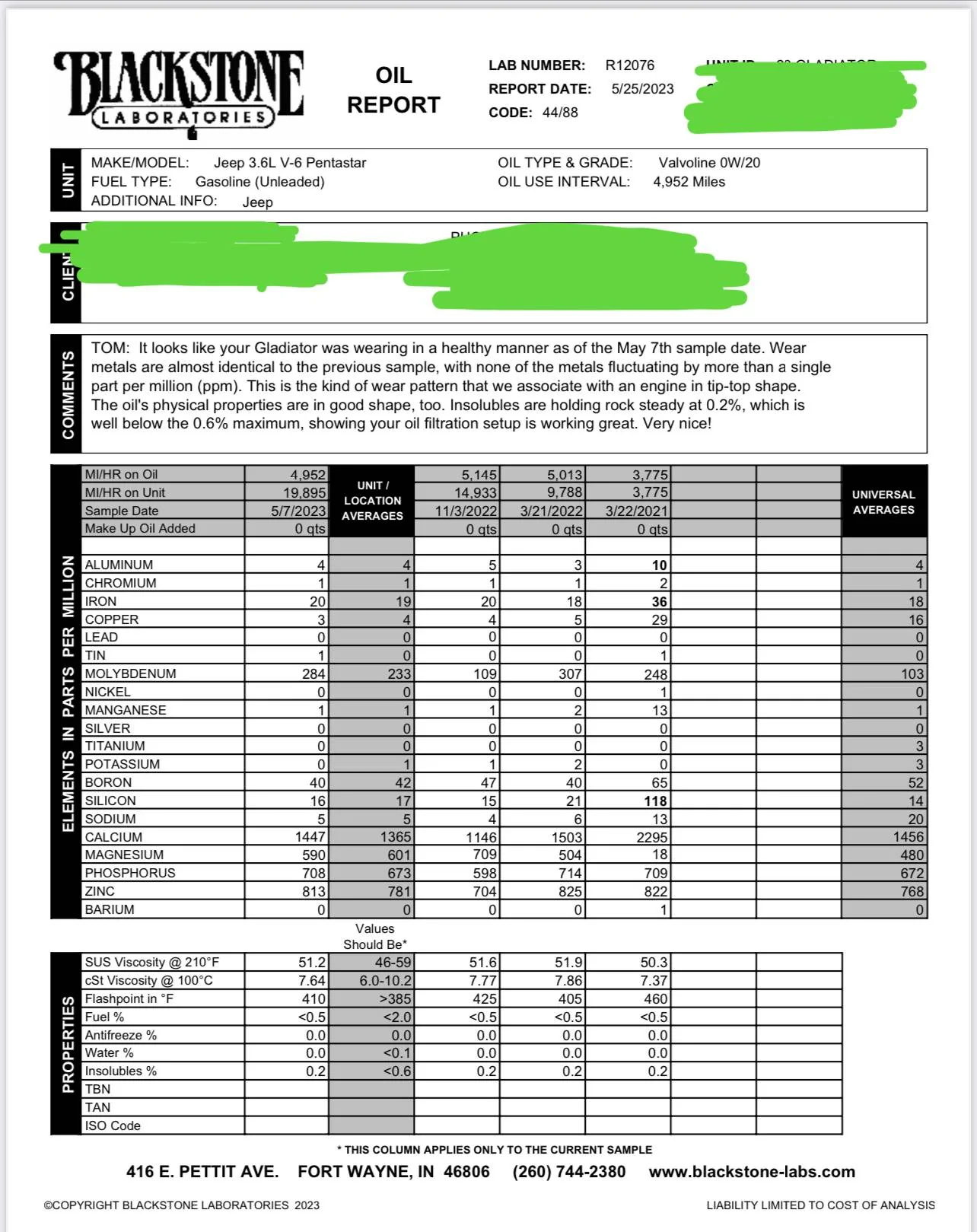
Valvoline OW-20 Synthetic every change and you can see my UOA here

9E6E9E32-A95D-4534-9B72-12AECD270A45.jpeg
Good looking report. Nice to see current Valvoline formulation with a health dose of Moly instead of sodium like they use to.
 

Compton

Active Member
First Name
Scott
Joined
May 27, 2023
Threads
4
Messages
37
Reaction score
10
Location
Shenandoah Valley Virginia
Vehicle(s)
2020 Gladiator Overland
Interesting thank you - yeah i dug it up because it had the design engineer link. I had a jku years ago and just bought a slightly used 2020 gladiator so researching what to put in it. I always ran PP 5-20 or 5-30 in the jku at 5k intervals. Just want to take care of the Jeep best i can -
 

Sponsored

ShadowsPapa

Well-Known Member
First Name
Bill
Joined
Oct 12, 2019
Threads
247
Messages
40,463
Reaction score
53,911
Location
Runnells, Iowa
Vehicle(s)
'25 JTMX, '23 JLU 4xe, '82 SX4, '73 Javelin
Occupation
Retired auto mechanic, frmr gov't ntwrk security admin
Vehicle Showcase
3
Interesting thank you - yeah i dug it up because it had the design engineer link. I had a jku years ago and just bought a slightly used 2020 gladiator so researching what to put in it. I always ran PP 5-20 or 5-30 in the jku at 5k intervals. Just want to take care of the Jeep best i can -
I'm getting mixed and uneasy vibes about the bit you quoted above - and too many things cause me pause about what's been said, like this - makes no sense ->
cool but -its not clear from what i read as the next reply he posted says
" i wish I had some more data for you 2015_PSD, Unfortunately I left the company as the Gen II was kicking off. I do know the engineering team was VERY nervous on the 0w-20 stuff and it was 100% for fuel economy. My personal opinion knowing the bearing surface area would not have gone up because of the cost I would go up a notch in weight. "
What's the latter got to do with the former? Bearing surface area? Knowing what I know, I have to question a whole lot of things about his comments. Viscosity does NOT protect and bearing surface isn't going to matter with a different viscosity.
I could go into a lot of detail, but seeing what I've seen, I just don't trust a lot of that information. Liquid oil can't be compressed. As long as that bearing area is kept with oil in it, it's fine. As long as the pump keeps oil supplied into the bearings (as witnessed by the fact it's keeping the pressure up) it's fine.

Run what they say - or go to 5w30 if you wish, and do what makes you comfortable about how far you drive it, temper the distance between changes with how you use it, how hard you use it, you'll be fine. The best thing that can be done is use a GOOD oil. This argument about viscosity doesn't hold up to science - or the fact that some oils will actually be thinner than others at 212 degrees even if they are the same advertised viscosity.
Take a look at 7 decent oils, ALL of them the same advertised viscosity (5w30) but look at the differences at 212 degrees.

1. 5W30 Quaker State “Full Synthetic”
KV at 100°C (212°F) = 11.6 cSt
2. 5W30 Mobil 1 Advanced Full Synthetic
KV at 100°C (212°F) = 11.1 cSt
3. 5W30 Quaker State High Mileage Full Synthetic
KV at 100°C (212°F) = 10.8 cSt
4. 5W30 Valvoline Full Synthetic Extended Protection
KV at 100°C (212°F) = 10.7 cSt
5. 5W30 Valvoline Advanced Full Synthetic
KV at 100°C (212°F) = 10.5 cSt
6. 5W30 Amsoil Signature Series
KV at 100°C (212°F) = 10.3 cSt
7. 5W30 Pennzoil Platinum Full Synthetic
KV at 100°C (212°F) = 9.8 cSt

Just in this list a range of 11.6 cSt ("thickest") to 9.8 cSt
 

Compton

Active Member
First Name
Scott
Joined
May 27, 2023
Threads
4
Messages
37
Reaction score
10
Location
Shenandoah Valley Virginia
Vehicle(s)
2020 Gladiator Overland
I'm getting mixed and uneasy vibes about the bit you quoted above - and too many things cause me pause about what's been said, like this - makes no sense ->


What's the latter got to do with the former? Bearing surface area? Knowing what I know, I have to question a whole lot of things about his comments. Viscosity does NOT protect and bearing surface isn't going to matter with a different viscosity.
I could go into a lot of detail, but seeing what I've seen, I just don't trust a lot of that information. Liquid oil can't be compressed. As long as that bearing area is kept with oil in it, it's fine. As long as the pump keeps oil supplied into the bearings (as witnessed by the fact it's keeping the pressure up) it's fine.

Run what they say - or go to 5w30 if you wish, and do what makes you comfortable about how far you drive it, temper the distance between changes with how you use it, how hard you use it, you'll be fine. The best thing that can be done is use a GOOD oil. This argument about viscosity doesn't hold up to science - or the fact that some oils will actually be thinner than others at 212 degrees even if they are the same advertised viscosity.
Take a look at 7 decent oils, ALL of them the same advertised viscosity (5w30) but look at the differences at 212 degrees.

1. 5W30 Quaker State “Full Synthetic”
KV at 100°C (212°F) = 11.6 cSt
2. 5W30 Mobil 1 Advanced Full Synthetic
KV at 100°C (212°F) = 11.1 cSt
3. 5W30 Quaker State High Mileage Full Synthetic
KV at 100°C (212°F) = 10.8 cSt
4. 5W30 Valvoline Full Synthetic Extended Protection
KV at 100°C (212°F) = 10.7 cSt
5. 5W30 Valvoline Advanced Full Synthetic
KV at 100°C (212°F) = 10.5 cSt
6. 5W30 Amsoil Signature Series
KV at 100°C (212°F) = 10.3 cSt
7. 5W30 Pennzoil Platinum Full Synthetic
KV at 100°C (212°F) = 9.8 cSt

Just in this list a range of 11.6 cSt ("thickest") to 9.8 cSt
I'm getting mixed and uneasy vibes about the bit you quoted above - and too many things cause me pause about what's been said, like this - makes no sense ->


What's the latter got to do with the former? Bearing surface area? Knowing what I know, I have to question a whole lot of things about his comments. Viscosity does NOT protect and bearing surface isn't going to matter with a different viscosity.
I could go into a lot of detail, but seeing what I've seen, I just don't trust a lot of that information. Liquid oil can't be compressed. As long as that bearing area is kept with oil in it, it's fine. As long as the pump keeps oil supplied into the bearings (as witnessed by the fact it's keeping the pressure up) it's fine.

Run what they say - or go to 5w30 if you wish, and do what makes you comfortable about how far you drive it, temper the distance between changes with how you use it, how hard you use it, you'll be fine. The best thing that can be done is use a GOOD oil. This argument about viscosity doesn't hold up to science - or the fact that some oils will actually be thinner than others at 212 degrees even if they are the same advertised viscosity.
Take a look at 7 decent oils, ALL of them the same advertised viscosity (5w30) but look at the differences at 212 degrees.

1. 5W30 Quaker State “Full Synthetic”
KV at 100°C (212°F) = 11.6 cSt
2. 5W30 Mobil 1 Advanced Full Synthetic
KV at 100°C (212°F) = 11.1 cSt
3. 5W30 Quaker State High Mileage Full Synthetic
KV at 100°C (212°F) = 10.8 cSt
4. 5W30 Valvoline Full Synthetic Extended Protection
KV at 100°C (212°F) = 10.7 cSt
5. 5W30 Valvoline Advanced Full Synthetic
KV at 100°C (212°F) = 10.5 cSt
6. 5W30 Amsoil Signature Series
KV at 100°C (212°F) = 10.3 cSt
7. 5W30 Pennzoil Platinum Full Synthetic
KV at 100°C (212°F) = 9.8 cSt

Just in this list a range of 11.6 cSt ("thickest") to 9.8 cSt
I don't quite understand the meaning of some of
I'm getting mixed and uneasy vibes about the bit you quoted above - and too many things cause me pause about what's been said, like this - makes no sense ->


What's the latter got to do with the former? Bearing surface area? Knowing what I know, I have to question a whole lot of things about his comments. Viscosity does NOT protect and bearing surface isn't going to matter with a different viscosity.
I could go into a lot of detail, but seeing what I've seen, I just don't trust a lot of that information. Liquid oil can't be compressed. As long as that bearing area is kept with oil in it, it's fine. As long as the pump keeps oil supplied into the bearings (as witnessed by the fact it's keeping the pressure up) it's fine.

Run what they say - or go to 5w30 if you wish, and do what makes you comfortable about how far you drive it, temper the distance between changes with how you use it, how hard you use it, you'll be fine. The best thing that can be done is use a GOOD oil. This argument about viscosity doesn't hold up to science - or the fact that some oils will actually be thinner than others at 212 degrees even if they are the same advertised viscosity.
Take a look at 7 decent oils, ALL of them the same advertised viscosity (5w30) but look at the differences at 212 degrees.

1. 5W30 Quaker State “Full Synthetic”
KV at 100°C (212°F) = 11.6 cSt
2. 5W30 Mobil 1 Advanced Full Synthetic
KV at 100°C (212°F) = 11.1 cSt
3. 5W30 Quaker State High Mileage Full Synthetic
KV at 100°C (212°F) = 10.8 cSt
4. 5W30 Valvoline Full Synthetic Extended Protection
KV at 100°C (212°F) = 10.7 cSt
5. 5W30 Valvoline Advanced Full Synthetic
KV at 100°C (212°F) = 10.5 cSt
6. 5W30 Amsoil Signature Series
KV at 100°C (212°F) = 10.3 cSt
7. 5W30 Pennzoil Platinum Full Synthetic
KV at 100°C (212°F) = 9.8 cSt

Just in this list a range of 11.6 cSt ("thickest") to 9.8 cSt
My point was only that some people used his earlier post in the thread as proof to use 0-20 then he says in the next post i quoted they were very nervous and go up a notch. I was just researching and it wasn't clear. I do adjust for summer/winter/hard use or not. I don't know if i gain much or anything one way or the other Thanks for the input.
 

ShadowsPapa

Well-Known Member
First Name
Bill
Joined
Oct 12, 2019
Threads
247
Messages
40,463
Reaction score
53,911
Location
Runnells, Iowa
Vehicle(s)
'25 JTMX, '23 JLU 4xe, '82 SX4, '73 Javelin
Occupation
Retired auto mechanic, frmr gov't ntwrk security admin
Vehicle Showcase
3
I don't quite understand the meaning of some of

My point was only that some people used his earlier post in the thread as proof to use 0-20 then he says in the next post i quoted they were very nervous and go up a notch. I was just researching and it wasn't clear. I do adjust for summer/winter/hard use or not. I don't know if i gain much or anything one way or the other Thanks for the input.
He's hard to take as he waffles a bit - and then comments about the crankshaft journals - that last part shouldn't even be in the conversation. So, I find him not the best resource, personally.
0w20 would be fine, going up to 5w30 isn't going to hurt, going higher can be a negative and won't help a thing.

In other words, my suggestion is to do what you've been doing.
 

DanW

Well-Known Member
First Name
Dan
Joined
Mar 2, 2017
Threads
45
Messages
1,878
Reaction score
2,459
Location
Brownsburg, Indiana
Vehicle(s)
21 JT Rubi, 18 JLU Rubi, 2008 JKU Rubi, 07 Vette
For people like me digging into this -I find this really interesting and having a former design engineer input is cool but -its not clear from what i read as the next reply he posted says
" i wish I had some more data for you 2015_PSD, Unfortunately I left the company as the Gen II was kicking off. I do know the engineering team was VERY nervous on the 0w-20 stuff and it was 100% for fuel economy. My personal opinion knowing the bearing surface area would not have gone up because of the cost I would go up a notch in weight. "
He´s running 5w20 in his Pentastar (Chrysler 300) and did from Day 1. At 100 degrees Centigrade, it is the same viscosity as 0w20. He´s probably got over 200k on it by now. He´s had zero issues and runs it hard. He told me long after that post in a PM to run 0w20 with confidence, as they have more than enough data on it. Remember this, too. There is a coating on the high startup wear parts in the PUG Pentastar to mitigate wear from start/stop. He told me these engines could be the longest lasting of the Pentastars if you shut off the ESS, which he highly recommends. I´ve not used ESS since I installed the Taser JL very shortly after I got the Jeep. I´m now at 77k miles and loving it. I´m mostly running Mobil 1 EP 0w20 but still have 2 or 3 changes worth of Rotella Gas Truck, which I´ll probably run next winter.
 

DanW

Well-Known Member
First Name
Dan
Joined
Mar 2, 2017
Threads
45
Messages
1,878
Reaction score
2,459
Location
Brownsburg, Indiana
Vehicle(s)
21 JT Rubi, 18 JLU Rubi, 2008 JKU Rubi, 07 Vette
I don't quite understand the meaning of some of

My point was only that some people used his earlier post in the thread as proof to use 0-20 then he says in the next post i quoted they were very nervous and go up a notch. I was just researching and it wasn't clear. I do adjust for summer/winter/hard use or not. I don't know if i gain much or anything one way or the other Thanks for the input.
He won´t say that now. He´s sold on 0w20 now. He will tell you to run it with confidence, but make sure it is a reputable brand. Most are. Even Walmart Supertech is very good. API SP/GF6 is a high standard. Today´s 0w20 can pass tests that yesterday´s 10w30 couldn´t pass.
Sponsored


Top