
Sponsored

Dealer Trying to Void Warranty

sharpsicle

Well-Known Member
Joined
Apr 29, 2021
Threads
22
Messages
2,770
Reaction score
6,261
Location
Tampa, FL / Milwaukee, WI
Vehicle(s)
2020 Gladiator Overland, 2002 VTX1800
If it's not fused it's direct power. If it shorts or draws too much current while in use it will melt things. It's a simple enough concept.

Well that doesn't help lol. You can absolutely have fused hardwired connections. Those are not mutually exclusive things.

Jeep Gladiator Dealer Trying to Void Warranty 1701973455983
Sponsored


SargeDiesel

Well-Known Member
First Name
michael
Joined
Aug 22, 2021
Threads
25
Messages
1,889
Reaction score
1,452
Location
35173
Vehicle(s)
Jeep Gladiator Rubicon Diesel
Occupation
Retired Military
Chances are more likely it's your main battery than your aux battery. The same thing happened on mine and almost identical to yours did and dealership said the main had a few dead cells and replaced it and I haven't had anymore issues. The battery was replaced at 52,000 miles, I still have my original Aux battery installed and I'm at 82,000 miles now. Don't assume both batteries are the problem or it's just the Aux battery.

Also my harbor freight Badlands battery came with a solenoid kill switch to wire between the battery and the winch so when not in use I just turn the switch off and it draws nothing. A winch can absolutely draw enough to drain a battery if a vehicle sits for a few days and can draw from the battery. Most of the not cheaper winch's come with a kill switch nowadays
What is this "harbor freight Badlands battery" you speak of ?
 

SargeDiesel

Well-Known Member
First Name
michael
Joined
Aug 22, 2021
Threads
25
Messages
1,889
Reaction score
1,452
Location
35173
Vehicle(s)
Jeep Gladiator Rubicon Diesel
Occupation
Retired Military
I'm not the OP and haven't had a battery problem in either JL or my JT. I wouldn't want another garbage factory battery even if I did have a problem. I can change a battery in 1/10th the time it would take to drive to the dealer. Not saying you can't run one, hell people are still wearing masks, do whatever makes you feel safe. I've been to the warn headquarters, pop the hood on every vehicle in the parking lot and see what percentage are wired straight to the battery.
Ok.... since I can't, maybe you will share ? What percentage ?
 

Sponsored

ShadowsPapa

Well-Known Member
First Name
Bill
Joined
Oct 12, 2019
Threads
247
Messages
40,463
Reaction score
53,911
Location
Runnells, Iowa
Vehicle(s)
'25 JTMX, '23 JLU 4xe, '82 SX4, '73 Javelin
Occupation
Retired auto mechanic, frmr gov't ntwrk security admin
Vehicle Showcase
3
If it's not fused it's direct power. If it shorts or draws too much current while in use it will melt things. It's a simple enough concept.
Not true either - anything that's hardwired in your house goes through a breaker. The Level 2 charger i installed is hardwired - to a breaker. It means there is no switch and no outlet between power source and device.
Anything with a switch or outlet or some other connection (like a dash cam plugged into the 12v socket) is not hardwired.

You are saying that nothing in your house is hardwired.

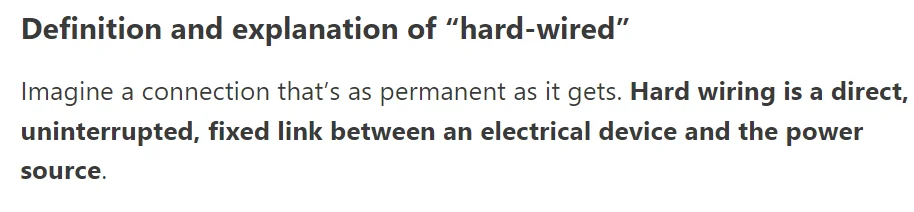
Jeep Gladiator Dealer Trying to Void Warranty Screenshot 2023-12-07 105127


The power source is the fuse or the breaker.

Jeep Gladiator Dealer Trying to Void Warranty 1701976427463


Uninterrupted - no switch, no control device - a direct, fixed link between device and source.

Because they’re directly connected to the power source, there’s less risk of disconnection or interference.

Jeep Gladiator Dealer Trying to Void Warranty 1701976584218


Aux 1 (F93-40A) Brown/pink stripe
Aux 2 (F92 - 40A) Green/pink stripe
Aux 3 (F103- 15A) Pink/orange stripe
Aux 4 (F108 -15A) Blue/pink stripe
yes, like the snippet of the owners manual I posted.
If accessory lights such as a light bar are safely under 40 amps you can absolutely wire them "through the aux switches" because 1 and 2 can handle up to 40 amps.

A relay is a switch, electrically controlled.
A solenoid is also a switch, electrically controlled.
Anything going through a relay or a solenoid as the word "solenoid" is used in automotive terms is switched.
 

Lost1wing

Well-Known Member
First Name
Tim
Joined
Dec 22, 2020
Threads
24
Messages
2,611
Reaction score
2,866
Location
West Georgia
Vehicle(s)
2020 Jeep Gladiator Rubicon
Occupation
Retired AMT
We get into semantics there because when you say "hard wired" for most that means a single wire from device to power source. So if you say "hardwired to the battery" most think of a single cable running directly from the device to the positive battery post.
It's not switched power.
If you run a solenoid, it's technically switched power because the solenoid is a switch.
When you install a level 2 EV charger, you can use a 220 outlet of the proper rating or you can hardwire it - and that means you have a single wire from the charger to the breaker. it's hardwired. No switch, no outlet.
Hardwired implies a switch or other device is not in the line. A solenoid is a switch so mind is switched power.
I contend that in your example, the device or items at the rear are switched, not hardwired. Hardwired is a direct connection to the power source, unswitched, no connections.

1701967896728.webp


It refers to a type of wiring with no switches and no outlets.
A solenoid is a switch (it's really a relay, a high current relay)
Add a relay, you now have a switch in the mix it's no longer hardwired, it's switched.

People also have a bad picture of the aux switches in mind - nothing you connect actually goes through those switches in the center pod.
Any device you wire using the aux switches goes through relays. The aux switch simply controls the relay. No power from the light bar goes into the cabin.
So the aux switch is actually controlling a relay which in turn power the coil in a "solenoid" which electrically is another relay. Not a lick of the power goes to the aux switch.
So technically you wire nothing "to" the aux switches themselves, you connect to the colored wires that come from the PDC where the aux switch relays sit. The switches only power the relays, and even that is not done directly because you can have them be momentary, NO, NC, ignition source or battery source. So the switches don't even directly control the relays. The aux switches control electronics that in turn control the relays which in turn control a device like a solenoid (a form of relay) or a device like a light bar.
You have 2 40 amp and 2 15 amp "aux switch circuits")
So if anyone says "you can't connect that to an aux switch!" - they are technically correct, you are connecting to a wire that runs to a relay controlled by the aux switch, and if the draw is under 40 amps, you can control if via one of the two 40 amp circuit aux switches.
I asked my son what his definition of hardwired is. His response was, if it is bolted crimped or screwed to a terminal stud or post, it is hardwired. If it has clamps or lose cable ends it is not hardwired. I gave him examples of direct to the battery and through a solenoid. He said both are hardwired by definition. He added, why would anyone hook up directly to the battery?. Someone's looking for a dead battery. I laughed at that reply. He said that He has pulled out several people with winches that didn't work or disconnected. He has pulled a few that had solenoids that failed. He showed them how to move one of the cables to the other post on the solenoid for a temporary solution.

My son is a get it done kind of guy. He will swap driveshafts on the trail to get things moving again, very resourceful.
 

ShadowsPapa

Well-Known Member
First Name
Bill
Joined
Oct 12, 2019
Threads
247
Messages
40,463
Reaction score
53,911
Location
Runnells, Iowa
Vehicle(s)
'25 JTMX, '23 JLU 4xe, '82 SX4, '73 Javelin
Occupation
Retired auto mechanic, frmr gov't ntwrk security admin
Vehicle Showcase
3
He has pulled out several people with winches that didn't work or disconnected. He has pulled a few that had solenoids that failed. He showed them how to move one of the cables to the other post on the solenoid for a temporary solution.
If he had to do that, I wonder who the heck installed that winch for them. Seriously? He had to show them? No wonder there are so many Jeep fires.

Winch contacts can fail as well - run it long enough, get into low voltage, high amperage and the contacts inside can weld together preventing shutting the winch down. Not common, but it's not unlike the Ford owners who said their starter won't stop running - contacts in the solenoid stuck
Anything is possible with any situation, no matter how it's wired. It's an electro-mechanical device.

The only way you'd have a dead battery from a winch is if it's a wireless and the electronics inside weren't turned off (either by switch on the winch or by a disconnect like a solenoid or switch on the vehicle) or the contacts in the winch fried and stuck but then it would be trying to run. There's no draw on a winch that's totally wire-controlled. It's sitting there powerless until you press a button. Wireless - that's different - it has to be sitting ready to receive a signal. Mine is either wired or wireless, to operate the wireless mode I have to flip a switch on the winch to give the electronic receiver power.
 

Lost1wing

Well-Known Member
First Name
Tim
Joined
Dec 22, 2020
Threads
24
Messages
2,611
Reaction score
2,866
Location
West Georgia
Vehicle(s)
2020 Jeep Gladiator Rubicon
Occupation
Retired AMT
If he had to do that, I wonder who the heck installed that winch for them. Seriously? He had to show them? No wonder there are so many Jeep fires.

Winch contacts can fail as well - run it long enough, get into low voltage, high amperage and the contacts inside can weld together preventing shutting the winch down. Not common, but it's not unlike the Ford owners who said their starter won't stop running - contacts in the solenoid stuck
Anything is possible with any situation, no matter how it's wired. It's an electro-mechanical device.

The only way you'd have a dead battery from a winch is if it's a wireless and the electronics inside weren't turned off (either by switch on the winch or by a disconnect like a solenoid or switch on the vehicle) or the contacts in the winch fried and stuck but then it would be trying to run. There's no draw on a winch that's totally wire-controlled. It's sitting there powerless until you press a button. Wireless - that's different - it has to be sitting ready to receive a signal. Mine is either wired or wireless, to operate the wireless mode I have to flip a switch on the winch to give the electronic receiver power.
If you haven't done the relay box relocation and it gets wet a few times for corrosion to start, it will drain your battery if it is hot off the battery. That was a recovery we did about 10 years ago. A 1500 Ram was crossing a creek it stalled out with the winch under water. The battery would not start the truck and before they hooked up the controller to the winch they heard the bacon sizzling in the relay box. We ended up disconnecting the cable to stop the relays from cooking.
 

Sponsored

Zachanadandy

Well-Known Member
First Name
Zach
Joined
Oct 17, 2023
Threads
4
Messages
3,015
Reaction score
4,769
Location
Patterson, ca
Vehicle(s)
2023 gladiator Mojave
Occupation
Electrical foreman
Not true either - anything that's hardwired in your house goes through a breaker. The Level 2 charger i installed is hardwired - to a breaker. It means there is no switch and no outlet between power source and device.
Anything with a switch or outlet or some other connection (like a dash cam plugged into the 12v socket) is not hardwired.

You are saying that nothing in your house is hardwired.

Screenshot 2023-12-07 105127.png


The power source is the fuse or the breaker.

1701976427463.png


Uninterrupted - no switch, no control device - a direct, fixed link between device and source.

Because they’re directly connected to the power source, there’s less risk of disconnection or interference.

1701976584218.png


yes, like the snippet of the owners manual I posted.
If accessory lights such as a light bar are safely under 40 amps you can absolutely wire them "through the aux switches" because 1 and 2 can handle up to 40 amps.

A relay is a switch, electrically controlled.
A solenoid is also a switch, electrically controlled.
Anything going through a relay or a solenoid as the word "solenoid" is used in automotive terms is switched.
You can use whatever semantics you want, I explained my interpretation of the language used. In the industrial electrical world, hardwired would simply mean there's no plug. Your light fixtures are hardwired. They are obviously fed through a breaker, usually with multiple different areas on a single circuit, usually controlled by switches or other control devices. But still hard wired. Your desk lamp isn't hardwired as it plugs in to an outlet. Direct wired would be fed directly from the source panel, which almost always has multiple circuit breakers in it, but the items being powered is direct wired to the panel. Again semantics. The way I interperated the question I responded to which was something like "why is the winch wired directly to the battery and not the aux switches?" Was that the person was asking why the winch isn't wired to the aux switches? Not "why isn't the winch wired to a relay and controlled by the aux switches"? The answer to that question is simply ampacity. The answer to the "why not use a solenoid and control it by the aux switches?" Question was also answered, it's not necessary in my opinion and not even recommended by most manufacturers. You can run one. You can assume with no evidence that they don't recommended it for cost, or simplicity, or ease of wiring but that's just an opinion.
 

sharpsicle

Well-Known Member
Joined
Apr 29, 2021
Threads
22
Messages
2,770
Reaction score
6,261
Location
Tampa, FL / Milwaukee, WI
Vehicle(s)
2020 Gladiator Overland, 2002 VTX1800
You can use whatever semantics you want, I explained my interpretation of the language used. In the industrial electrical world, hardwired would simply mean there's no plug. Your light fixtures are hardwired. They are obviously fed through a breaker, usually with multiple different areas on a single circuit, usually controlled by switches or other control devices. But still hard wired. Your desk lamp isn't hardwired as it plugs in to an outlet. Direct wired would be fed directly from the source panel, which almost always has multiple circuit breakers in it, but the items being powered is direct wired to the panel. Again semantics. The way I interperated the question I responded to which was something like "why is the winch wired directly to the battery and not the aux switches?" Was that the person was asking why the winch isn't wired to the aux switches? Not "why isn't the winch wired to a relay and controlled by the aux switches"? The answer to that question is simply ampacity. The answer to the "why not use a solenoid and control it by the aux switches?" Question was also answered, it's not necessary in my opinion and not even recommended by most manufacturers. You can run one. You can assume with no evidence that they don't recommended it for cost, or simplicity, or ease of wiring but that's just an opinion.
You must get a thrill out of arguing with others with how often you change your tune.
 

Gvsukids

Well-Known Member
First Name
Justin
Joined
Mar 7, 2020
Threads
26
Messages
7,297
Reaction score
6,934
Location
Grand Rapids
Website
www.youtube.com
Vehicle(s)
2020 Gladiator Sport S Max Tow
Occupation
Delivery Driver
I've bought a warn winch that came with one and I know people with warn winch's that have them installed. Other brands provide them as well. You can argue all you want about it but maybe back in the day that didn't but a lot of people use them in today's times. I'm not saying your winch is the problem but it absolutely gives the dealership ammunition to void a warranty if you have it wired directly to the battery without a kill switch. Just saying, my dealership had no problem fixing my battery on mine with a winch installed with a kill switch.
My cheap Warn Evo 12S did not come with a kill switch.
 

ShadowsPapa

Well-Known Member
First Name
Bill
Joined
Oct 12, 2019
Threads
247
Messages
40,463
Reaction score
53,911
Location
Runnells, Iowa
Vehicle(s)
'25 JTMX, '23 JLU 4xe, '82 SX4, '73 Javelin
Occupation
Retired auto mechanic, frmr gov't ntwrk security admin
Vehicle Showcase
3
You can use whatever semantics you want, I explained my interpretation of the language used. In the industrial electrical world, hardwired would simply mean there's no plug.
Boiled down right there.
Get into things like winches, though, when someone comes in and says it's "hardwired" it's typically a homerun to the battery - don't pass go, don't collect $200, no switch, no solenoid, no nothing, power cable exits winch, enters Jeep and goes directly to the top of the positive cable.

Agree on the electrical world - I did electric work for PFG and for a while held a maintenance electricians license for a city in Iowa. Hard wired in those buildings meant it was wired to a breaker or to the breaker panel through a junction box somewhere - there was no outlet. It's just like described in EV chargers - hard wired or not hardwired = no outlet or outlet involved.
 

Jeeperjamie

Well-Known Member
First Name
Jamie
Joined
Feb 12, 2020
Threads
135
Messages
4,754
Reaction score
5,412
Location
Kannapolis nc
Vehicle(s)
2020 jeep gladiator
Occupation
Weyerhaeuser
Vehicle Showcase
1
My cheap Warn Evo 12S did not come with a kill switch.
I'm not sure which model it was but I bought it from a local store. It came with the warn solenoid. I got it for a Christmas gift for my brother in law a few years back.
Sponsored


Top