
Sponsored
Wide vs Narrow Off-Road Tires -- a Scientific Comparison
Moe-Jave
Well-Known Member
This is a great video. He uses excellent control and measurement techniques to produce solid data. I'm a fan.
While I don't think my 35x11.5 Nitto Trail Grapplers are quite "pizza cutters" I appreciate the logic used here and I think along the same lines, but for slightly different reasons...
My Mojave is still otherwise stock and I felt it would clear better in actual off-road use and would be easier on associated driveline/suspension components for everyday use. I'm sure I'll eventually upgrade like I did my past Wranglers, but I'm fine with it "stock" for now.
I was inspired by fellow posters here to take the plunge with the "narrow" 11.5s and I'm glad I did. It is nice to contain more of the mud/dirt/rock spray within the factory fenders.
I can also say these tires represent a nice upgrade over the stock Falken AT3Ws "33s" for the kind of conditions I drive in here (SE AZ). I wasn't too happy about the price, but I really like the Nitto Trail Grapplers in 35x11.5!
While I don't think my 35x11.5 Nitto Trail Grapplers are quite "pizza cutters" I appreciate the logic used here and I think along the same lines, but for slightly different reasons...
My Mojave is still otherwise stock and I felt it would clear better in actual off-road use and would be easier on associated driveline/suspension components for everyday use. I'm sure I'll eventually upgrade like I did my past Wranglers, but I'm fine with it "stock" for now.
I was inspired by fellow posters here to take the plunge with the "narrow" 11.5s and I'm glad I did. It is nice to contain more of the mud/dirt/rock spray within the factory fenders.
I can also say these tires represent a nice upgrade over the stock Falken AT3Ws "33s" for the kind of conditions I drive in here (SE AZ). I wasn't too happy about the price, but I really like the Nitto Trail Grapplers in 35x11.5!
Badunit
Well-Known Member
I was left wondering why the contact patch was not the entire width of the tread at normal tire pressures. When doing a chalk test, the entire tread is supposed to make contact with the pavement when the psi is correct. If I understood his results, I'd have to air down to like 10psi or less for that to be so for on-highway driving. Did I misunderstand the results?
Rahkmalla
Well-Known Member
all solid elements to consider on hard or mostly hard surfaces.
I have to imagine this doesn't hold up in mud or on soft sand.
I have to imagine this doesn't hold up in mud or on soft sand.
Moe-Jave
Well-Known Member
That was a mild surprise for me too, but the explanation is valid. I think the generalization that you get a longer patch on airing down follows conventional wisdom. He also explained that the special lateral flexing unique to some tires and specifically the BFG allowed a bigger flex/patch for low pressure. I buy it. As a motorcyclist I'm also very keenly aware of my "traction pie" and just how little tire actually touches the pavement under normal conditions!I was left wondering why the contact patch was not the entire width of the tread at normal tire pressures. When doing a chalk test, the entire tread is supposed to make contact with the pavement when the psi is correct. If I understood his results, I'd have to air down to like 10psi or less for that to be so for on-highway driving. Did I misunderstand the results?
From past experiences with bead lock wheels and very low pressure, I agree with the comments made in the video. I also would not dare go as low as necessary to get those results on ordinary wheels. I've seen people pop beads a few times trying to find the limit.
I roll around at 29 PSI cold on my Nitto Trail Grapplers and have not needed to air down for what I do...but would consider going to about 15PSI on the factory wheels to get better traction from a wider contact patch and maybe better flexing on rocks. I don't really rock crawl anymore and is why I bought a Gladiator instead of a Wrangler. That said, I get a fair bit of "incidental rock crawling" on the way to my destination and just keep my normal air pressure.
Sponsored
Moe-Jave
Well-Known Member
I agree with that.all solid elements to consider on hard or mostly hard surfaces.
I have to imagine this doesn't hold up in mud or on soft sand.
When I used to take my built Jeeps to Pismo Beach, I'd air down considerably. It made a huge difference and was a heckuva lot of fun! Too bad Pismo is closed to motor vehicles now. I think that's a trend in lots of places...
Rahkmalla
Well-Known Member
It's worth noting he seems to use the same rims for both the 10s and the 12.5. I understand he's trying to isolate variables, but wouldn't ideal sized rims provide a better comparison? I'm thinking this because skinny rims on wide tires does affect PSI needed for chalk test pass.I was left wondering why the contact patch was not the entire width of the tread at normal tire pressures. When doing a chalk test, the entire tread is supposed to make contact with the pavement when the psi is correct. If I understood his results, I'd have to air down to like 10psi or less for that to be so for on-highway driving. Did I misunderstand the results?
Moe-Jave
Well-Known Member
Great point and I thought about that too (guessing you meant 12.5s). I'm sure he'd have different results with a wider wheel.It's worth noting he seems to use the same rims for both the 10s and the 21.5. I understand he's trying to isolate variables, but wouldn't ideal sized rims provide a better comparison? I'm thinking this because skinny rims on wide tires does affect PSI needed for chalk test pass.
I thought the test was still good since many people do that very thing (new tires, factory/same rims). Still, I even checked comments for that and figured I'd let it go. It doesn't corrupt the overall message but is worth pointing out.

Rahkmalla
Well-Known Member
Oh i absolute agree. I just think a more complete test would be to do each tire on its recommended wheel width, then both tires on an intermediate width between the two recommendations.It doesn't corrupt the overall message
Moe-Jave
Well-Known Member
Right! I imagine this took a TON of time to do what he already did, and I have already commented to a friend just how refreshing the approach was. I want to see more of that kind of thing and he hinted it is coming. I'd be surprised if he doesn't acknowledge this point. Good stuff!Oh i absolute agree. I just think a more complete test would be to do each tire on its recommended wheel width, then both tires on an intermediate width between the two recommendations.
I also like his integrity in both the pursuit of truth in data, but also why he gave up the free tires. I've been there with other vehicles/testing and had the exact situation with a certain tire manufacturer (when writing a magazine article about it). This is a very real part of publishing anything when you are given "free" products in exchange for a review.
Sponsored
TheGrendel
Well-Known Member
- First Name
- Jordan
- Joined
- Jul 19, 2021
- Threads
- 7
- Messages
- 108
- Reaction score
- 131
- Location
- Jonestown, TX
- Vehicle(s)
- JKU
great video and interesting data. but, i would add that load range E tires are not ideal for setups. stiff load range e sidewalls are contributing to a lack of flex.
Last edited:

BourbonRunner
Well-Known Member
I've run varying widths on my old Tacoma and 4Runner and found pizza cutters were far superior in snow and slush, and never had any trouble on sand, but most importantly the narrower width and lower weight meant lower rolling resistance and slightly/marginally better MPG. Yes, they don't look as beefy as wide tires but I'm after performance and capability, not so much style.
On my 2nd Gen 4Runner I saw a 1+MPG improvement switching to skinnier tires from the stock size.
(When I swapped the auto front hubs to manual lockers I saw another 1-1.5MPG improvement. Back in the day this was a common swap- you'd grab locking hubs off a junkyard Toyota pickup, rebuild the internals, paint the faded plastic and boom. No more spinning drivetrain components in RWD mode unless you wanted them to.).
I never did any rock crawling so can't judge there.
On my 2nd Gen 4Runner I saw a 1+MPG improvement switching to skinnier tires from the stock size.
(When I swapped the auto front hubs to manual lockers I saw another 1-1.5MPG improvement. Back in the day this was a common swap- you'd grab locking hubs off a junkyard Toyota pickup, rebuild the internals, paint the faded plastic and boom. No more spinning drivetrain components in RWD mode unless you wanted them to.).
I never did any rock crawling so can't judge there.
AustinL911
Well-Known Member
- First Name
- Austin
- Joined
- Jun 18, 2019
- Threads
- 32
- Messages
- 500
- Reaction score
- 672
- Location
- Central Ohio
- Vehicle(s)
- 2021 JTR 6MT
- Occupation
- Nurse
I really wish there were more skinny wheel/tire options out there. Same goes for wheels with neutral or positive offsets; damn near everything is a negative offset causing the tires to stick out way further than they need to.
If I could get skinny tires tucked up into the fender, in a wheel/tire combo I liked, I'd most certainly run them.
If I could get skinny tires tucked up into the fender, in a wheel/tire combo I liked, I'd most certainly run them.

Terminus33
Well-Known Member
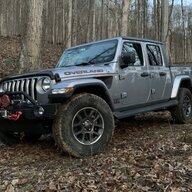
I'm still running stock wheels on kenda 35x10.5 and they fit perfect for me. Except my first set in 2020 cost me $850. I just replaced them with the same 5 months ago and it jumped to $1200. I have a feeling the Kenda's are getting more popular. Plus as was stated, not many options for 10.5" wide tires.I really wish there were more skinny wheel/tire options out there. Same goes for wheels with neutral or positive offsets; damn near everything is a negative offset causing the tires to stick out way further than they need to.
If I could get skinny tires tucked up into the fender, in a wheel/tire combo I liked, I'd most certainly run them.
robinja
Well-Known Member
- First Name
- James
- Joined
- Jan 14, 2020
- Threads
- 25
- Messages
- 306
- Reaction score
- 773
- Location
- Florida and North Carolina
- Vehicle(s)
- Gladiator Overland, Grand Cherokee Trailhawk, JK, TJ ... we like Jeeps
- Occupation
- Project Manager
- Vehicle Showcase
- 1
Super interesting video. I run Falken LT285/75R18 tires at 35psi on the stock Overland rims and have found them to perform exceptionally well on and offroad. I haven't aired them below 20psi, but they wrap and grab well at that psi offroad. Sand and snow have never given me any issues as well. Would love to see some performance differences for road driving - probably what one would expect. For me , the choice of a narrower 35 tire was more about mpg and maintaining ability to tow. I can confirm I do not have the 8th gear search or gas mileage issues a lot of people running wide 35s have.
Sponsored
Last edited:
Similar threads

- Replies
- 4
- Views
- 1,247


