
Sponsored

smlobx

Well-Known Member
First Name
Eddie
Joined
Jun 28, 2018
Threads
86
Messages
2,639
Reaction score
4,487
Location
Mid Atlantic
Vehicle(s)
JTR, F-350 diesel, Porsche Spyder, Model Y
Occupation
Semi retired consultant
I was thinking the same thing. He spent so much time on the science but failed to pick a tire with the right load range for his vehicle. And the BFG is most likely not a E-range tire which skews the data even further.
He stated that all the tires were E rated. We ran E rated BFG’s on our Foreman’s truck and they flat out sucked though. They didn’t last 15K miles of construction use…
Sponsored


bleda2002

Well-Known Member
Joined
May 11, 2021
Threads
24
Messages
2,746
Reaction score
4,489
Location
34655
Vehicle(s)
2021 JTR Firecracker Red
Which is why skinny tires work better in snow- they cut through the crud to the pavement.
Better for light snow. Heavy snow where you won't get through to the pavement you want a wide tire that will load up with snow.

It looks like people mentioned it but as soon as he said e rated at recommend 35 psi I laughed as an FJ weighs 4k lbs so it's more like 26-28 psi it should be running on an e.

Other thing is he seems shocked at the contact patch being the same, but of course they are. The tire supports the weight of the vehicle, at a given pressure on a hard surface the same amount of tire needs to be on the ground to provide the lift.
 

BourbonRunner

Well-Known Member
First Name
Steve
Joined
Jul 10, 2022
Threads
16
Messages
1,374
Reaction score
2,708
Location
Baltimore
Vehicle(s)
'22 JTM, '04 E46. I hate my money and it shows.
Occupation
Foole
but worse in sand
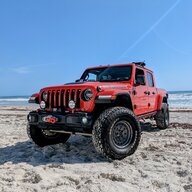
Not really. Aired down they do pretty okay on beaches.

You can do pretty okay over sand in an Econoline van with radials if you've got enough weight over the drive axle, air them down appropriately and know what you're doing.

Better for light snow. Heavy snow where you won't get through to the pavement you want a wide tire that will load up with snow.
Right, our "heavy" storms in the Mid Atlantic are over 6" so my frame of reference may be a bit... off. And it's more slushy than not.
 

Chief_jeep

Well-Known Member
First Name
Justin
Joined
Nov 7, 2022
Threads
17
Messages
389
Reaction score
446
Location
Park City, UT
Vehicle(s)
2022 Gladiator Ecodiesel
Occupation
Real Estate Agent
He stated that all the tires were E rated. We ran E rated BFG’s on our Foreman’s truck and they flat out sucked though. They didn’t last 15K miles of construction use…
i missed that part. Either way, putting a new E rated tired on a 4100lb vehicle and expecting the side wall to flex isn’t going to get you great results. Also the Mickeys were brand new and it seemed like he had been wheeling the km3 for awhile. Sidewalls need to break in and they will get more flexible. I really like what he tried to do, I just think you’d get different results with a tire better suited to the weight of the vehicle.
I’d also like to see some real world results. There’s a lot of money and r&d spent on off-road racing. I think if those guys got better results running a skinny tire that every company would make a 37 and 40 that’s much narrower than 12.5” and 13.5”.
 

Terminus33

Well-Known Member
First Name
Ernie
Joined
Jul 3, 2020
Threads
6
Messages
363
Reaction score
662
Location
Ocala FL
Vehicle(s)
2020 Gladiator 2019 Cherokee
Occupation
Pool Tech
Not really. Aired down they do pretty okay on beaches.

You can do pretty okay over sand in an Econoline van with radials if you've got enough weight over the drive axle, air them down appropriately and know what you're doing.
Yes street radials or proper All Terrain tires aired down will get you better results in sand than M/T tires will oddly enough.
 

Sponsored

ScottBeach

Well-Known Member
First Name
Scott
Joined
Mar 29, 2021
Threads
27
Messages
660
Reaction score
977
Location
Fl
Vehicle(s)
2020 Jeep Gladiator sport sold. 2024 JTM
Occupation
Engineer
Skinny tires for the win in florida monsoon season.. floating wide tires in flooding streets is butt puckering. 255/80 ridge grapplers (33s) have been great this summer. Nothing florida weather throws at em makes even a shutter in direction. And for florida. The bigger issue is mall crawlers with near bald 12.5 wide tires. Only for rain road safety do i want florida to do vehicle inspections. Old man rant over
 

BourbonRunner

Well-Known Member
First Name
Steve
Joined
Jul 10, 2022
Threads
16
Messages
1,374
Reaction score
2,708
Location
Baltimore
Vehicle(s)
'22 JTM, '04 E46. I hate my money and it shows.
Occupation
Foole
Yes street radials or proper All Terrain tires aired down will get you better results in sand than M/T tires will oddly enough.
And that is something I've never quite understood. No physicist by any stretch of the imagination but I'd assume the lower rolling resistance to a skinnier tire is the reason? Unscientifically I would think that a M/T would "float" over loose sand but that's never been the case.
 

bleda2002

Well-Known Member
Joined
May 11, 2021
Threads
24
Messages
2,746
Reaction score
4,489
Location
34655
Vehicle(s)
2021 JTR Firecracker Red
And that is something I've never quite understood. No physicist by any stretch of the imagination but I'd assume the lower rolling resistance to a skinnier tire is the reason? Unscientifically I would think that a M/T would "float" over loose sand but that's never been the case.
MTs are designed to dig and clear tread, as they roll on the sand they're digging their own holes but not to push you forward. This is also why they are poor for heavy snow is that snow sticks to snow and so a tire loaded up with snow will stick better.

In sand you ideally want a wide soft tire that won't dig down but actually float over the sand. Alternatively if all you do is sand, you can go paddles and then the digging is deep enough to actually push you forward while the tire is wide enough to float most of it over the sand.

At the end of the day you want the widest contact patch possible on sand to keep you floating as much as possible though. It's why people like Matt's off-road recovery run 3-8psi out on the dunes.
 

smlobx

Well-Known Member
First Name
Eddie
Joined
Jun 28, 2018
Threads
86
Messages
2,639
Reaction score
4,487
Location
Mid Atlantic
Vehicle(s)
JTR, F-350 diesel, Porsche Spyder, Model Y
Occupation
Semi retired consultant
I’m going to sound like Shadowpapa ? but here goes!

Back during the early days of WW2 before D day the US set up a military post on Hatteras Island, NC to keep track of all the German U boat activity happening just a few miles offshore. There was a big problem however, there were no roads and the only way to drive on the island was on the beach. Hatteras Island has some of the softest sand known to man and an enterprising young 14 YO started a business ferrying the soldiers from Oregon Inlet (the last point of pavement) in a small boat to HI where the soldiers go on an old school bus! for the 20 or so mile ride down the beach. They of course would occasionally get stuck but with a bunch of strong guys it didn’t take much to push the bus and get unstuck. The bus had regular street tires and of course were aired down but the bus would float over the soft sand.

The name of that 14 YO was Sam Midgett and Midgett is now one of the largest real estate companies on the island as well as a bunch of other businesses.

PS if you want to see how soft the sand is go on the Oregon Inlet Idiot’s Facebook page…
 

BourbonRunner

Well-Known Member
First Name
Steve
Joined
Jul 10, 2022
Threads
16
Messages
1,374
Reaction score
2,708
Location
Baltimore
Vehicle(s)
'22 JTM, '04 E46. I hate my money and it shows.
Occupation
Foole
MTs are designed to dig and clear tread, as they roll on the sand they're digging their own holes but not to push you forward. This is also why they are poor for heavy snow is that snow sticks to snow and so a tire loaded up with snow will stick better.

In sand you ideally want a wide soft tire that won't dig down but actually float over the sand. Alternatively if all you do is sand, you can go paddles and then the digging is deep enough to actually push you forward while the tire is wide enough to float most of it over the sand.

At the end of the day you want the widest contact patch possible on sand to keep you floating as much as possible though. It's why people like Matt's off-road recovery run 3-8psi out on the dunes.
Totally makes sense, thanks. I've never actually owned a set of M/Ts on any truck I've ever owned because... well, I don't go mudding. I've always run A/Ts.


I’m going to sound like Shadowpapa ? but here goes!

Back during the early days of WW2 before D day the US set up a military post on Hatteras Island, NC to keep track of all the German U boat activity happening just a few miles offshore. There was a big problem however, there were no roads and the only way to drive on the island was on the beach. Hatteras Island has some of the softest sand known to man and an enterprising young 14 YO started a business ferrying the soldiers from Oregon Inlet (the last point of pavement) in a small boat to HI where the soldiers go on an old school bus! for the 20 or so mile ride down the beach. They of course would occasionally get stuck but with a bunch of strong guys it didn’t take much to push the bus and get unstuck. The bus had regular street tires and of course were aired down but the bus would float over the soft sand.

The name of that 14 YO was Sam Midgett and Midgett is now one of the largest real estate companies on the island as well as a bunch of other businesses.

PS if you want to see how soft the sand is go on the Oregon Inlet Idiot’s Facebook page…
Now that's cool.

I do love me some OBX and southern beaches and that sand is very soft, and requires judicious throttle management along with planning out your turns well in advance. Much like driving Assateague. I catered a function years ago near Carova and our maintenance guy drove an older Econoline RWD on radials. Aired down and knowing how to drive made it nearly as capable as just about any 4x4 out there.
 

Sponsored

montechie

Well-Known Member
First Name
Wes
Joined
Nov 26, 2021
Threads
4
Messages
303
Reaction score
574
Location
Bozeman, MT, USA
Vehicle(s)
2005 LJ Rubicon, 2022 JT Rubicon
Occupation
Writer of code, designer of things
MTs are designed to dig and clear tread, as they roll on the sand they're digging their own holes but not to push you forward. This is also why they are poor for heavy snow is that snow sticks to snow and so a tire loaded up with snow will stick better.
...
At the end of the day you want the widest contact patch possible on sand to keep you floating as much as possible though. It's why people like Matt's off-road recovery run 3-8psi out on the dunes.
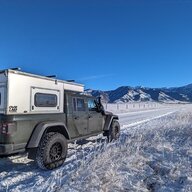
Yeah, MTs really need to have sypes added to be the most effective in snow. I've had good luck with that in the Rockies, but will take an aggressive AT with great syping for better snow on snow grip (as you said) any day.

For soft surfaces more accurately you want the largest contact patch with the least amount of rolling resistance, not necessarily the widest. If you can fit both a wide and a much taller tire, great, but if you have to choose or are limited, the tallest tire you can fit which creates a much longer contact patch when aired down will win hands down over a wide and short contact patch with greater rolling resistance since even aired way down you're going to have to plow a bit on soft surfaces.

Now, given all that I would still love to fit some tall and wide super syped Nokian Hakkapeliitta 44s tires on a buggy for winter trails :)
Jeep Gladiator Wide vs Narrow Off-Road Tires -- a Scientific Comparison 1690816732581
 

ShadowsPapa

Well-Known Member
First Name
Bill
Joined
Oct 12, 2019
Threads
247
Messages
40,440
Reaction score
53,853
Location
Runnells, Iowa
Vehicle(s)
'25 JTMX, '23 JLU 4xe, '82 SX4, '73 Javelin
Occupation
Retired auto mechanic, frmr gov't ntwrk security admin
Vehicle Showcase
3
I saw this posted last night but didn’t watch it until now. I’ve been a skinny tire guy forever because I’ve seen the difference in action, and I’m glad to see I’m still right ?
Another bonus that he didn’t cover is the ability to take a different line on the trail and squeeze between rocks and other obstacles. I really like having a narrower track.
The side effect is being better in snow. It's why I don't go wider than I did.

Once you load the vehicle down you will contact the edges.
Edge contact should be a constant. You should have contact across the face, not in the center. The reason for the tread differences across the face is different (two cousins worked at Bridgestone/Firestone)

May be true for semis where you are running fully loaded a lot more often but you want the full face contact on car and pickup tires.

Someone at a former off-road shop near me once told me the wider the tire the more traction you need when I was looking for tires for a different Jeep. I have heard that saying in different ways for 30 some years
PSI - force, pressure per square inch. The more square inches on the surface, the less force in a given area. What do you want stepping on your foot? Someone wearing spikes, or someone with a clown shoe on?
 

TreeTownRanch

Member
First Name
Scott Roberts
Joined
Jun 21, 2023
Threads
0
Messages
5
Reaction score
2
Location
Union, MO
Vehicle(s)
Ecodiesel 2022 Gladiator
Occupation
Self employed
It's worth noting he seems to use the same rims for both the 10s and the 12.5. I understand he's trying to isolate variables, but wouldn't ideal sized rims provide a better comparison? I'm thinking this because skinny rims on wide tires does affect PSI needed for chalk test pass.
That was the first thing I thought also, is he using the same rim size for both tires or is the rim to tire size equivalently the same.
 

Reddog

Well-Known Member
First Name
Mike
Joined
Jul 10, 2023
Threads
1
Messages
278
Reaction score
386
Location
Alexandria, Virginia
Vehicle(s)
2023 Jeep Gladiator Rubicon
Occupation
Retired Army. Retired Construction Manager / Contracting Officer
Not bashing the guys work here but I question the macro result he appears to assign to all tire brands that "narrow is better than wider". He could only make that conclusion if he tested all brands of tires equally. What he got was a data point, not a true conclusion. Various things like sidewall stiffness and other issues affect the results as well. Anyone been to a drag race lately? Strictly antidotal, but drag racing is all about traction and you don't see many dragsters or other vehicles using narrow tires. Seems to me there could be a standard set by tire manufacturing associations to measure "bite or traction" in different tires.
 

Volt0

Well-Known Member
First Name
Tim
Joined
Apr 27, 2022
Threads
31
Messages
762
Reaction score
989
Location
MidMo
Vehicle(s)
JTM,JTHA
PSI - force, pressure per square inch. The more square inches on the surface, the less force in a given area. What do you want stepping on your foot? Someone wearing spikes, or someone with a clown shoe on?
I totally agree with this, in certain situations. This is the reason for spikes & chains on ice and shallow snow. On the first snow/ice day of the year, there were always sports cars with wide tires in the ditch.

Similarly, In terms of rock climbing, the softer shoe compounds ( to a point ) provide better traction for your feet/toes. On some slab climbs your better off with a big contact area, and in some places your better with your entire body weight focused on a small point ( like your big toe ).

This seems like it’s commonly overlooked, even thought the wide tires look better. For off-road, I would aim for the softest compound, proper siping, while being puncture/cut resistant

In terms of traction, it’s super situational. If I’m truly honest with myself, and where I drive/wheel, the only place that a wider tire will give me more traction is on dry pavement.
Sponsored


Top