
Sponsored

What diesel additive is best to protect the CP4 pump

Rusty PW

Well-Known Member
First Name
Russ
Joined
Jan 10, 2022
Threads
37
Messages
11,385
Reaction score
30,364
Location
Fayette Nam, Pennsyltucky
Website
www.youtube.com
Vehicle(s)
'22 JTRD, '11 370Z Nismo, '07 Honda VFR
Build Thread
Link
Occupation
Muff Diver
Is it particles coming off the pump during normal operation, or only when it starts to fail? I have not seen anything about metal in the fuel until that AI clip was posted.

I only know what I read on this site about the issue. I don't have, or want, one of the current (DEF required) diesel engines.
From what I've read. The piston inside the pump gets turned sideways. The pump is still working at this point. It's also sending particles to the injectors and back to the tank through the return line and the rest of the fuel system. Then the pump goes BOOM! Game over.
Sponsored

 
OP
OP
Teqsand

Teqsand

Well-Known Member
First Name
Todd
Joined
Nov 25, 2021
Threads
39
Messages
927
Reaction score
1,263
Location
SoCal
Vehicle(s)
21 JLURD & 22 JTRD
Occupation
Bum
Insert sarcasm*
Everyone thinks that Bosch dropped the ball when designing the pump for North America which is the reason why people keep dumping snake oil additives into their tanks.
So you're saying they DID effectively compensate for the ultra low suffer fuel and its what, an odd coincidence the pumps are failure prone?
 

Mr._Bill

Well-Known Member
First Name
Bill
Joined
Jul 22, 2019
Threads
38
Messages
6,649
Reaction score
7,750
Location
North Las Vegas, NV
Vehicle(s)
2023 Gladiator High Altitude - 2013 Nissan Leaf SV
Vehicle Showcase
1
European Diesel is the answer, the Bosch pumps work perfectly with it just dont use US diesel. Simple solution.
So, show us where to get this European diesel in the US. It must be readily available if it is the simple solution you claim it to be.
 

Gladbrennan

Banned
Banned
First Name
Brennan
Joined
Oct 8, 2022
Threads
0
Messages
62
Reaction score
21
Location
Connecticut
Vehicle(s)
2021 Gladiator Diesel
So you're saying they DID effectively compensate for the ultra low suffer fuel and its what, an odd coincidence the pumps are failure prone?
Is it odd I've put over 60k flawless miles on the pump without additives and filling up at any random fuel station i could find...
Most people on this thread haven't actually had a failure.
 

Gladbrennan

Banned
Banned
First Name
Brennan
Joined
Oct 8, 2022
Threads
0
Messages
62
Reaction score
21
Location
Connecticut
Vehicle(s)
2021 Gladiator Diesel
So, show us where to get this European diesel in the US. It must be readily available if it is the simple solution you claim it to be.
Shell is Dutch. Wait I'm confused all diesel fuel is from the US in the US?
 
Last edited:

Sponsored

OP
OP
Teqsand

Teqsand

Well-Known Member
First Name
Todd
Joined
Nov 25, 2021
Threads
39
Messages
927
Reaction score
1,263
Location
SoCal
Vehicle(s)
21 JLURD & 22 JTRD
Occupation
Bum
Is it odd I've put over 60k flawless miles on the pump without additives and filling up at any random fuel station i could find...
Most people on this thread haven't actually had a failure.
Well for one thing mother MOPAR seems to think there is a problem, most manufacturers don't recall an entire line and issue stop sell orders because they are bored....
And it's hit and miss as to when the pumps go, my wife 21 JLURD has 35k on it, my 22 JTRD blew the pump with 3k on it, my 23 JTRD has 10k and still ok....
But i am one who has had experiance with a blown pump....and experience withcthe repair and a MFR buyback
 

Hdog911

Well-Known Member
First Name
Harman
Joined
Jul 24, 2022
Threads
7
Messages
57
Reaction score
35
Location
Red Bluff
Vehicle(s)
22 JTRD
Occupation
Clerk
2oz EDT
+
2oz LX4

Usually EDT but I add LX4 too.
 

ShadowsPapa

Well-Known Member
First Name
Bill
Joined
Oct 12, 2019
Threads
247
Messages
40,457
Reaction score
53,901
Location
Runnells, Iowa
Vehicle(s)
'25 JTMX, '23 JLU 4xe, '82 SX4, '73 Javelin
Occupation
Retired auto mechanic, frmr gov't ntwrk security admin
Vehicle Showcase
3
Stop blaming lack of sulfur in US diesel - EU diesel has LOWER sulfur content.


Jeep Gladiator What diesel additive is best to protect the CP4 pump 1683471168850


Do these not have a lift pump?

Jeep Gladiator What diesel additive is best to protect the CP4 pump 1683471319850


Jeep Gladiator What diesel additive is best to protect the CP4 pump 1683471348355


I see a number of sites suggesting aeration of the fuel and/or water being involved -

Jeep Gladiator What diesel additive is best to protect the CP4 pump 1683471690241


Jeep Gladiator What diesel additive is best to protect the CP4 pump 1683471559863


Now where people are getting hung up is on the copy 'n paste bit about "being designed for European diesel which is dirtier....... blah blah" and you see the same snippets in forum after forum, expert auto/truck blogs all over the place (yeah, those rags/blogs) and someone posted it and it's been copied by every magazine and blog and being put on forums left and right and has thus become "fact" - but it's not correct.
European diesel fuel is not "dirtier".
Oh, it's the sulfur and that lubricates.........
No, sulfur in itself is not a lubricant no matter how many automotive blogs or forum posts say so. It can combine with nickel in the device to form a barrier, but sulfur isn't a lubricant.

The USA -
Jeep Gladiator What diesel additive is best to protect the CP4 pump 1683472211550


However -
In 2009, the Euro V fuel standard came into effect which reduced maximum sulfur to 10 ppm.

So wait a minute - how can it be sulfur when the USA has HIGHER sulfur content than the EU?
Explain that one, automotive "journalists". Hmmmm.......

USA - ULSD is 15 ppm
EU is 10 ppm.
And yet- it's the lack of sulfur compared to the EU?

Like my former boss said - "misinformation stupid highway".

Hey, motortrend, motorbisquit, and others - DO SOME RESEARCH, eh?

Took me a whopping 5 minutes to disprove that European diesel is "dirtier" and has more sulfur which lubricates.

Jeep Gladiator What diesel additive is best to protect the CP4 pump 1683472597299


BUNK.

USA fuel is DIRTIER as far as sulfur.

Jeep Gladiator What diesel additive is best to protect the CP4 pump 1683472693530


3 to 5 ppm in certain EU countries, while 10 is allowed in the states?
And yet EU fuel is better?
 

Rusty PW

Well-Known Member
First Name
Russ
Joined
Jan 10, 2022
Threads
37
Messages
11,385
Reaction score
30,364
Location
Fayette Nam, Pennsyltucky
Website
www.youtube.com
Vehicle(s)
'22 JTRD, '11 370Z Nismo, '07 Honda VFR
Build Thread
Link
Occupation
Muff Diver
Stop blaming lack of sulfur in US diesel - EU diesel has LOWER sulfur content.


1683471168850.png


Do these not have a lift pump?

1683471319850.png


1683471348355.png


I see a number of sites suggesting aeration of the fuel and/or water being involved -

1683471690241.png


1683471559863.png


Now where people are getting hung up is on the copy 'n paste bit about "being designed for European diesel which is dirtier....... blah blah" and you see the same snippets in forum after forum, expert auto/truck blogs all over the place (yeah, those rags/blogs) and someone posted it and it's been copied by every magazine and blog and being put on forums left and right and has thus become "fact" - but it's not correct.
European diesel fuel is not "dirtier".
Oh, it's the sulfur and that lubricates.........
No, sulfur in itself is not a lubricant no matter how many automotive blogs or forum posts say so. It can combine with nickel in the device to form a barrier, but sulfur isn't a lubricant.

The USA -
1683472211550.png


However -
In 2009, the Euro V fuel standard came into effect which reduced maximum sulfur to 10 ppm.

So wait a minute - how can it be sulfur when the USA has HIGHER sulfur content than the EU?
Explain that one, automotive "journalists". Hmmmm.......

USA - ULSD is 15 ppm
EU is 10 ppm.
And yet- it's the lack of sulfur compared to the EU?

Like my former boss said - "misinformation stupid highway".

Hey, motortrend, motorbisquit, and others - DO SOME RESEARCH, eh?

Took me a whopping 5 minutes to disprove that European diesel is "dirtier" and has more sulfur which lubricates.

1683472597299.png


BUNK.

USA fuel is DIRTIER as far as sulfur.

1683472693530.png


3 to 5 ppm in certain EU countries, while 10 is allowed in the states?
And yet EU fuel is better?
Well.......the Europeans have 1% failure rate. We have a 7% failure rate. Why the difference?
 

fourfa

Well-Known Member
Joined
Dec 12, 2021
Threads
14
Messages
1,107
Reaction score
1,403
Location
CA
Vehicle(s)
22 JTRD + ACCC
Build Thread
Link
One thing I've seen in other discussions of this is that it's not sulfur directly - it's the defined level of lubricity required by regulation and achieved by various additive packages. In this telling, US ULSD has a lower defined level, Europe has a higher level, and Bosch designed around the European standard. But as complained about above, this is basically just internet hearsay until someone can cite these regs (I can't)

I'm casually looking through the US ULSD fuel spec but it's not easy reading
 

Sponsored

ShadowsPapa

Well-Known Member
First Name
Bill
Joined
Oct 12, 2019
Threads
247
Messages
40,457
Reaction score
53,901
Location
Runnells, Iowa
Vehicle(s)
'25 JTMX, '23 JLU 4xe, '82 SX4, '73 Javelin
Occupation
Retired auto mechanic, frmr gov't ntwrk security admin
Vehicle Showcase
3
Well.......the Europeans have 1% failure rate. We have a 7% failure rate. Why the difference?
Looking around I've found more informed and logical writings that dispute that saying that although some have posted that as fact, there's no real way of knowing because those who have never had a failure don't report they've never had a failure, and those that have failures outside of warranty won't be tracked.
These have been in use for quite a few years in various diesel applications and knowing those percentages is next to impossible. Think of the RAM owners, and others, who have done the task of swapping out pumps on their own - some fitting in different pumps (a complex task, I suspect) - those numbers will never be tracked.
But guess who is posting those numbers? Those selling fuel additives. Yeah, great source of facts.
It COULD be correct, but to accept such places as a source for fact, and then think about the logic of it all - how does one even come up with such figures after all of these years (and do European post their failures on forums like Americans do? Who tracks those out of warranty, or those after 100,000 miles that have not failed?)
Other sources are attorney/class action sites. Another great source of facts (look at the class action suite on the 3.6 valve train - they lump ALL years together including the Gen 1 engine, but stop short of the 2020 Gladiator?)

So I'd love to know, after all of these years, all of the vehicles out there, and many outside of warranty, how does one get those figures?

One thing I've seen in other discussions of this is that it's not sulfur directly - it's the defined level of lubricity required by regulation and achieved by various additive packages.
Now that makes more sense. Yet all of the crap you see out there, including COURT CASES, claim that EU diesel has more sulfur and that's the obvious reason. But if those who are crying that out at the top of their lungs would do 5 minutes or less of searching they'd find that can't be the case.
And for two reasons - sulfur itself is not a lubricant, and, EUI diesel fuel contains a fraction of what US fuel contains in most cases. Often sub-5ppm to our 10.
This is why I seldom believe what you find in forums, fakebook or even those so-called auto-journalism sites.

These have been around since, what, 2011 at least?

Frankly, I think the motortrend article is among the best because they don't speculate - they dig into it and call the reasons floating about as "speculative" - and that's closer to the truth than what is being repeated out there.

https://www.motortrend.com/how-to/what-is-cp4-failure/


Jeep Gladiator What diesel additive is best to protect the CP4 pump 1683482356269


How about looking at other possible reasons - instead of 'it's lubrication!"

Jeep Gladiator What diesel additive is best to protect the CP4 pump 1683482515873


I go back to my post from earlier today where everyone is leaving out other possible reasons and concentrating on just one reason.
It's like cops finding their favorite suspect and concentrating only on that one while the real one escapes into China. Humans - they can only support one idea at a time, excluding even considering any others.

Maybe it's lube, but it's not sulfur and no one knows for sure the different rates of failure in various places.
 

Rusty PW

Well-Known Member
First Name
Russ
Joined
Jan 10, 2022
Threads
37
Messages
11,385
Reaction score
30,364
Location
Fayette Nam, Pennsyltucky
Website
www.youtube.com
Vehicle(s)
'22 JTRD, '11 370Z Nismo, '07 Honda VFR
Build Thread
Link
Occupation
Muff Diver
Quick google search.

Diesel around the world is the same, right? At first glance you might say diesel is diesel. In most of the world on-road diesel is referred to as Ultra-Low Sulfur Diesel (ULSD), but government regulations tell a different story. Starting in 2011, the United States required ultra-low sulfur diesel at all fuel pumps. This fuel has the requirements of no more than 15 parts per million (ppm) of sulfur and a minimum cetane rating of 40. In comparison, the European Union in 2009, made ultra-low sulfur diesel the standard at the pump, with limits of 10ppm sulfur and a 51 cetane rating. The minimum requirements of diesel fuel are set by different government agencies around the world.

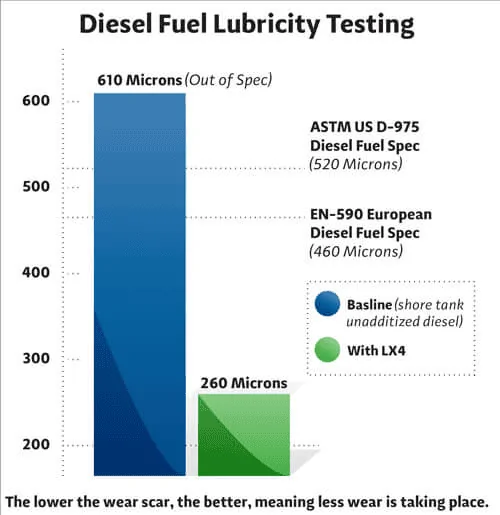
US produced Ultra-Low Sulfur Diesel does not contain the lubricity needed to fully protect our vehicles.

The Bosch CP4 fuel pump has an unusually high failure rate in the U.S., upwards of 7%, when compared to 1% failure rate in Europe. This is due to the U.S. diesel fuel’s lack of lubricity. General Motors is currently facing a class-action lawsuit because of the issue. Why is the failing CP4 being installed in so many vehicles? When leaving the manufacturer, the CP4 pump is typically successful because the pump is manufactured in Europe. The difference being that the lubricity has not been removed from the European diesel fuel, as it has in the U.S. fuel. The European EN-590 Diesel has a Wear Scar Diameter 460-micron specification, while in the U.S. the base is 520-micron in ASTM US D-975. Therefore, the failure is caused by the lack of lubricity in ultra-low sulfur fuel in the USA. High rates of wear introduce metal shavings into the fuel system, creating wear that damages your injectors, cylinder walls, pistons and rings costing several thousands of dollars to repair.

In an attempt to improve fuel efficiency, the CP4 injection pump replaced the CP3 pump to create a higher-pressure expulsion with less fuel volume consumed. With the lack of ability to supply the adequate fuel needed, thereby also reducing the amount of lubrication to the system, the CP4 forms air bubbles inside the injectors. When air is within the system, there is no fuel. Where there is no fuel there is no lubrication. Where there is no lubrication, there is instead metal friction against metal, causing accelerated wear and components to fail. During the degradation of the parts, metal shavings are traveling through the entire fuel system, including the fuel injectors and the fuel lines thereby causing more friction and abrasive compounds throughout the travel of the fuel.

The attempt to reduce fuel consumption is a compounded effect of low-quality fuel with less lubricity, and then less of the fuel itself. The double negative is a direct reduction of lubricity in the system. The Engine Manufacturers Association (EMA) recommends all diesel fuel should be below the 460-micron specification to protect all fuel injection systems. By increasing the lubricity of the diesel fuel the Wear Scar Diameter is lowered. By bringing the Wear Scar Diameter back below the recommended threshold, excessive wear is prevented.


Found this chart for what it's worth.

Jeep Gladiator What diesel additive is best to protect the CP4 pump 1683483722825
 

ShadowsPapa

Well-Known Member
First Name
Bill
Joined
Oct 12, 2019
Threads
247
Messages
40,457
Reaction score
53,901
Location
Runnells, Iowa
Vehicle(s)
'25 JTMX, '23 JLU 4xe, '82 SX4, '73 Javelin
Occupation
Retired auto mechanic, frmr gov't ntwrk security admin
Vehicle Showcase
3
Diesel around the world is the same, right? At first glance you might say diesel is diesel. In most of the world on-road diesel is referred to as Ultra-Low Sulfur Diesel (ULSD), but government regulations tell a different story. Starting in 2011, the United States required ultra-low sulfur diesel at all fuel pumps. This fuel has the requirements of no more than 15 parts per million (ppm) of sulfur and a minimum cetane rating of 40. In comparison, the European Union in 2009, made ultra-low sulfur diesel the standard at the pump, with limits of 10ppm sulfur and a 51 cetane rating. The minimum requirements of diesel fuel are set by different government agencies around the world.

US produced Ultra-Low Sulfur Diesel does not contain the lubricity needed to fully protect our vehicles.
Varies widely and even wildly around the world, that's for sure. And even in the EU, they set one spec and member countries can tighten that up as Germany did. Similar to how the EPA here sets standards for things while states like CA cut things even more.

But - the last sentence I quoted there while perhaps factual, implies it's the sulfur - it's not, it's the fact that the new diesel fuel is different in other ways. Seeing that sentence people jump on the "it's the SULFUR, stupid" argument.
It's not the sulfur but that sentence tends to get people quoting that and taking it out of context.
If all they did was reduce sulfur, there'd likely be no real issues. But........... no one bothers digging like you just did or like @fourfa has done.

So, like an old college professor friend used to do to people, taking a debate point, tossing out arguments even if he didn't believe in that stance, forced others to dig in and prove their own statements, or at least find things out they otherwise might not have.
A former boss and I used to "spar" back and forth for kicks at times. We'd take debate positions, often taking a position contrary to our own, and go back and forth. Like that professor did - it was forcing the other party to support what they were saying, make them dig, instead of "because I said so".

In an attempt to improve fuel efficiency, the CP4 injection pump replaced the CP3 pump to create a higher-pressure expulsion with less fuel volume consumed. With the lack of ability to supply the adequate fuel needed, thereby also reducing the amount of lubrication to the system, the CP4 forms air bubbles inside the injectors. When air is within the system, there is no fuel. Where there is no fuel there is no lubrication. Where there is no lubrication, there is instead metal friction against metal, causing accelerated wear and components to fail.
Bingo - many tech sites, not forums, not SELLERS and marketers of lube product who will push charts to get your money, they've found most of the issues are happening in systems where this little light pump is being forced to pull and supply the fuel, leading to potential (didn't say absolute) aeration of the fuel. It's doing all of the heavy lifting. That combined with other factors (ok, the lack of fuel lubrication??) air, water.
Some have shown that replacing filters and water separating devices being checked or drained has led to longer life for these pumps - those who do maintenance a lot more frequently tending to have fewer issues with these pumps.

Likely it's a stack-up of conditions -
Light pump doing more work, water, air, lack of fuel lubricity, the pump doing the whole job lifting and pushing, all combining.
There are a whole lot of people doing 100,000 miles on these pumps so it's possible that there's no one thing causing it - and what they are doing differently - top quality fuel, frequent filter changes and so on, are helping even with lack of lube.
 

NCJL

Well-Known Member
First Name
Dean
Joined
Jul 22, 2021
Threads
31
Messages
251
Reaction score
289
Location
New Mexico
Vehicle(s)
JLURD
Build Thread
Link
Occupation
Electrical
^
I went down the Diesel spec rabbit hole a few years back.
I came to the conclusion that most diesel is stored and passed around a lot more than gasoline. Refineries refine for gasoline, aviation fuel and the other little goodies yet diesel equates to about 50% of what science can get out of a barrel of oil. Gasoline is about 25%. The remaining 25% is the goodies.
I don’t think the US sells twice as much Diesel as Gasoline…. Why I think Diesel is stored for extended periods of time.
I’ve worked at refineries. Most concern is making absolutely sure the Sulfur is below 15ppm. They do this by making it 10ppm +/- Also most refineries sell off the diesel to a 3rd party to take responsibility for adding what’s needed to meet spec and extend shelf life. The longer something sits the more prone to water contamination it becomes.
Most Shell, Mobil, Chevron,Sinclair ETC stations I’ve been too have a sticker on the Diesel pump stating ā€œnot a Shell, Mobil, Chevron, Sinclair productā€. Why not?

Diesel has always been dirty compared to gasoline. Our modern EPA regulated 1/2 ton EcoDiesel (CP4) needs a high quality very clean diesel fuel for longevity.

Change filters often and use whatever additives you want. I mix it up between several different ones.
Sponsored


Top