
Sandevino
Well-Known Member
- First Name
- Mike
- Joined
- Jun 14, 2022
- Threads
- 21
- Messages
- 946
- Reaction score
- 1,828
- Location
- North Texas
- Vehicle(s)
- 2023 Jeep Gladiator Rubicon
I haven’t read all 54 pages of comments but I’ll chime in for the diesel mechanic perspective and compare heavy diesel to the EcoDiesel platform in the Gladiator and Ram. I spent most of my time working on CAT, Detroit and Cummins engines in pre and post EPA emissions configurations.
Heavy diesel and the EcoDiesel are vastly different applications but the principles of the Diesel engine are the same. Fuel, air, compression are the key components of the diesel stroke but you can’t forget about cylinder temperature. The compression and subsequent ignition of diesel fuel produces far less heat than a similar stroke in a gasoline powered engine. Friction will eventually warm the engine but the process takes time as you all know.Glow plugs, block heaters, grid heaters and a host of other warming aids are used to keep the block warm in cold weather. Head and cylinder temps must be at operating temp to attempt to completely burn diesel during the cycle and any unburnt fuel is sent down the tube to the DPF in modern diesel exhausts. Idling for long periods of time without idling up will result in a drop in head and cylinder temp and increased unburnt fuel. Oil temps in modern Diesel engines increase and help to maintain cylinder temps resulting in cleaner burns and less unburnt fuel going down the tube. As load increases, oil temp increases and vice versa unless you idle up which isn't a factory option on the EcoDiesel.
When running around town, there is very little to any load on the engine. Turbo inlet temps are around 350*, head temps are between 350-400* and turbo outlet temps are about 450*. The DPF is relatively cool and passive regens don't occur. On the freeway, temps increase 100/100/250 (inlet, head and outlet) and passive regens begin to occur. Engine OIL temps increase and come up to operating temp (190 - 210*) around town and on the freeway with no load. When you add load through payload or trailer, the engine is working harder. Inlet, head and outlet temps begin to increase cylinder temps which in turn increase oil temps thus increasing efficiency as you're pumping more fuel which requires a hotter cylinder to efficiently burn sending less unburnt fuel down the tube.
Coolant temps have no bearing on this process as the coolant will stay around 208 - 230* regardless of load assuming your cooling system is functioning properly. The x-factor is oil temp which is a byproduct of load, inlet, head and outlet temp.
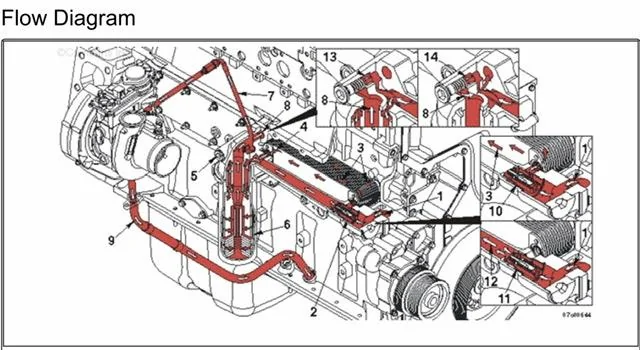
On heavy diesel, there is an external oil cooler with a bypass pump from the pan to the oil filter with a thermostatic switch that opens once oil temps reach 230-235* depending on a multitude of factors. Factors include ambient temp, coolant temp, speed, throttle position, RPM and gear. The thermostatic switch opens when conditions are met to cool down the oil temp and prevent excessive head temps which can cause engine failure. Older units have a mechanical thermostat that opens / closes at temps. The plumbing is fairly straight forward. The bypass cooler line is connected to the oil pump and in a tee connection which leads to the cooler and flows back into the oil filter housing bypassing the filter. Higher end units have an inline filter to catch any debris.
There is a direct correlation between decreasing oil / cylinder temp and fuel burn efficiency. Cooling the oil too much could reduce efficiency but not cooling enough could lead to derating or head failure.
These units used to cost about $2500 to install on older non-factory optioned or available trucks. After 2007-ish they were factory installed as part of the EPA packages.
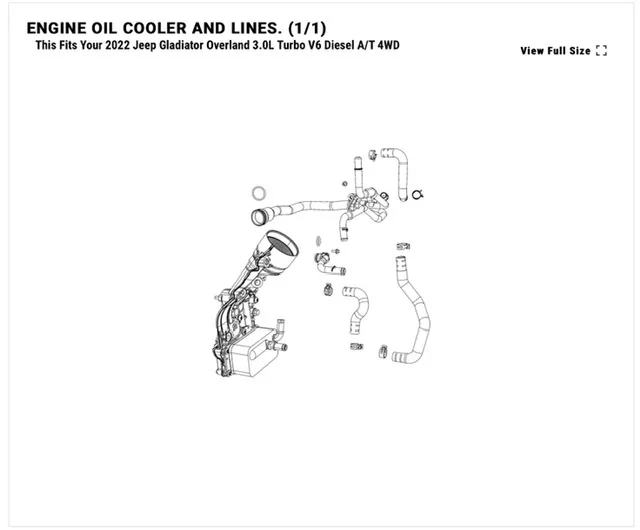
As for the EcoDiesel...why FCA didn't develop or install an external cooler on the EcoDiesel is beyond me. The cooler element inline with the oil filter and filler neck is OK but a more robust solution likely has something to do with space, intended use and cost savings. The JT radiators are a bit small for a diesel and appear to be the same part number for the gas models. There are aftermarket solutions but many say not for the Gladiator but I'd bet there are more issues with use case (off-road risks) than actual application.
Heavy diesel and the EcoDiesel are vastly different applications but the principles of the Diesel engine are the same. Fuel, air, compression are the key components of the diesel stroke but you can’t forget about cylinder temperature. The compression and subsequent ignition of diesel fuel produces far less heat than a similar stroke in a gasoline powered engine. Friction will eventually warm the engine but the process takes time as you all know.Glow plugs, block heaters, grid heaters and a host of other warming aids are used to keep the block warm in cold weather. Head and cylinder temps must be at operating temp to attempt to completely burn diesel during the cycle and any unburnt fuel is sent down the tube to the DPF in modern diesel exhausts. Idling for long periods of time without idling up will result in a drop in head and cylinder temp and increased unburnt fuel. Oil temps in modern Diesel engines increase and help to maintain cylinder temps resulting in cleaner burns and less unburnt fuel going down the tube. As load increases, oil temp increases and vice versa unless you idle up which isn't a factory option on the EcoDiesel.
When running around town, there is very little to any load on the engine. Turbo inlet temps are around 350*, head temps are between 350-400* and turbo outlet temps are about 450*. The DPF is relatively cool and passive regens don't occur. On the freeway, temps increase 100/100/250 (inlet, head and outlet) and passive regens begin to occur. Engine OIL temps increase and come up to operating temp (190 - 210*) around town and on the freeway with no load. When you add load through payload or trailer, the engine is working harder. Inlet, head and outlet temps begin to increase cylinder temps which in turn increase oil temps thus increasing efficiency as you're pumping more fuel which requires a hotter cylinder to efficiently burn sending less unburnt fuel down the tube.
Coolant temps have no bearing on this process as the coolant will stay around 208 - 230* regardless of load assuming your cooling system is functioning properly. The x-factor is oil temp which is a byproduct of load, inlet, head and outlet temp.
On heavy diesel, there is an external oil cooler with a bypass pump from the pan to the oil filter with a thermostatic switch that opens once oil temps reach 230-235* depending on a multitude of factors. Factors include ambient temp, coolant temp, speed, throttle position, RPM and gear. The thermostatic switch opens when conditions are met to cool down the oil temp and prevent excessive head temps which can cause engine failure. Older units have a mechanical thermostat that opens / closes at temps. The plumbing is fairly straight forward. The bypass cooler line is connected to the oil pump and in a tee connection which leads to the cooler and flows back into the oil filter housing bypassing the filter. Higher end units have an inline filter to catch any debris.
There is a direct correlation between decreasing oil / cylinder temp and fuel burn efficiency. Cooling the oil too much could reduce efficiency but not cooling enough could lead to derating or head failure.
These units used to cost about $2500 to install on older non-factory optioned or available trucks. After 2007-ish they were factory installed as part of the EPA packages.
As for the EcoDiesel...why FCA didn't develop or install an external cooler on the EcoDiesel is beyond me. The cooler element inline with the oil filter and filler neck is OK but a more robust solution likely has something to do with space, intended use and cost savings. The JT radiators are a bit small for a diesel and appear to be the same part number for the gas models. There are aftermarket solutions but many say not for the Gladiator but I'd bet there are more issues with use case (off-road risks) than actual application.
Sponsored
Last edited: