
Sponsored

Diesel cooling options and ideas

rubicon4wheeler

Well-Known Member
First Name
Geoff
Joined
Jan 1, 2022
Threads
1
Messages
228
Reaction score
373
Location
Sierra Nevada, California
Vehicle(s)
2022 Gladiator Rubicon Diesel
Occupation
Safety Supervisor
I think it was discussed and tossed due to the already limited airflow there from the intercooler, trans, radiator, and ac coil. Adding anything in front of that already over used stack would result in issues down stream.
I know there's a lot of heat exchanger activity going on at the front of the Jeep, but I'm willing to consider going this route since my Jeep has absolutely no issues keeping the water and transmission temps under control. I'm curious if anyone has actually tried fitting an oil cooler up front, rather than beneath the bumper.
Sponsored


Stan H

Well-Known Member
First Name
Stanley
Joined
Oct 26, 2022
Threads
10
Messages
5,499
Reaction score
5,480
Location
WV
Vehicle(s)
Gladiator Rubicon 2021
Occupation
Safety Consultant
One of the things that I see as a Modification that could add to cooling is the inner fender wells liners that have the grated section in them which would allow heat to escape via the wheel well, I also have been thinking about hood vents. I dont own the diesel but I cant see how anything that allows more hot out isnt also allowing more cool to come in the more places for heat to go out the the better.
 

GladiatorPilot23

Well-Known Member
Joined
Dec 15, 2023
Threads
13
Messages
404
Reaction score
236
Location
So Cal
Vehicle(s)
2023 Gladiator Rubicon Eco-Diesel
My thought is the oil heat exchanger was designed to heat oil on cold mornings as a primary function, the cooling function is secondary, and it doesn't have the capacity/surface area to keep up with cooling hot oil.

SO the work around seems to be to pump in cooler coolant into the heat exchanger through a aux cooler which basically adds a little more capacity to the exchanger.

From what I read, the early ecod units 21 and 22? the exchanger came with a thermostat. the later production units the thermostat in the exchanger was removed. At least that is what I read somewhere on here.

The best outcome would be to find a replacement exchanger that has more capacity and swap that in, but someone with more time than me needs to take the first bite.

I am shocked to see you need more trans cooling, mine hardly ever goes past 210.
The thermostat I have is external on my 23'. I would say 190F is a long term safe number for the trans. Even if you use a good oil that can take the heat like a Group 4 and 5, the components inside take a hit, especially the electric ones.
 

Stan H

Well-Known Member
First Name
Stanley
Joined
Oct 26, 2022
Threads
10
Messages
5,499
Reaction score
5,480
Location
WV
Vehicle(s)
Gladiator Rubicon 2021
Occupation
Safety Consultant
My thought is the oil heat exchanger was designed to heat oil on cold mornings as a primary function, the cooling function is secondary, and it doesn't have the capacity/surface area to keep up with cooling hot oil.

SO the work around seems to be to pump in cooler coolant into the heat exchanger through a aux cooler which basically adds a little more capacity to the exchanger.

From what I read, the early ecod units 21 and 22? the exchanger came with a thermostat. the later production units the thermostat in the exchanger was removed. At least that is what I read somewhere on here.

The best outcome would be to find a replacement exchanger that has more capacity and swap that in, but someone with more time than me needs to take the first bite.

I am shocked to see you need more trans cooling, mine hardly ever goes past 210.
Ypu are correct that bypass stayed closed till the transmission reached 180 then opened allowing for the oil to flow to the transcooler and back to the heat exchanger. It was eliminated and now immediately starts full circulation. I believe in was the same on both 8hp50's and 8hp75's up to about 22
 

caryt

Well-Known Member
First Name
Cary
Joined
May 29, 2023
Threads
35
Messages
444
Reaction score
306
Location
Wellington NV
Vehicle(s)
'84 stretched CJ7/LS/tons/40's, 2021 Rubicon JT 39
Occupation
Retired/ Build jeeps
So your saying that the '21 and 22's do not have any transmission stat?
 

Sponsored

rharr

Well-Known Member
Joined
May 6, 2021
Threads
29
Messages
2,028
Reaction score
2,777
Location
Tucson, AZ
Vehicle(s)
21 JTRD 3" RKK lift, (former) 95 XJ 5sp 8" lift
The thermostat I have is external on my 23'. I would say 190F is a long term safe number for the trans. Even if you use a good oil that can take the heat like a Group 4 and 5, the components inside take a hit, especially the electric ones.
Ypu are correct that bypass stayed closed till the transmission reached 180 then opened allowing for the oil to flow to the transcooler and back to the heat exchanger. It was eliminated and now immediately starts full circulation. I believe in was the same on both 8hp50's and 8hp75's up to about 22
For my clarification your responses confuse me. I was under the impression the heat exchanger for the engine oil has the thermostat to improve engine oil temps during cold weather. As such my thread above is talking about the engine oil heat exchanger, not the transmission oil heat exchanger. I believe our jeeps have both.

For the record, i have no issues with the trans oil heat exchanger.

let me know if i am wrong here.
 

Stan H

Well-Known Member
First Name
Stanley
Joined
Oct 26, 2022
Threads
10
Messages
5,499
Reaction score
5,480
Location
WV
Vehicle(s)
Gladiator Rubicon 2021
Occupation
Safety Consultant
For my clarification your responses confuse me. I was under the impression the heat exchanger for the engine oil has the thermostat to improve engine oil temps during cold weather. As such my thread above is talking about the engine oil heat exchanger, not the transmission oil heat exchanger. I believe our jeeps have both.

For the record, i have no issues with the trans oil heat exchanger.

let me know if i am wrong here.
Nope the older ones have both now if it is a newer one. Then just the engine . Not trans .
 

vicsvx

Well-Known Member
Joined
Jul 11, 2021
Threads
21
Messages
491
Reaction score
434
Location
Arizona
Vehicle(s)
2021 Gladiator Sport S 3.0
One of the things that I see as a Modification that could add to cooling is the inner fender wells liners that have the grated section in them which would allow heat to escape via the wheel well, I also have been thinking about hood vents. I dont own the diesel but I cant see how anything that allows more hot out isnt also allowing more cool to come in the more places for heat to go out the the better.
Folks reported taking the hood and grill off and nothing changed. The consensus is there isn't sufficient oil cooling hence why people are trying to find decent ways to cool the oil
 

ericw.

Well-Known Member
First Name
Eric
Joined
Aug 18, 2025
Threads
5
Messages
356
Reaction score
534
Location
USA
Vehicle(s)
23 Gladiator Rubicon Diesel, JKU, Audi S7, Mercedes AMG GLB
Build Thread
Link
Folks reported taking the hood and grill off and nothing changed. The consensus is there isn't sufficient oil cooling hence why people are trying to find decent ways to cool the oil
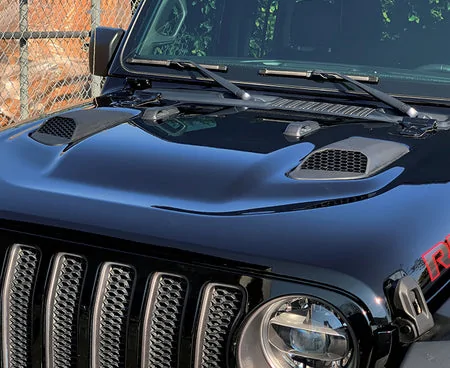
So does that mean there is no gain to be had from hood vents such as the S&B scoops?

Photo for ref
Jeep Gladiator Diesel cooling options and ideas 1758998113124-q3
 

vicsvx

Well-Known Member
Joined
Jul 11, 2021
Threads
21
Messages
491
Reaction score
434
Location
Arizona
Vehicle(s)
2021 Gladiator Sport S 3.0
So does that mean there is no gain to be had from hood vents such as the S&B scoops?

Photo for ref
1758998113124-q3.webp
Yes sir... No additional cooling is provided with air vents/scoops. Only cooling gains are found from aluminum rads, external oil coolers and/or oil bypass.
 

Sponsored

rubicon4wheeler

Well-Known Member
First Name
Geoff
Joined
Jan 1, 2022
Threads
1
Messages
228
Reaction score
373
Location
Sierra Nevada, California
Vehicle(s)
2022 Gladiator Rubicon Diesel
Occupation
Safety Supervisor
So does that mean there is no gain to be had from hood vents such as the S&B scoops?

Photo for ref
1758998113124-q3.webp
Even if these scoops managed to force air into the engine compartment, they would be counter-productive. The vast majority of the engine's cooling comes from airflow through the grille-mounted heat exchangers (radiators). To promote airflow through the grille, you need to reduce air pressure in the engine compartment. You want to give the air being rammed through the radiators somewhere to evacuate - air that goes in needs somewhere to go out. If these scoops performed as their styling suggests, they would increase underhood air pressure and reduce the amount of cool air that can flow through the radiator. These more than likely are merely acting as poorly-designed vents.

I believe more testing needs to be done to verify the claim that removing the hood altogether does nothing to reduce engine temps. I for one do not believe that claim, as it goes against everything I know about fluid dynamics. However, I do not claim to be an aerodynamicist. All I know is that a sealed-up engine bay traps more heat than one that is well ventilated. I have removed my engine cover, the foam blocks, and the faux hood vents from my Jeep, and there is a constant rush of heat rising through the vents and cowl when stopped. I have no doubts that there is a huge amount of heat released through these points when a 60mph blast of air is flowing through the grille. The engine bay is sealed up from the factory for NVH reasons; I for one enjoy the diesel clatter and whistling turbo, so the heat- and noise-trapping foam blocks are counter-productive.
 

ericw.

Well-Known Member
First Name
Eric
Joined
Aug 18, 2025
Threads
5
Messages
356
Reaction score
534
Location
USA
Vehicle(s)
23 Gladiator Rubicon Diesel, JKU, Audi S7, Mercedes AMG GLB
Build Thread
Link
Even if these scoops managed to force air into the engine compartment, they would be counter-productive. The vast majority of the engine's cooling comes from airflow through the grille-mounted heat exchangers (radiators). To promote airflow through the grille, you need to reduce air pressure in the engine compartment. You want to give the air being rammed through the radiators somewhere to evacuate - air that goes in needs somewhere to go out. If these scoops performed as their styling suggests, they would increase underhood air pressure and reduce the amount of cool air that can flow through the radiator. These more than likely are merely acting as poorly-designed vents.

I believe more testing needs to be done to verify the claim that removing the hood altogether does nothing to reduce engine temps. I for one do not believe that claim, as it goes against everything I know about fluid dynamics. However, I do not claim to be an aerodynamicist. All I know is that a sealed-up engine bay traps more heat than one that is well ventilated. I have removed my engine cover, the foam blocks, and the faux hood vents from my Jeep, and there is a constant rush of heat rising through the vents and cowl when stopped. I have no doubts that there is a huge amount of heat released through these points when a 60mph blast of air is flowing through the grille. The engine bay is sealed up from the factory for NVH reasons; I for one enjoy the diesel clatter and whistling turbo, so the heat- and noise-trapping foam blocks are counter-productive.
While that makes sense, the airflow moving through the radiator evacuates below the engine, where there is much more capacity for air flow volume than what is being brought through the radiator.

Without some sort of wind tunnel, a clear hood, and smoke test, it's hard to validate any of this. As far as I can tell, nobody has actually provided data on any of the claims.

One reviewer on the hood scoops claims a 10 degree drop for eco diesel, however there's no supporting data citation with anyone's theory.
 

rubicon4wheeler

Well-Known Member
First Name
Geoff
Joined
Jan 1, 2022
Threads
1
Messages
228
Reaction score
373
Location
Sierra Nevada, California
Vehicle(s)
2022 Gladiator Rubicon Diesel
Occupation
Safety Supervisor
While that makes sense, the airflow moving through the radiator evacuates below the engine, where there is much more capacity for air flow volume than what is being brought through the radiator.
The air will flow from a high pressure area to a low pressure area, wherever that may be. Obviously the open bottom of the engine bay is where the majority of air ramming through the radiator will wind up exhausting, but opening up passages (vents, cowl line) to the low pressure area above the hood will give another route for the hot air to flow and further reduce underhood pressure, promoting additional airflow through the radiator.

Without some sort of wind tunnel, a clear hood, and smoke test, it's hard to validate any of this. As far as I can tell, nobody has actually provided data on any of the claims.
Agreed 100%. I would really love to see what affects our various mods have on the airflow through and around the front-end of our Jeeps.

One reviewer on the hood scoops claims a 10 degree drop for eco diesel, however there's no supporting data citation with anyone's theory.
As they say, don't believe everything you read on the Internet. :LOL:
 

Stan H

Well-Known Member
First Name
Stanley
Joined
Oct 26, 2022
Threads
10
Messages
5,499
Reaction score
5,480
Location
WV
Vehicle(s)
Gladiator Rubicon 2021
Occupation
Safety Consultant
Folks reported taking the hood and grill off and nothing changed. The consensus is there isn't sufficient oil cooling hence why people are trying to find decent ways to cool the oil
Additional external oil cooler has to be the answer then
 

brsnow2585

Well-Known Member
First Name
Bryan
Joined
Jan 16, 2025
Threads
0
Messages
305
Reaction score
307
Location
Illinois
Vehicle(s)
22 JT Rubicon diesel
An additional
Additional external oil cooler has to be the answer then
An additional cooler will get the 3.0 up into the big boy diesel class, probably from 9qt up close to 12qt of oil. I get crap from some of the big truck guys for only needing 9qt, like that's some kind of bragging right.
Sponsored


Top