tjZ06
Active Member
- First Name
- TJ
- Joined
- Jul 7, 2021
- Threads
- 1
- Messages
- 30
- Reaction score
- 48
- Location
- Palo Alto, CA
- Vehicle(s)
- '03 JGC Overland 4.7 HO, '18 JGC Trackhawk 6.2 SC
- Occupation
- Tech
Thermostats set MIMIMUM operating temperature and have nothing at all to do with maximum.
That's a fact.
The only time a thermostat is involved in overheating is if it won't open.
Otherwise, snake oil....... it has no impact.
You are right, and wrong at the same time. You're making lots of odd assumptions and thinking about things in a very lab-centric way, not real-world. I don't think any of us are talking bout parking at the base of a grade over-night, letting the vehicle fully cool down, then starting it and immediately heading up the grade.Old wive's tale. Trust me, I've worked on overheating cars for decades. There's no such thing as a head start. Sooner? Totally wrong. The fact the thermostat isn't fully open for while when warming up counters your point.
There's no heat to shed.
No wonder people get so confused.
What we're talking about is cruising down the freeway towing for probably hours on end, then encountering a grade. I'll use my WJ as an example, the factory t-stat was 195 degrees and the factory fan didn't really start doing anything until nearer to 210 (which makes sense for the usual rule-of-thumb that you want your fans starting to activate ~15 degrees above the t-stat temp). Folks have confirmed this with scan-gauges seeing when the solenoid that opens the valve for the hydraulic fan. I have added a 180 t-stat and e-fans that I have set to come on around 195 (again, ~15 degrees above the t-stat).
This means when I'm just cruising down the freeway, even with the trailer, I tend to run around 190-195 before I encounter a grade, vs. 215-220 previously. That's roughly a 25 degree difference, and does indeed give the cooling system a "head start", period. Now, that head start is absolutely a band-aid, but we use band-aids for a reason, right? If the hill is short, I have about 40 degrees of additional heat I am comfortable with the ECT gaining before I really have to back out (190 up to 230) vs. only 15 degrees (215-230). If the hill is short enough, that is the difference between needing to severely back out of it, or not.
Of course, the proper, real (non-band-aid) solution is a cooling system that can maintain 220 or less at WOT at max weight/load in 120 degree ambient temps on a 7% grade... which you'll find in things like big-rigs and RVs (my RV has a 11.9L diesel and with trailer I roll well over 50k lbs and I can stay flat-footed up any grade and it'll stay well under 220) but very rarely in standard "passenger vehicles."
In summary, I agree on a grade long 'nough to reach or exceed your target max ECT temp, the lower temp t-stat (and accompanying fan settings) will do absolutely nothing. However, in the real world it can help, particularly on short-steep kicks.
Good info and helpful pics, I guess we can hope the aftermarket will make a radiator (and install kit) that utilizes ALL of the available real estate, but I wouldn't hold my breath for it.I have not had over heating problems yet in my 2021 Eco Diesel Rubicon Gladiator with my new serial number 1 bumper (has low profile winch inside bumper and fog lights under radiator bottom of bumper) but I have not towed yet. Back in the mid to late 80's I designed a radiator for a national forklift company to stop their forklifts from over heating at paper mills. I opened up the air flow in the fins to not clog as easy with paper hence lowered the velocity and increased the volume at the paper plants but because I lost heat transfer I then added heat transfer in the driving direction by adding cores to make the radiator thicker (deeper), in another words if it was a 3 inch core I made it a 5 inch core in the driving direction to increase the heat transfer.
For instance here is a place that makes custom radiators:
https://detroitradiatorcorp.com/drc/page/manufacturing_capabilities
Have the core made thicker (deeper)

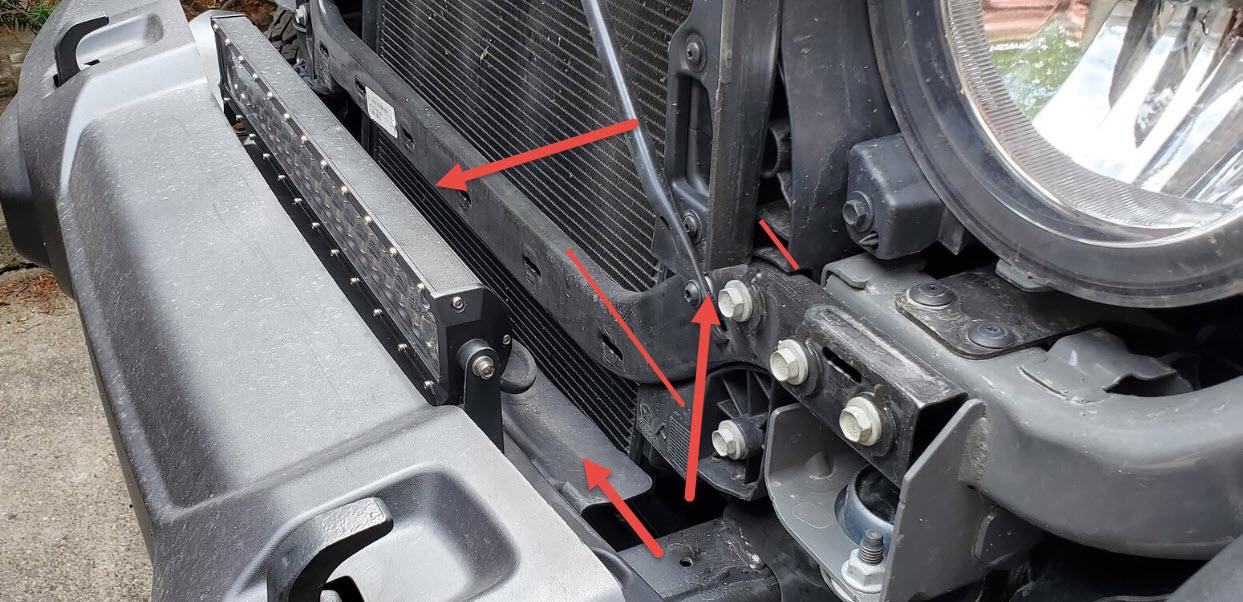
This is the OP's Bumper who started this thread: There is room to fit the thicker core in the driving direction , the front bracket will need to be moved out and that flap cut but there is lots of space like this:

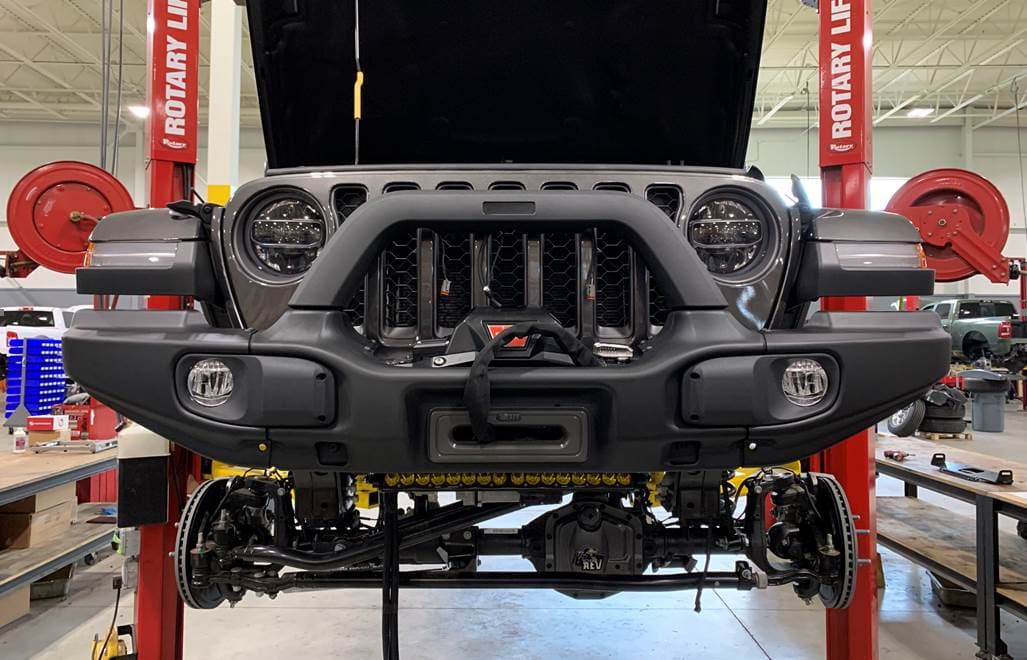
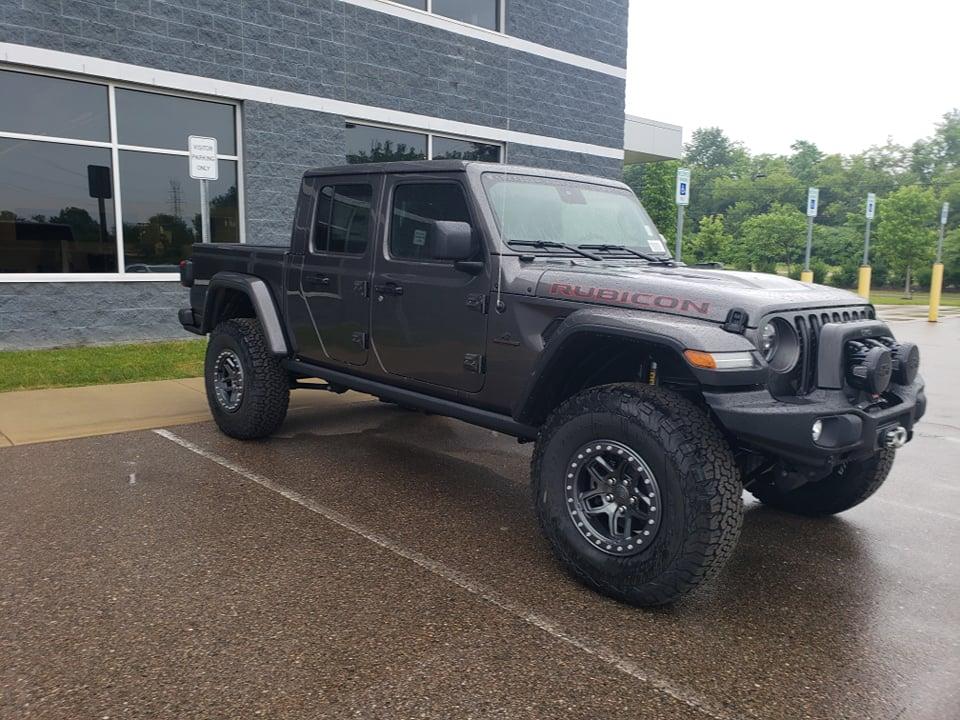
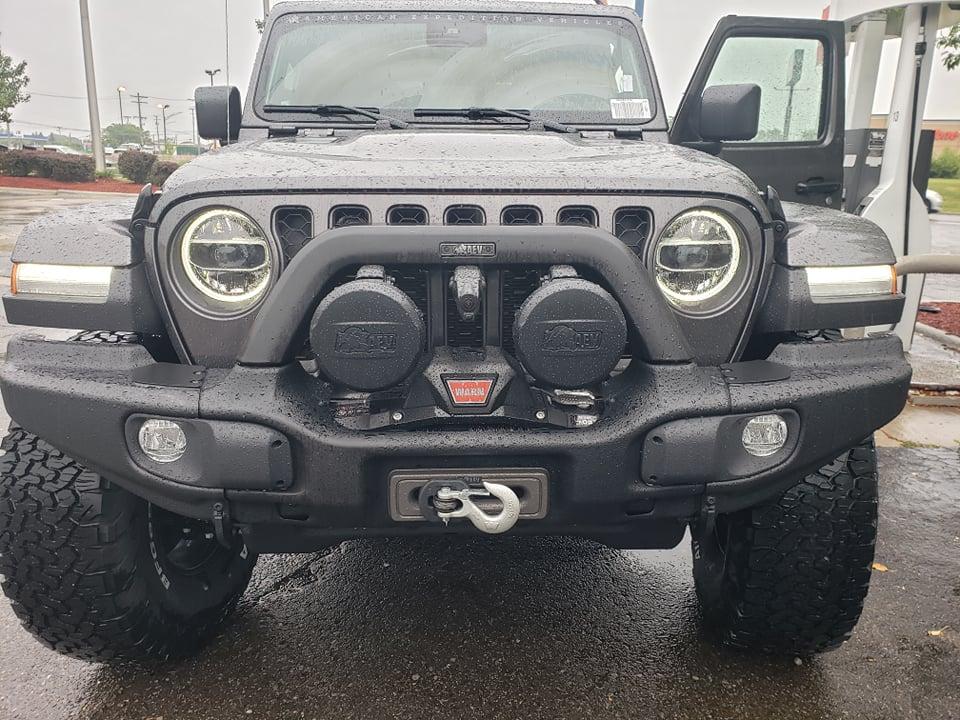
Here is my serial number 1 new bumper after installation, I have the winch buried inside it and the ends come off if I want it to be a stubby. (This bumper has low profile winch inside bumper and fog lights under radiator bottom of bumper). Notice below at bottom picture when lights added it interferes with air flow. I'm thinking of designing a ram tube for air flow behind the lights to reduce the pressure drop.

I'm now concerned about my off road lights restricting air flow. Notice the lights restrict air flow; I'm thinking of designing a ram tube for air flow behind the lights to reduce the pressure drop. My manometer will measure if it's (lights) restricting air flow for air to water heat transfer, see picture below.?

I need to reduce the pressure drop behind the lights, I'm going to take a manometer and measure the pressure drop behind the lights to assess if I have a high delta P. If the drop is high then I will design a ram to eliminate the pressure drop or move the lights.

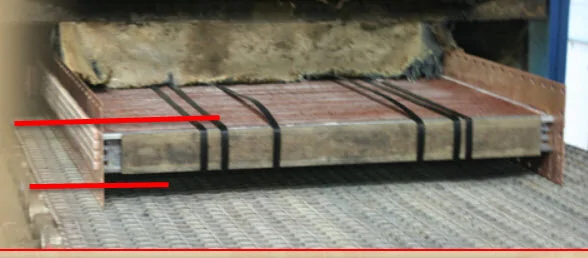
Opening the hood when stopped generally helps, especially in tight engine bays with lots of heat sources (like a turbo diesel in a Gladiator). It's not going to be a huge difference while you're still running it (which I recommend until temps get back down below 200) though. What opening the hood will really help is when you shut it off. Heat will escape up and out of the open hood, vs. just heat-soaking everything.A lot of LEO's pop the hood when idling for extended periods. Does it help? Lately, the temp gauge comes up to halfway at the drive through, waiting for the supposedly quick stop at the grocery store etc. It will come down a bit if idling in P or N as the higher idle speed circulates faster. Not much but noticeable. So, do you need a higher flow water pump and more air flow? Open the side vents and find or design a vented hood similar to the Rubi one but with operational louvers that divert water away AND allow air to escape. A while back some one posted a photo of an aftermarket extraction hood. Vents on the side with air coming in at the back and channeled to the airbox. Looked nice and well made, plastic though.
WRT vents I think you're totally right, making the hood and side vents functional would be a big gain. However, I think you want all of them pulling air OUT, not pushing air IN. The grill and fans are moving a ton of air INto the engine bay, it needs help getting it out of the tight engine bay.
The OP mentioned they tried again, and this time didn't flat-foot and had much better results. I have towed a ton before trying to tow with a Jeep (both with my diesel pickup, and multiple RVs) and have always managed throttle as ECT, EGT, speed and load dictate, vs. just flat-footing or letting cruise control handle it. That said, in 40k+ lbs RVs with 10k+ lbs trailers sometimes managing things DOES mean flat-footing, but watching temps and all.Don’t tow with my gladiator but I do tow it behind my diesel motorhome..
came through brianhead headed to duck creek.. very steep switch back and tight turns. Coach weighs in at about 32k with gladly behind it.. never ran hot or over heated .. I kept the motor in the upper rpm’s and down shifted.. sometimes only going 25 mph but she stayed at 200.. maybe some of you guys just need to down shift and not keep your foot in it. Once you find the happy spot .. keep it.
But if you are saying you are still having an issue. Like the op I’d start by reomiving the grill and hood to start. Maybe change the front skid to a customer scoop dam of sorts.
Towing is not just get in and floor it.. there is a fine line from rpm’s to heat displacement
I do think you're right, it'd be a really interesting experiment to have somebody who has heat issues when towing first make a run up a grade as-is. Then pull just the grill off it, and see if there is a noticeable difference (as goofy as it would look, worth it for science
 ). Then, do the same with the grill back in, and hood off. Finally grill and hood out/off. It'd really give us an idea where to focus with airflow management. If the grill helps the most it's going to be about getting air IN, if the hood helps the most it's about getting air OUT. If neither do much of anything, but grill AND hood off helps, well we know it's the overall airflow both in and out that needs help.
Again, I see what you're saying in theory, but don't agree with your science in practice. Air mostly acts like a fluid moving in/around things. Yes, the air in front of the radiator is under pressure, like you said. However, you are considering it as a closed system, as if the air has no choice but to go through the radiator. That's not the case, air can bypass the grill/radiator area all together if it becomes the path of least resistance. For some of the air that was directly in the grill's path, that may be the case because of the high pressure bubble.Those horns aren't blocking anything. The air up there is under pressure and will make it past those horns.
Speaking of theory and science - if the air right ahead of the radiator is under any pressure at all - then it expands going through the radiator, it would remove MORE heat as air expanding or under decreasing pressure actually removes more heat as it expands than air that is simply flowing. Think carburetor icing at 38 degrees. Think canned air as you blow off your keyboard and the can gets icy cold.
If anything causes air to be under higher pressure ahead of the radiator, then it is allowed to expand again going through, it actually aids heat removal.
The horns are nothing in the grand scheme of things - removing or moving them won't do anything to help but if it makes people FEEL GOOD, move 'em. A lot of times that's all it takes, someone to believe or feel better about it.
If it mattered, ya think Jeep wouldn't have put them somewhere else? Really? With all the scrambling they did for heat removal?
The more things that block airflow through the radiator (like horns) the higher the pressure will be, and the more air will therefor be diverted to some other path. We're driving around with a big high-pressure bubble in front of the radiator, which means some air that would otherwise want to go through the radiator is going to find another path. If you lower that pressure, by taking away obstructions like horns, more air will get through the radiator. Also, the section of radiator right behind the horns will not be seeing as much flow.
Again, think of air as a fluid when it comes to flow in/around things. Put your hand in a flowing stream... your hand is the horns in this analogy. Look at what the water does just behind (downstream) of your hand - it stagnates. You could set a flower petal on the surface of the water behind your hand and it'd just stay there. You could argue that more water is going just to the sides of your hand, and that's true, but you're still under-utilizing some of the surface area of the radiator. Going back to the stream analogy if you then dipped a radiator in the stream, you'd create higher pressure in front of it and some water would be diverted around, not through the radiator. Putting your hand back in the water in front of the radiator would exacerbate the issue, causing more water to divert around not through the radiator.
Hopefully the aftermarket will have good replacements that are actually engineered to effectively extract air.Because the vents are factory cosmetic add ons with little to do with air flow unless you mod them, just like the side vents.
A turbo blanket certainly wouldn't hurt, especially with the heat soak after stopping issue folks are seeing.PTP makes quality lava rock based turbo blankets. Had great results running their blankets on hopped up cars over the years and I know they make OEM full frame blankets for those that opt for wheel/bearing upgrades. The are so effective that you can walk up and touch a blanketed unit after pulls. Although I’ve heard that they work so well they can lead to cooked oil of not idled before shutoff, I’ve never actually seen the blanket being the cause. It’s almost always degraded (or low) oil. Yeah, I’ll likely reach out and see if they have a match for the Gen 3 unit.
Anyone know if the Gen 3 starts as a Honeywell M1S45?
-TJ
Sponsored